
You're waiting for an urgent parcel, the tracking page hasn't changed, and you're wondering whether to stay home or start making calls. The frustrating part is that an unchanged status doesn't tell you whether the driver is still moving, an update is late, or the shipment needs attention.
If you've searched for Direct Couriers track, start with the booking reference and the latest recorded event. Tracking shows recorded movement, not a guaranteed outcome. The useful question isn't just where the parcel was, but whether its next expected event is overdue.
Table of Contents
- How to Track a Direct Couriers Parcel
- Reading Each Tracking Status and Its Timing
- Details to Have Ready Before You Chase
- When Tracking Stops Updating
- Missed Deliveries, Redelivery and Proof Disputes
- Decide Between Waiting and Redirecting Your Parcel
How to Track a Direct Couriers Parcel
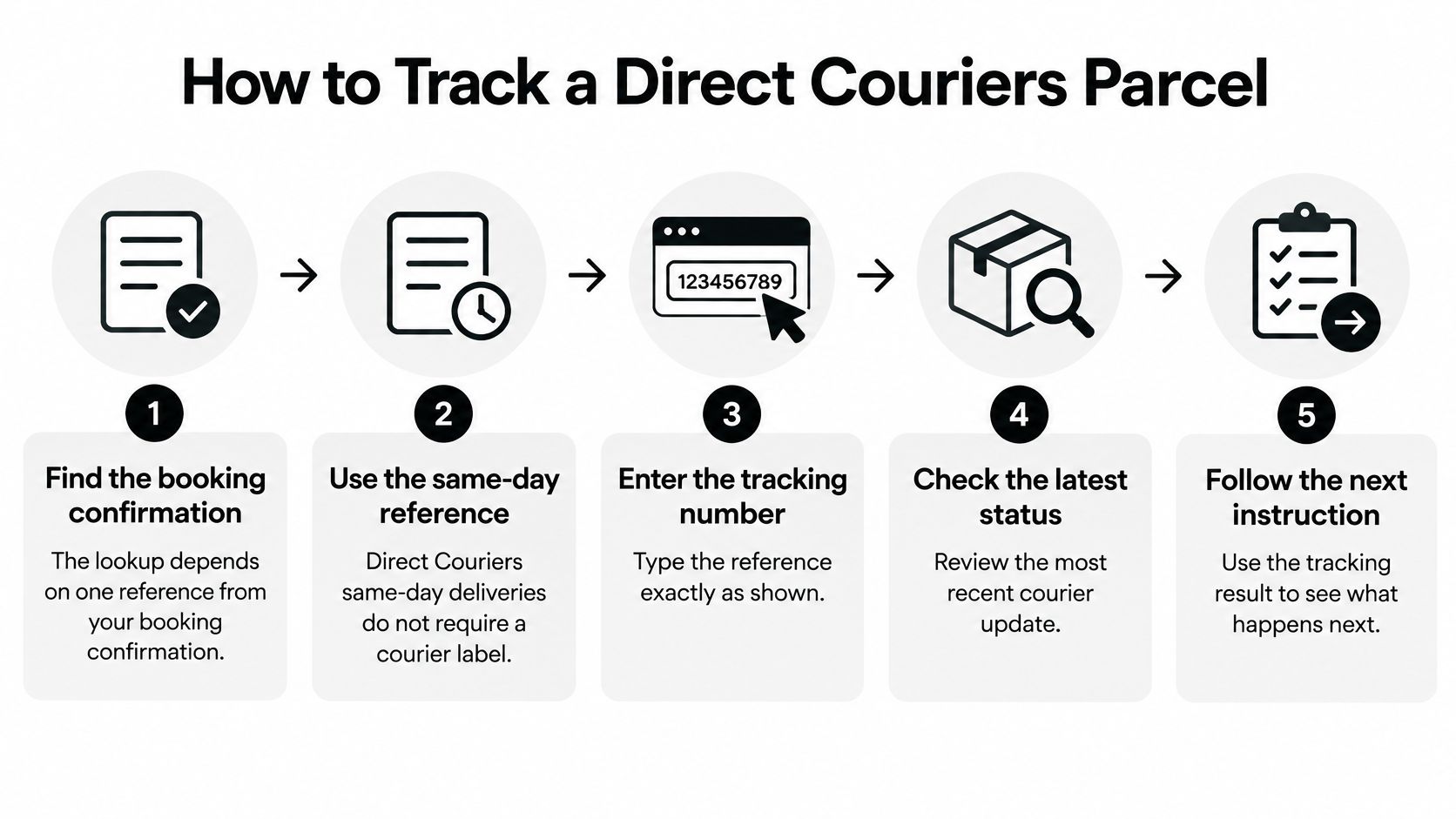
Your lookup depends on one reference from the booking confirmation. Direct Couriers same-day deliveries don't require a courier label, so don't waste time looking for a barcode sticker that wasn't needed for the booking.
Use the courier booking or consignment reference rather than assuming your shop's order number will work. If someone else arranged delivery, ask them for the reference associated with the courier job.
Follow the booking reference
Find the booking or consignment reference. Look in your confirmation email or the Tracking section of your account. If the email contains several identifiers, use the one assigned to the shipment, not an invoice or payment reference.
Match it to the correct collection. Compare the pickup postcode and collection date with your booking confirmation. A mistyped reference can return no result or an unrelated record, so don't assume a successful lookup means you've found your parcel.
Open tracking and find the newest event. Read the most recent scan, usually displayed at the top, rather than starting with the original booking event. Check the timestamps if the page uses a different sort order.
Note the event's date, time and location. The timestamp tells you how old the information is. A location attached to an earlier scan isn't necessarily where the parcel is now.
Compare the event with your booked service. A same-day shipment still showing Booked after its collection window deserves a check of the handover details. An interstate shipment needs to be assessed against its own booking estimate, not a metropolitan same-day expectation.
Record when you checked. Set a deliberate recheck point instead of refreshing continuously. That gives you a useful comparison between the last courier event and the time you noticed the problem.
Keep the lookup process handy when checking another shipment.
For online retailers answering repeated delivery enquiries, SignalZen's resource on order tracking bots for ecommerce is relevant to automating reference-based responses. Keep a human escalation option available, because repeating a status isn't the same as resolving an exception.
A quiet tracking page is a reason to check the booking context, not proof that the parcel is lost.
Reading Each Tracking Status and Its Timing
| Status shown | What it usually means | Expected timing | What to do next |
|---|---|---|---|
| Booked | Booking created, collection not yet recorded | Until the booked collection window | Confirm the collection date and that the parcel is packed and ready |
| Collected | Courier has recorded taking possession | Same-day metro timeframe is indicative only | Wait unless the indicative window has passed |
| In transit | Parcel moving between locations | Assess against the booked route's delivery estimate | Check again at the next scan point |
| Out for delivery | Parcel is on the final delivery run | Expected that day on metro routes, not a guarantee | Make sure someone can receive it |
| Delivery attempted | Driver couldn't complete delivery | Act when the attempt notification appears | Read the courier note and follow its redelivery instructions |
| Delivered | Delivery completion recorded; proof may be available | Check the recorded completion timestamp | If not received, check the proof record and contact the courier |
| No update for longer than expected | Scan delayed or parcel potentially stalled | Collection or delivery window has passed without the expected event | Check the reference, then escalate with the shipment details |
These are working interpretations of common status labels, not a promise that every Direct Couriers booking displays identical wording. Read any accompanying driver note before acting on the label alone.
The need for useful interpretation is clear: 45% of shoppers actively track parcels, according to the Australia Post eCommerce Report 2025. Watching a timeline is useful only if you can connect the event to a decision.
Delayed scan or stalled shipment
A delayed scan becomes apparent when a later event confirms the parcel continued moving despite a missing or late update. A potentially stalled shipment has no new event beyond the expected service window and needs the courier to confirm its position.
You can't reliably distinguish those situations from silence alone. Tracking may update after an event takes place, and a parcel can be late without being lost.
Direct Couriers same-day timeframes are indicative metropolitan service guides, subject to account terms, route and collection availability. There's no universal scan interval to apply to every same-day or interstate consignment, so use the window attached to the booking rather than an arbitrary hourly deadline.
For business senders, the AmaJova guide to order records provides context for keeping shipment references connected to customer orders. Preserve the original event timestamp rather than replacing it with the time a staff member checked.
Practical rule: For a routine tracking gap, allow a deliberate recheck after the expected window, then escalate with the last scan time. Don't delay an enquiry about an incorrect attempt or a disputed delivery just to refresh again.
Details to Have Ready Before You Chase
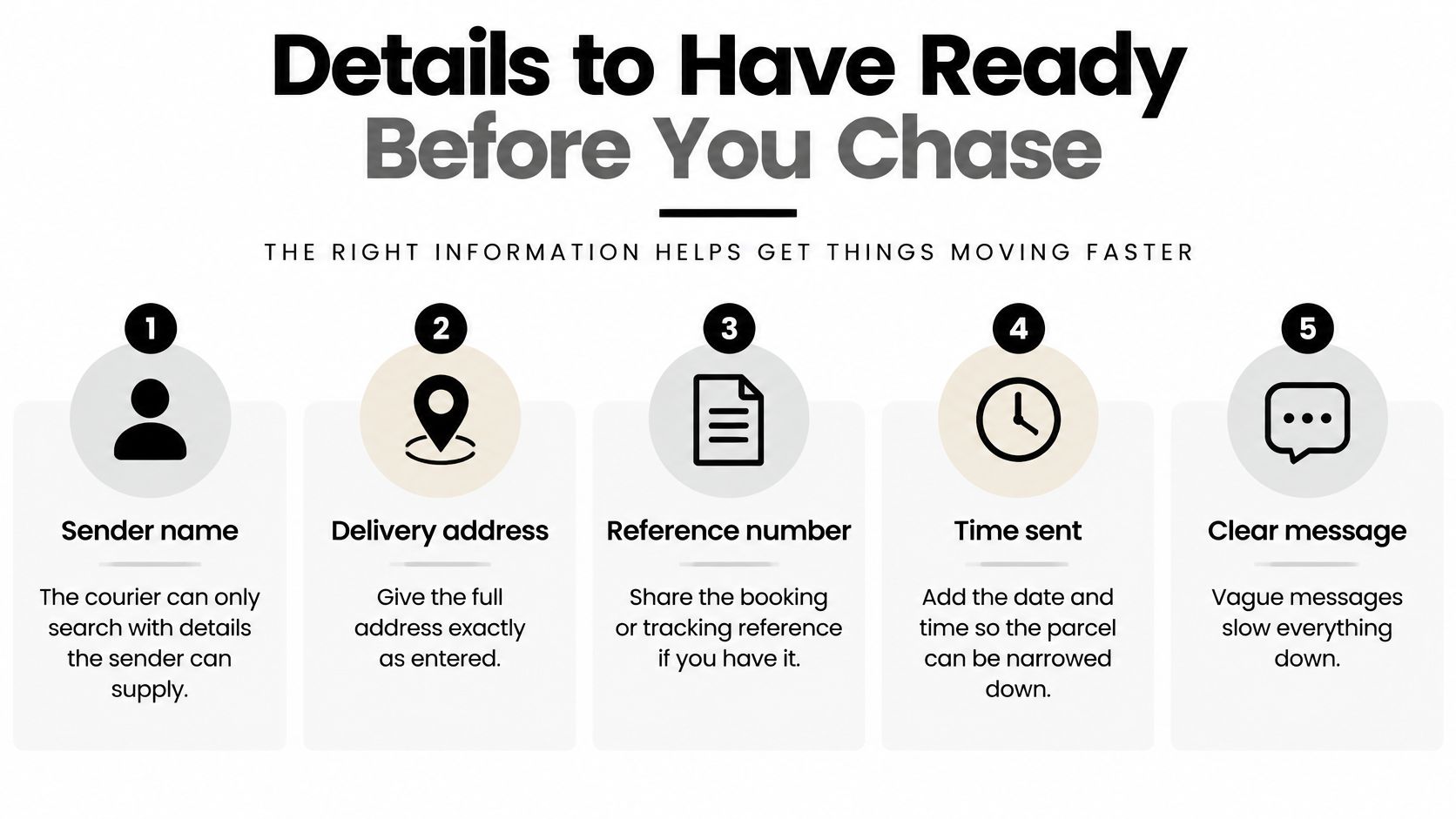
The courier needs enough booking information to identify the job and investigate the right movement. Gather what the sender supplied rather than opening with a vague message that the parcel hasn't arrived.
Build a usable enquiry record
- Booking or consignment reference: Copy it exactly, preserving letters, digits and any prefixes.
- Sender and booking contact: Record who arranged the shipment and who can authorise changes.
- Pickup and delivery suburbs and postcodes: These distinguish the route and help expose an address mismatch.
- Collection date and approximate handover time: Separate the requested collection from the time someone gave the parcel to the driver.
- Packed dimensions and weight: Use the booked measurements, not the unpacked product specifications.
- Selected service: Identify the same-day or interstate option shown on the confirmation.
- Latest tracking event: Save its wording, timestamp and location, together with a screenshot or written note.
Check the recipient information before sending the enquiry.
- Full delivery address: Include the unit, business name, building entrance and any access instructions.
- Reachable phone number: Confirm the recipient can answer a driver's call.
- Receiving arrangements: Establish whether someone was present and whether an authorised safe place was nominated.
Use this checklist to keep the details together.
Check the route, not just the city
Our Australia-wide courier options cover metropolitan, regional and rural destinations, but coverage depends on the exact pickup and delivery postcodes. For an interstate enquiry, check the destination postcode against the booked service instead of assuming a nearby city's coverage applies.
If your business delegates delivery enquiries, use the same enquiry record across staff and contractors. Teams looking to compare BPO support providers through The CX Guys should include reference handling and escalation ownership in their assessment.
Keep the record in one place and add each response beneath it. The next person handling the enquiry shouldn't need to reconstruct the shipment from scattered messages.
When Tracking Stops Updating
Choose between waiting, checking and escalating based on the missing event, not your frustration with the page. First rule out a wrong reference or postcode, because a failed lookup can look like a shipment that never moved.
Once you've matched the record to the booking, work through a controlled escalation.
Ask for an operational answer
Recheck after the indicative window. Record the time you checked and whether a new event appeared. You're establishing that the expected milestone is missing, rather than merely reporting an old timestamp.
Verify actual collection. Ask the sender whether the parcel was handed over, where it was collected and who released it. A booking confirmation establishes that a job exists, not that the courier received the goods.
Contact the courier or booking support channel. Provide the prepared shipment record and ask for the last confirmed scan, current known location and expected next event. If support can't confirm the current location, ask them to distinguish that uncertainty from a confirmed depot or vehicle position.
Get the next action agreed. If the courier confirms no movement, ask whether it will open a trace, arrange an operational follow-up or require the booking customer to lodge a claim. A replacement is a separate decision for the sender, not something a tracking status authorises.
The most useful response identifies who will act and what they will check. A revised estimate without a confirmed next step may help you plan, but it doesn't resolve uncertainty about possession.
Match the enquiry to the missing milestone
For a missed pickup, ask whether the collection is still assigned and whether the parcel needs to be made available again. For an overdue interstate movement, ask which transfer or arrival event should appear next.
For a parcel already assigned to a local delivery run, the constraints are different. Our explanation of last-mile delivery gives context for that final stage, where access, receiving arrangements and route progress matter more than another depot scan.
Ask for the next verifiable event, not just reassurance that the parcel is on its way.
Record the courier's response, the enquiry reference and any agreed follow-up point. Delivery estimates are guides, and service conditions are confirmed by the courier, so preserve their actual answer rather than interpreting an estimate as a commitment.
Missed Deliveries, Redelivery and Proof Disputes
Tracking shows Delivery attempted, but there's no card and nobody remembers a knock. Start with the latest event's reason and driver note, not the assumption that another attempt is already arranged.
Check the receiving location while the details are fresh.
Open Tracking, read the latest courier update and follow the courier's instructions for the selected service. If the reason is unclear or incorrect, describe the specific discrepancy, such as reception being staffed or the recorded entrance not matching the property.
Arrange another attempt deliberately
Confirm whether the parcel is being held, returned or made available for redelivery before requesting a change. Address changes after dispatch need confirmation, may attract charges and may not be possible once the parcel is on its final delivery run.
We don't charge our own redelivery fee, but courier charges may apply. Confirm the cost and receiving arrangements before agreeing to another attempt.
Use a clear receiving instruction rather than asking the driver to try again. If your booking requires a signed handover, check the implications of signature on delivery before requesting an unattended drop.
For additional delivery context, the video is available below.
Challenge a delivered record with evidence
If tracking says Delivered but the parcel is missing, save the completion time and recorded location. Check the nominated receiving point, reception and authorised safe place, then ask the courier for the available proof of delivery.
Compare any photograph, recipient name or signature with the actual destination. Report a mismatch precisely rather than treating the Delivered label as conclusive evidence of correct receipt.
- Contact the courier for the investigation: The courier checks movement records, driver information and delivery evidence.
- Contact the sender for the order outcome: The sender can assess replacement or refund options and may need to lodge the formal enquiry as the booking customer.
Keep the sender's contact details with the dispute record, and retain correspondence rather than relying on a phone conversation alone. Ask who owns the next action so the enquiry doesn't bounce between parties.
Move towards a claim enquiry, rather than another delivery attempt, when the courier confirms loss, can't reconcile the delivery evidence or identifies a delivery to the wrong location. Claim eligibility, required evidence and any applicable deadlines must be confirmed under the booked service's conditions.
Decide Between Waiting and Redirecting Your Parcel
The fastest quoted option isn't always the best receiving plan. An urgent delivery has little practical value if it reaches a locked building and the recipient can't be contacted.
Australian delivery preferences aren't uniform: 64% prefer home delivery when unavailable, while 13% prefer changing the delivery day, according to the Australia Post quarterly eCommerce update. Those preferences describe different priorities, not a reason to assume every courier offers the same redirection choices.
Choose the receiving outcome
| Your situation | Sensible action | What to establish |
|---|---|---|
| Parcel progressing within its estimate and recipient available | Wait | Keep access and contact arrangements ready |
| Recipient will be away | Request rescheduling or redirection | Confirm the change is accepted, not merely requested |
| Time-sensitive parcel but nobody home | Explore an authorised safe place, staffed business address or supported collection option | Confirm the selected service permits it |
| Parcel already out for delivery | Contact the courier promptly | Establish whether any change is still operationally possible |
| Valuable or sensitive contents | Prioritise a controlled handover | Don't trade security for an unattended drop without considering the consequences |
A collection point or business address is an option to investigate, not an automatic entitlement. Don't nominate a locker or third-party location unless the courier confirms it can deliver there under that booking.
For future shipments, maintain accurate recipient details before dispatch. Our guidance on managing delivery addresses helps separate saved booking information from a change requested while goods are already moving.
Make the plan before the handover
Say an urgent document is heading to an office whose reception closes before the recipient finishes work. The useful intervention is confirming a staffed receiving point, not repeatedly checking whether the driver is closer.
Confirm your receiving plan today. If tracking already shows Out for delivery, contact the courier before the driver arrives and ask whether the requested change can still be accepted. Until you receive confirmation, plan around the existing delivery instructions.
Sendaparcel offers courier comparison, booking and shipment tracking for local and interstate parcels, including eligible same-day routes. Visit Sendaparcel to compare options for your next shipment and keep its booking reference and tracking record together.