
The contract is still on your desk, the recipient needs it this afternoon, and you're looking for a courier before the deadline becomes a problem. A two-hour option sounds ideal, but you still need to pack the document, arrange collection and make sure someone can receive it.
Two-hour delivery works best when you treat it as a sequence of handovers, not just a fast drive. What you do before collection can matter as much as the journey itself.
Table of Contents
- What Two-Hour Delivery Covers in Practice
- How to Check Two-Hour Availability for Your Route
- Why Route and Postcode Decide the Clock
- How Booking Conditions Change the Clock
- Common Misconceptions About Two-Hour Delivery
- When Two-Hour Delivery Is Worth the Premium
- Confirm the Two-Hour Option Before You Book
What Two-Hour Delivery Covers in Practice
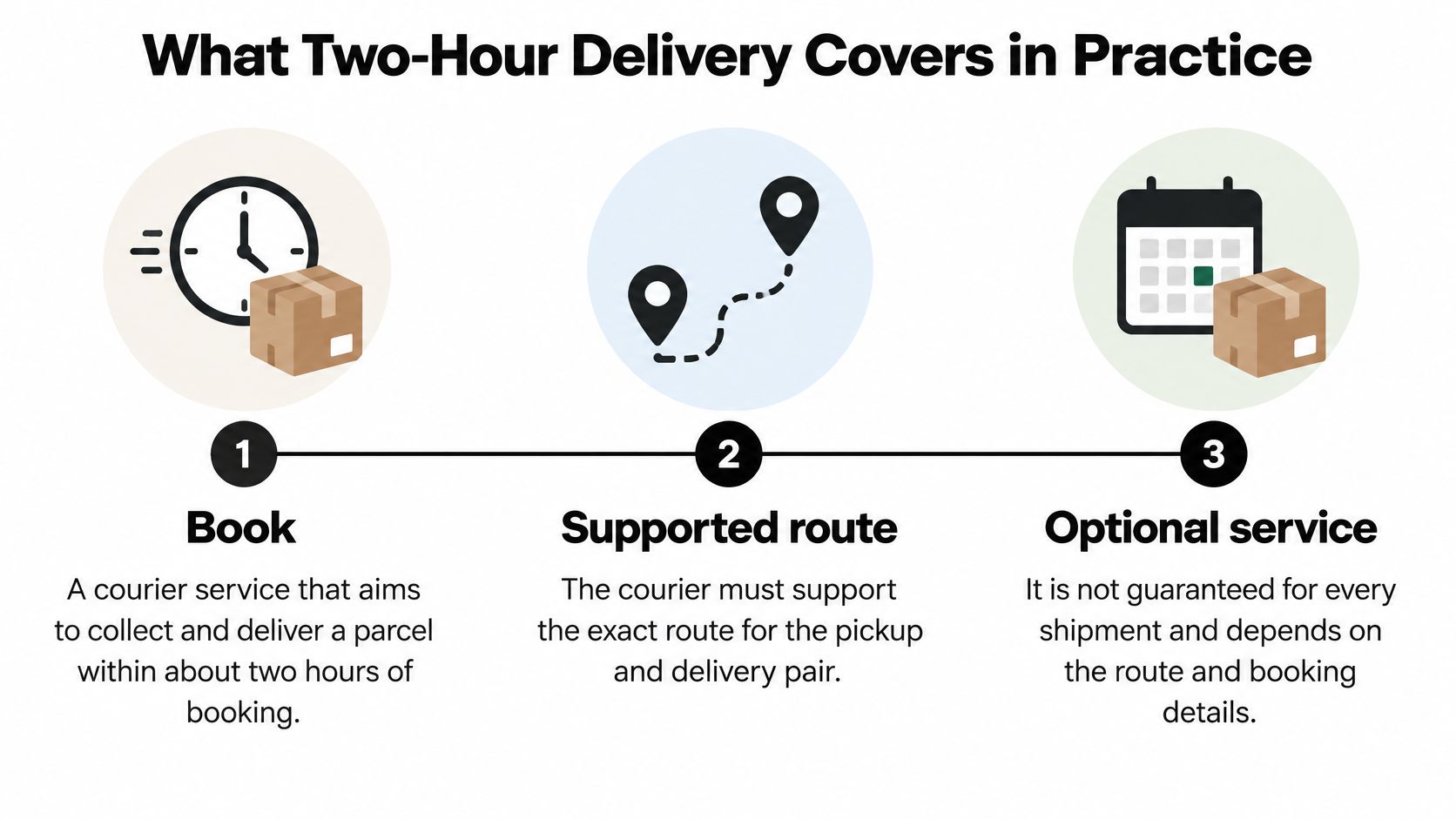
Two-hour delivery is a courier service that aims to collect and deliver a parcel within about two hours of booking, on a route the courier supports. Before relying on that description, check when the selected service starts its clock. An order-to-door estimate and a collection-to-door estimate don't cover the same work.
It's an optional premium service, rather than the normal expectation for every parcel. Australia Post's 2026 eCommerce report found that 26% of Australian consumers expect same-day or next-day delivery for time-sensitive or special-occasion orders, while 69% of shoppers want delivery choices at checkout. That supports offering a choice of speeds, not assuming everyone needs the fastest one.
The service has a simple outline, but the details determine whether it suits your shipment.
Where the time goes
Think of the shipment as a chain of tasks:
- Booking: You submit the correct addresses, parcel details and collection readiness information.
- Parcel preparation: You finish packing and meet the selected service's labelling requirements.
- Collection: The courier reaches the pickup address and receives the parcel.
- Transit: The driver travels along the supported route.
- Final handover: The courier accesses the destination and completes delivery, with the recipient available where required.
Where the service clock includes these stages, every delay reduces the time left for the remaining work. A driver arriving at reception can't complete collection while someone upstairs is still searching for the contents.
Practical rule: Prepare the parcel before you commit to a delivery window, rather than treating packing as something to fit in afterwards.
Local fulfilment helps because the item starts close to its destination. Say a retailer already holds the requested product at a nearby shop: staff can prepare it there rather than wait for stock to travel from a distant warehouse.
The takeaway is straightforward: two hours is a shipment-specific window to check, not a fixed promise attached to every parcel.
How to Check Two-Hour Availability for Your Route
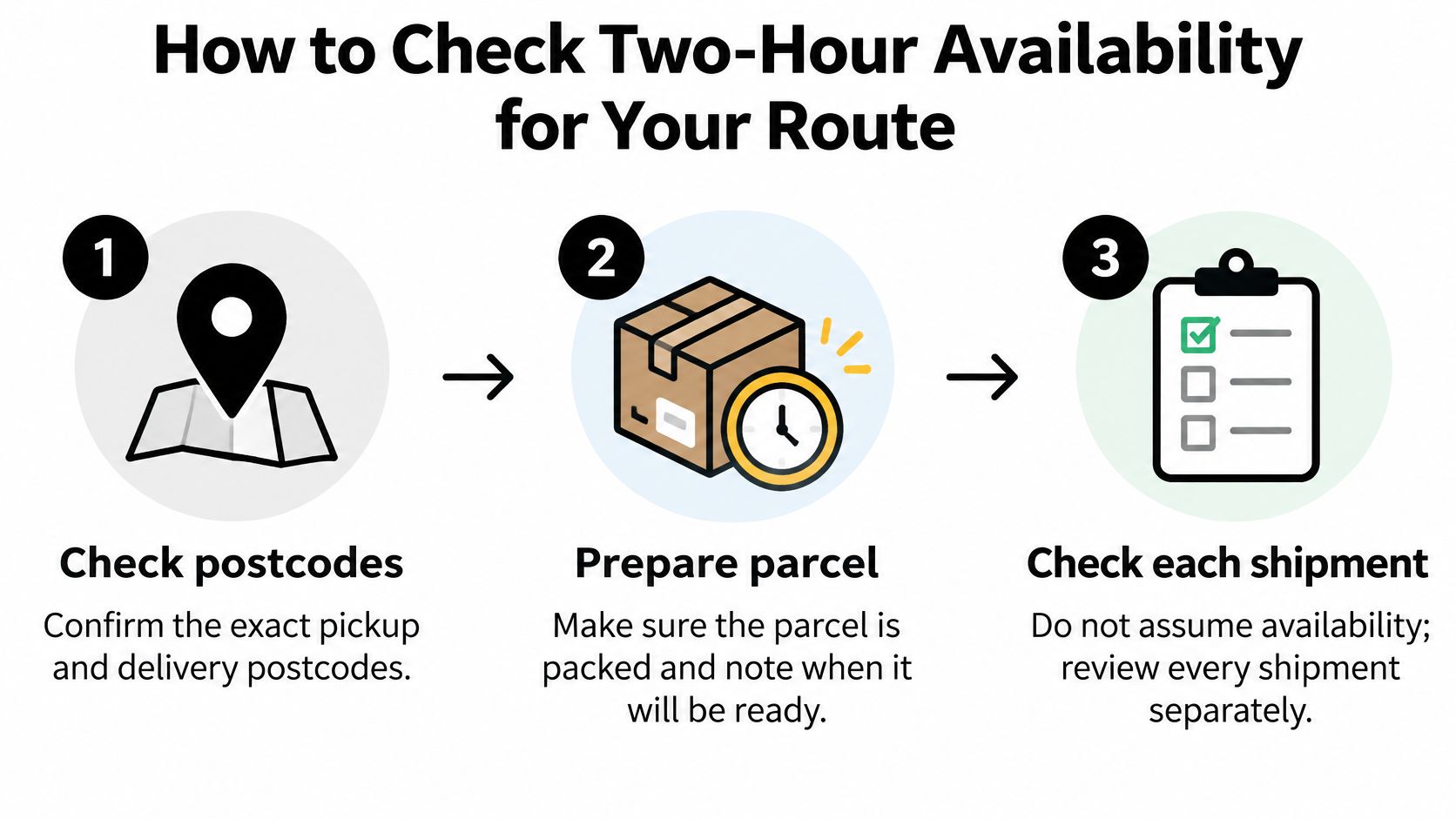
Start with the exact pickup and delivery postcodes, the packed parcel and an honest ready time. A service available for yesterday's shipment might not appear for today's address or collection request.
Use this sequence to organise the details before choosing a quote.
Enter the shipment accurately
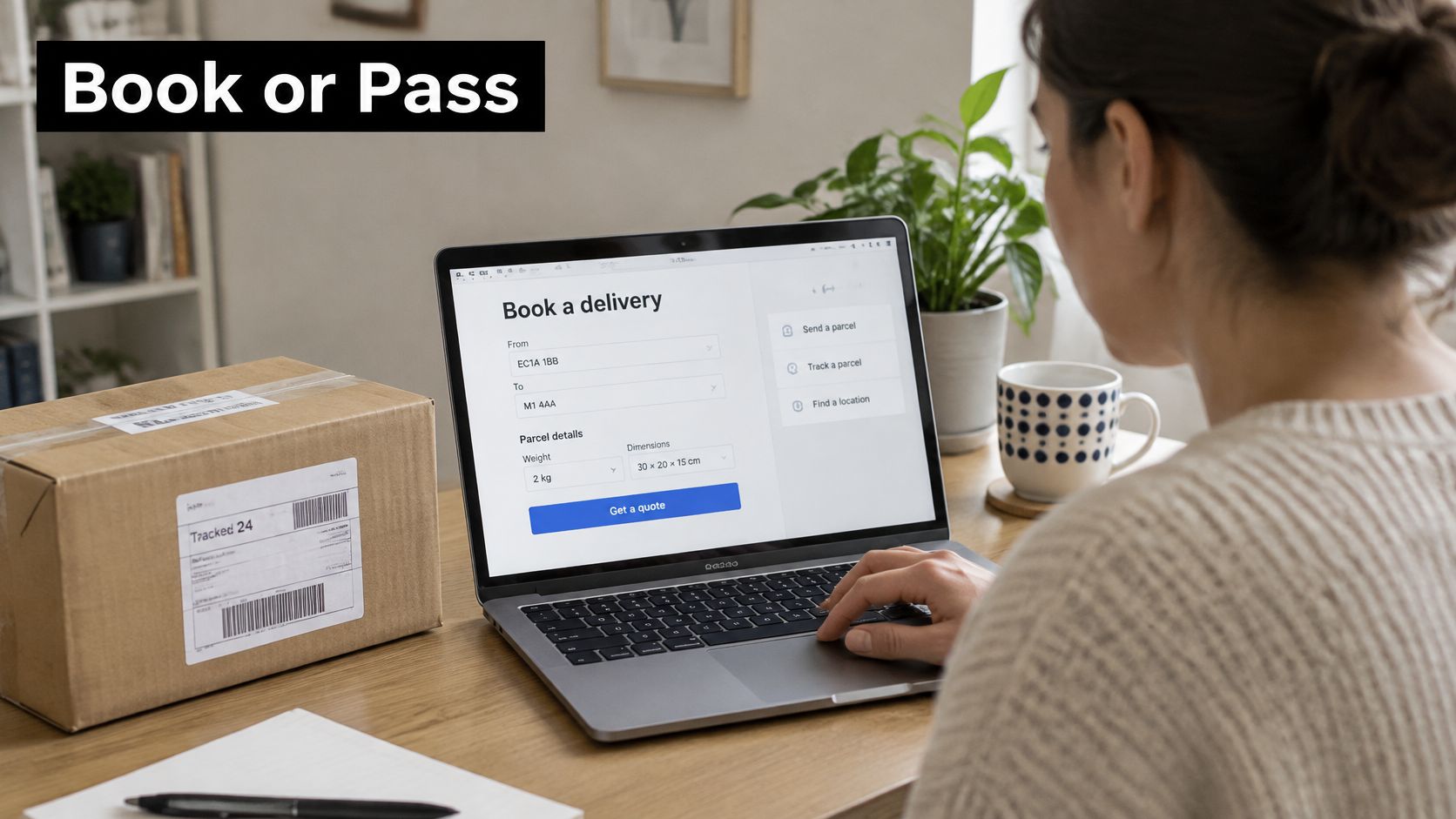
Set the pickup location. Enter the pickup postcode and choose the correct suburb from the suggestions. The common slip is selecting a similarly named suburb without checking it against the street address.
Confirm the destination. Enter the delivery postcode and select its matching suburb. Don't assume that knowing the destination city is enough to identify the actual route.
Measure the packed shipment. Choose Parcel or Satchel, then enter the packed weight and outside dimensions for each box, using quantity for identical boxes. Guessing from the contents alone leaves out the packaging and can produce an unsuitable quote.
Look for eligible urgent options. Open the Same day tab, or tick Compare same-day delivery with Direct Couriers, to view available options alongside regular services. Don't assume every same-day result has a two-hour timeframe.
Give a realistic ready time. Enter the collection date and the time the packed shipment will be ready, using local time at the pickup location. An optimistic entry doesn't help if the parcel is still being assembled when collection is attempted.
Compare the complete offer. Read the courier name, service, price and displayed estimated delivery together. Choosing on price alone can leave you with a service that doesn't meet the recipient's deadline.
Check the route if no option appears. Same-day services are offered only on supported routes within the same state, not interstate. Don't keep changing parcel measurements to try to reveal a service that doesn't support the journey.
Read the selected courier's conditions. Confirm collection requirements, the meaning of the estimate and any handover instructions before booking. Direct Couriers same-day deliveries don't require a courier label, so don't assume the preparation rules are identical across services.
Finish with a usable decision
A complete check gives you a selected service, its displayed estimate and the relevant conditions, not just a price. Keep the recipient's actual deadline beside those details so you can judge whether there's enough room for uncertainty.
For a visual walkthrough of the booking process, use the demonstration below.
Why Route and Postcode Decide the Clock
Rapid delivery depends more on where the parcel starts than on how quickly a driver can travel. A nearby pickup can leave room for preparation and handover; a distant origin can make the same deadline impractical before anyone accepts the booking.
The Australian Retailers Association's discussion of e-commerce shipping reports that 66% of retailers could dispatch an online order within four hours, while hyper-local delivery in one to three hours requires fulfilment from the closest store or location rather than a distant warehouse. Dispatch readiness and completed delivery are different milestones.
Proximity leaves room for the handovers
When stock is nearby, staff can pick and pack it without adding a warehouse-to-local-area journey. The courier also has less distance to cover between collection and the recipient.
Australia's large geography and dispersed population make broad rapid-delivery coverage difficult. Dense urban areas, including population centres along the eastern seaboard, offer more practical opportunities for short local journeys.
Our local courier guide can help you assess the collection-to-destination task. Check actual access, not just map distance: a loading dock, security desk or difficult parking arrangement can delay a short trip.
Route factors and their effect on a two-hour window
| Route factor | How it changes timing | Likely outcome |
|---|---|---|
| Same suburb or adjacent suburbs | Shortest travel and fewest handovers | Most likely to qualify |
| Metro to metro within one state | Short distance and dense courier network | Often qualifies; check the Same day tab |
| Regional destination | Longer travel and fewer local couriers | Less likely; check the displayed estimate |
| Remote or rural postcode | Limited carrier coverage | Often not offered |
| Interstate route | Outside the same-state same-day rules | Two-hour and same-day not available |
| Peak traffic hours | Slower driving and tighter collection timing | Narrower margin for error |
| Dense inner-city pickup | Short distance, but access and loading delays | Check building access and collection time |
Coverage isn't a speed commitment
Our Australia-wide courier options cover metro, regional and rural destinations, with coverage determined by the exact pickup and delivery postcodes. Courier availability varies by route and shipment, so general coverage doesn't establish urgent-service eligibility.
A small envelope heading a long way isn't automatically a better candidate than a larger parcel travelling locally. Once the shipment meets the service's parcel requirements, the route usually decides whether the urgent window is feasible.
How Booking Conditions Change the Clock
A suitable route can still fail an urgent deadline if the collection booking is too late. The date you request, the ready time you enter and the notice required for pickup determine when the courier can begin the job.
For our standard pickup arrangement, the window is 9 to 11 am, with at least one hour's notice. Later requests move to the next working day at 9 am. These are standard pickup rules, not a substitute for the conditions attached to a selected urgent service.
Match preparation to the confirmed collection
Parcels must be packed and labelled by the ready time for the confirmed collection date, except where the selected service doesn't require a courier label. A box beside an unfinished address label isn't ready for handover.
Our guide to express post cut-off times helps explain why booking time and dispatch time need separate attention. A late booking may move to the next eligible collection day, turning an intended afternoon delivery into a later-day task.
Booking conditions and their effect on timing
| Booking condition | Effect on the window | What to do |
|---|---|---|
| Standard 9 to 11 am pickup booked with at least one hour's notice | Collection falls within the 9 to 11 am window | Book in time for the notice period |
| Request made after the notice period | Pickup moves to the next working day at 9 am | Book the day before for urgent parcels |
| Parcel not packed and labelled by the ready time | Collection may be missed or move to the next eligible day | Pack and label before the ready time, where required |
| Missed pickup | Rebooking uses a shipment selection or tracking number | Keep the tracking number at hand |
If collection is missed, you can request pickup rebooking using a shipment selection or tracking number. Rebooking arranges another attempt; it doesn't mean the original delivery estimate remains achievable.
Book earlier in the day, and confirm readiness with the person who will physically hand over the parcel.
That final check matters in shared offices and shops, where the person booking may not be the person at the collection point.
Common Misconceptions About Two-Hour Delivery
The most damaging assumption is that a two-hour estimate guarantees arrival by a particular time. It doesn't. Delivery estimates are guides, and the courier confirms the service conditions.
Before telling a recipient that a parcel will arrive within a fixed window, separate what you've requested from what the selected service commits to.
- A two-hour option exists everywhere. Eligibility follows the postcode pair, available carrier and supported same-state route. A nearby city name on a coverage page isn't confirmation for a particular address.
- Same-day and two-hour mean the same thing. Direct Couriers same-day timeframes are indicative metropolitan service guides, subject to account terms, route and collection availability. Read the displayed service description rather than treating the Same day tab as a single speed.
- The courier controls the whole clock. You control preparation, accurate booking information and access at collection. Asking the driver to wait while you finish packing doesn't create extra time before the recipient's deadline.
- Faster is always better. The 2025 Grant Thornton and Power Retail report found that 39% of consumers are willing to wait three to five days and 15% up to a week, yet 65% expect click-and-collect within 60 minutes or less. Customers judge waiting time in the context of the task.
Choose a useful commitment
For an urgent document, the important question might be whether the receiving office can accept it before closing. For a routine purchase, a clearly communicated later delivery may be entirely suitable.
Certainty and suitability matter more than maximum speed. A workable fallback is more useful than an arrival claim you can't support.
Tell the recipient what the estimate means, and agree on what happens if the item can't arrive in time.
When Two-Hour Delivery Is Worth the Premium
Evaluate the consequence of lateness, not speed alone. Ask what the item is worth, what a missed deadline would cost, whether the route qualifies and whether a cheaper alternative would still solve the problem.
Commerce News' Australian delivery pricing coverage reports that average express pricing rose from AUD 14.24 in 2024 to AUD 14.69 in 2025, while same-day pricing fell from AUD 18.26 to AUD 17.39 over that period. Those are category averages, not two-hour quotes, so use the displayed shipment price for your decision.
Choosing between two-hour, same-day and standard delivery
| Situation | Best fit | Why it fits |
|---|---|---|
| Business-critical document needed the same afternoon, same state | Two-hour or same-day | A late arrival costs more than the premium |
| Replacement part stopping a business operation | Two-hour if the route qualifies | Downtime can outweigh the delivery cost |
| Gift needed tonight in the same city | Two-hour if available, otherwise same-day | The occasion is fixed and an estimate may be acceptable |
| Interstate urgent parcel | Next-day or standard service | Two-hour and same-day aren't offered across state lines |
| Routine restock or low-value order | Standard service | Speed adds cost with little added value |
Choose the fallback before paying
Compare same-day courier options against the actual deadline. If the urgent route doesn't qualify, consider recipient collection, a locally sourced replacement or next-day delivery where offered.
A production-stopping part and a routine restock shouldn't receive the same shipping decision. Spend the premium where it can prevent a meaningful loss, rather than applying it automatically.
Confirm the Two-Hour Option Before You Book
Go ahead only when the route qualifies, preparation will be complete by the ready time, the deadline justifies the premium and you have a fallback. If one of those checks fails, choose a suitable same-day, next-day or standard option instead.
We offer fast courier options for urgent parcels, with eligible same-day services available through the Same day tab alongside regular quotes. Select the service based on its displayed estimate and conditions, not the urgency of your situation alone.
Make the final check with the packed parcel beside you.
Keep control after booking
Use Tracking to check the latest courier update. After a missed delivery, follow the courier's instructions for the selected service rather than assuming another attempt will happen within your original window.
We don't charge a redelivery fee, although courier charges may apply. Allow for that possibility when deciding whether a recipient who may be unavailable should receive an urgent shipment.
Before clicking book, write down your fallback time: the point when you'll contact the recipient and switch plans if delivery is no longer workable. Give someone responsibility for that decision so a slipped estimate doesn't become an unnoticed missed deadline.
Sendaparcel offers courier comparison, booking and tracking for personal parcels and business shipments, including eligible same-day services on supported intrastate routes. Visit Sendaparcel with your postcodes, packed measurements and realistic ready time to compare the available options before you book.