
Most advice on how to calculate cubic weight boils down to one line: multiply length by width by height, divide by the divisor, done. That advice is wrong in a way that costs Australian senders money, because it treats a carrier's pricing rule as a law of physics. There isn't one divisor. There's a different conversion factor for each carrier and each service, and the same carton can land on three or four different weights depending on which rule you apply.
I'd treat this as a lookup problem before it's a maths problem. Find the rule, then measure, then multiply. Get the order wrong and you'll produce a tidy number that has nothing to do with the freight you're about to be charged. A quote is only useful when the carrier, the service, the units and the rounding rule are written next to it.
Table of Contents
- Start With the Factor Your Carrier Uses
- How to Measure a Packed Parcel and Where Measurement Goes Wrong
- Worked Example for the Same Parcel Under Each Rule
- Packaging Limits and Changes That Lower Chargeable Weight
- Confirm Your Chargeable Weight Before You Book
Start With the Factor Your Carrier Uses
Carriers convert space into a notional weight because a trailer or an aircraft hold fills up before it hits its weight limit on light freight. A carton of cushions and a carton of bolts occupy the same deck space, so the carrier prices the space, not just the scales. That notional weight is cubic weight, also called volumetric or dimensional weight.
The formula comes in two shapes. One takes volume in cubic metres and multiplies it by a factor in kilograms per cubic metre. Australia Post's explanation of cubic weight gives its domestic method as volume in cubic metres multiplied by 250, while Qantas Freight lists 200 kg per cubic metre for domestic air freight and 167 kg per cubic metre for international shipments. The other shape multiplies centimetre dimensions and divides by a divisor: FedEx Australia uses a dimensional factor of 5,000 and requires each dimension to be rounded up before the calculation.
Cubic weight factors by carrier and service
| Carrier and service | Cubic weight formula | Factor | Units |
|---|---|---|---|
| Australia Post domestic | Length × width × height (m³) × 250 | 250 kg per m³ | Metres |
| Qantas Freight domestic air | Length × width × height (m³) × 200 | 200 kg per m³ | Metres |
| Qantas Freight international air | Length × width × height (m³) × 167 | 167 kg per m³ | Metres |
| FedEx Australia | Length × width × height (cm) ÷ 5,000 | 5,000 cm³ per kg | Centimetres, each side rounded up |
The two shapes are interchangeable once you bridge the units, and that bridge is where most confusion clears up. A factor of 250 kg per m³ is the same rule as dividing cubic centimetres by 4,000. A factor of 200 kg per m³ is the same rule as a 5,000 divisor in centimetres, which is why FedEx Australia's divisor and Qantas Freight's domestic air factor produce an identical result on the same box.
Rounding is the quiet difference. Where a carrier requires each side rounded up before multiplying, a carton measured at 50.5 cm becomes 51 cm, and the volume grows before you've applied any factor. On a borderline measurement that's the difference between one price band and the next.
Chargeable weight rule: the carrier bills the greater of actual weight and cubic weight, never the smaller. Work out both figures before you assume which one applies.
Confirm the current published factor on the carrier's own page before you book, particularly for international services where the divisor changes with the mode of transport. A calculator that returns a single number without naming the service, the units and the rounding rule isn't giving you a quote. It's giving you one possible answer out of several.
How to Measure a Packed Parcel and Where Measurement Goes Wrong
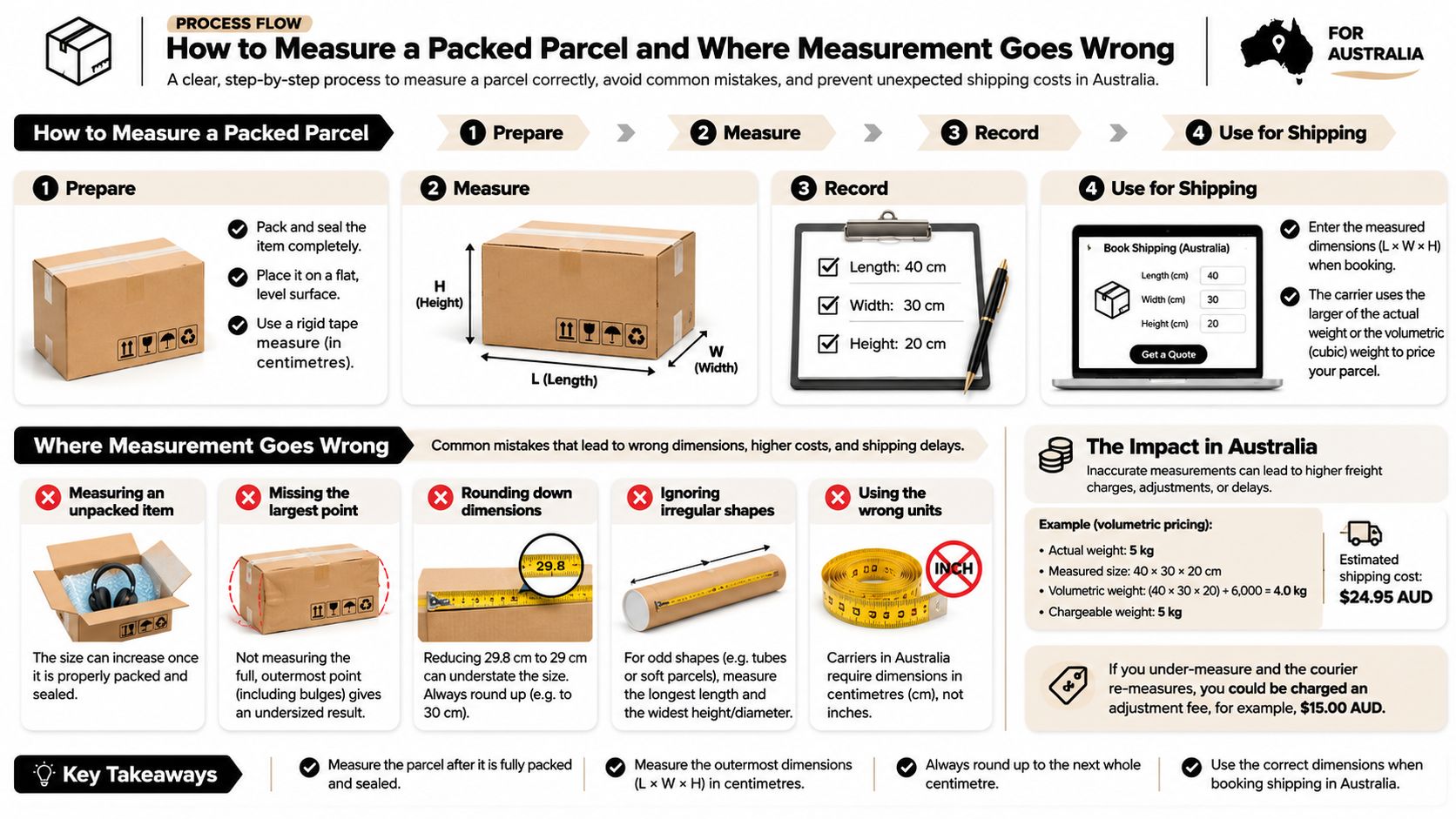
Carriers rate the outside envelope of the parcel, not the product inside it. Measure the box as it will be collected, with void fill, tape, labels and any outer wrap already in place, because every one of those adds to the space the parcel occupies on a truck.
This is the step people rush. They pull the carton dimensions off the supplier's spec sheet, or measure the item before packing it, and then book freight against a parcel that doesn't exist. The measurement that matters is the one a depot would take if it put your parcel on a measuring frame.
The measurement sequence
- Pack it fully first. Item, void fill, tape, labels and any outer bag go on before the tape measure comes out. A satchel bulging around a soft product measures bigger than the folded product ever will.
- Take the three sides in order. Longest side is length, next longest is width, shortest is height. Use a steel tape in centimetres and read it flat against the carton, not draped over it. A box measured at 50 × 40 × 30 cm has a volume of 60,000 cm³.
- Measure at the widest point. A bowed side, a bulging seam or a proud handle counts, because that's the rectangle of space the parcel blocks out. Run the tape across the fattest part of each face rather than along a clean edge.
- Round up where the carrier requires it. Each dimension goes to the next whole centimetre before you multiply, so 50.5 becomes 51. Don't round down to make a quote look better, and don't round at the end of the calculation instead of the start.
- Weigh the packed parcel. Use calibrated scales reading to one decimal place. Bathroom scales under a bulky carton won't give you a figure you'd want to defend on an invoice query.
- Convert units once. Divide centimetres by 100 to get metres, or stay in centimetres against a centimetre-based divisor. Typing centimetre values into a per-cubic-metre rule inflates the volume by a factor of a million, and that's the source of most absurd quotes.
- Record one row per size. Length, width, height, actual weight and quantity. To quote accurately we use the outside dimensions and weight of the packed item, with different carton sizes entered as separate rows and identical boxes entered using quantity.
Steps two and three are where a soft tape and a lazy eye cost you. If the carton has been reused and one panel has softened, measure it as it sits after packing, not as it looked when flat.
Watch the sequence in practice before you measure your next consignment.
Errors that change the price
- Inside dimensions: carton specs often list internal measurements, which understate the outside envelope the carrier rates.
- Product-only dimensions: measuring the item and ignoring the box and void fill produces a figure that bears no relation to the parcel handed over.
- Estimated weights: guessing the packed weight, or weighing the product alone, understates the actual weight and can flip which figure is chargeable.
- One box entered for a mixed order: averaging several carton sizes hides the largest parcel, which is usually the one setting the price.
- Wrong service or address details: a freight price depends on the information supplied and the service selected, and incorrect measurements, weight, addresses or service details may result in a revised charge.
Measure and weigh every consignment before booking, and make the booking match the parcel you actually hand over.
Under-declaring isn't a discount strategy. Carriers reassess freight against what arrives at the depot, and the adjustment lands after you've already quoted your customer. If you're sending irregular items or working out how to present a parcel for collection, our guide on how to post a parcel covers the packing and labelling side that sits alongside these measurements.
Worked Example for the Same Parcel Under Each Rule
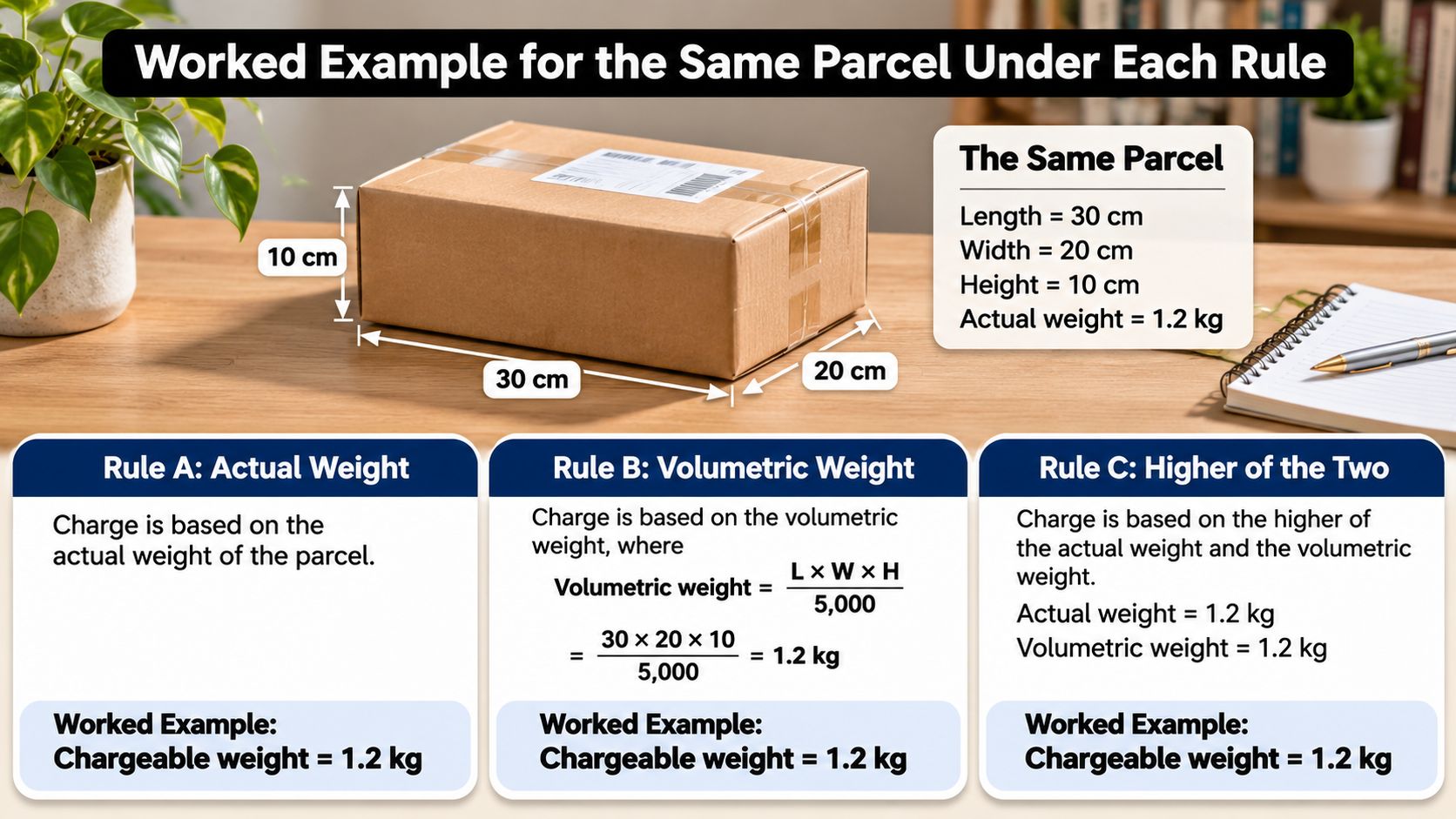
Take one carton: 50 cm long, 40 cm wide, 30 cm high, weighing 8 kg packed. Nothing about the box changes across the following calculations. Only the rule, the carrier and the service do.
Multiply the dimensions first: 50 × 40 × 30 = 60,000 cm³. Convert to cubic metres by dividing by 1,000,000, which gives 0.06 m³. That volume is the input for every per-cubic-metre factor, and the centimetre figure is the input for a centimetre divisor.
Four rules, four answers
Apply each factor to the same volume. Under the domestic postal factor, 0.06 × 250 = 15 kg. Under domestic air freight, 0.06 × 200 = 12 kg. Under international air freight, 0.06 × 167 = 10.02 kg. In centimetres, 60,000 ÷ 5,000 = 12 kg, matching the domestic air result because ÷ 5,000 cm³ is the same conversion expressed in different units.
Now compare each cubic figure with the 8 kg on the scales. The greater figure is chargeable, so this same packed parcel can bill at 15 kg, 12 kg or 10.02 kg depending on the rule named on the quote.
Chargeable weight for one 50 × 40 × 30 cm parcel at 8 kg
| Rule | Cubic weight | Actual weight | Chargeable weight |
|---|---|---|---|
| Australia Post domestic (× 250) | 15 kg | 8 kg | 15 kg |
| Qantas domestic air (× 200) | 12 kg | 8 kg | 12 kg |
| Qantas international air (× 167) | 10.02 kg | 8 kg | 10.02 kg |
| FedEx Australia (÷ 5,000) | 12 kg | 8 kg | 12 kg |
The gap between the highest and lowest chargeable figure is about 5 kg, more than half the parcel's real weight, and it comes entirely from rule selection. A lower rate per kilogram can still cost more when it sits beside a higher conversion factor on a bulky, light carton, so record the carrier and service beside every cubic weight.
What half a centimetre does
Say a second carton measures 50.5 × 40.3 × 30.9 cm because the packer used a slightly different box and the sides bow a little. Under the 250 factor its cubic weight is about 15.7 kg, roughly 0.7 kg more than the tidy 50 × 40 × 30 result. Round each side up first, as a centimetre-divisor rule requires, and 51 × 41 × 31 lifts the volume to 64,821 cm³ before any rounding the service applies.
That is the practical lesson from running one box through several rules. The arithmetic is trivial and takes seconds. The judgement is in naming the rule, so write the carrier and service beside every cubic weight you record, and treat a bare number as unfinished work.
Packaging Limits and Changes That Lower Chargeable Weight
Measurement is also a packing decision, and the two checks are separate: does the parcel physically qualify, and what does it price at? A box can pass one service's acceptance limits and be rejected by another, or be accepted by both and priced quite differently.
Parcel limits by service
| Service | Maximum weight | Maximum length | Maximum size |
|---|---|---|---|
| Sendaparcel parcel | 25 kg | No single length cap, set by the 180 cm combined total | 180 cm combined length, width and height |
| Australia Post domestic | 22 kg | 105 cm | 0.25 m³ cubic volume |
Australia Post's calculate your postage guide publishes those domestic limits of 22 kg physical weight, 105 cm maximum length and 0.25 m³ maximum cubic volume. With us, each parcel can weigh up to 25 kg, and length plus width plus height can be up to 180 cm in total. Both checks run against the packed measurements, not the product's.
On a bulky, light carton the cubic figure is usually the binding constraint, not the weight cap. You'll hit the volume ceiling or the combined-size total long before the scales complain, which is why trimming a dimension is often the cheapest fix available.
Which dimension to trim
Return to the 50 × 40 cm footprint. Cutting the height from 30 cm to 25 cm prices at 12.5 kg under the 250 factor instead of 15 kg. Cutting the length from 50 cm to 45 cm while keeping the 30 cm height gives 0.054 m³, or 13.5 kg. Same 5 cm removed, different saving, because the height sits against the larger face. Trim the dimension that multiplies against the biggest area.
Practical changes that get you there: remove excess void fill and close the carton snugly, orient the product so its shortest side becomes the height, and choose a carton that fits rather than one you have to fill.
Splitting an order into several boxes isn't automatically cheaper. Each parcel can carry its own charge, so compare the total shipment cost, not the cubic weight of one box.
Run both options as quotes before you commit, and check the limit and the factor together. Our notes on reducing shipping costs go further on carton choice and consolidation trade-offs.
Confirm Your Chargeable Weight Before You Book
Run this against your largest box, not your average one. The biggest parcel in a mixed order is usually the one that decides the freight bill, and it's the one people measure last.
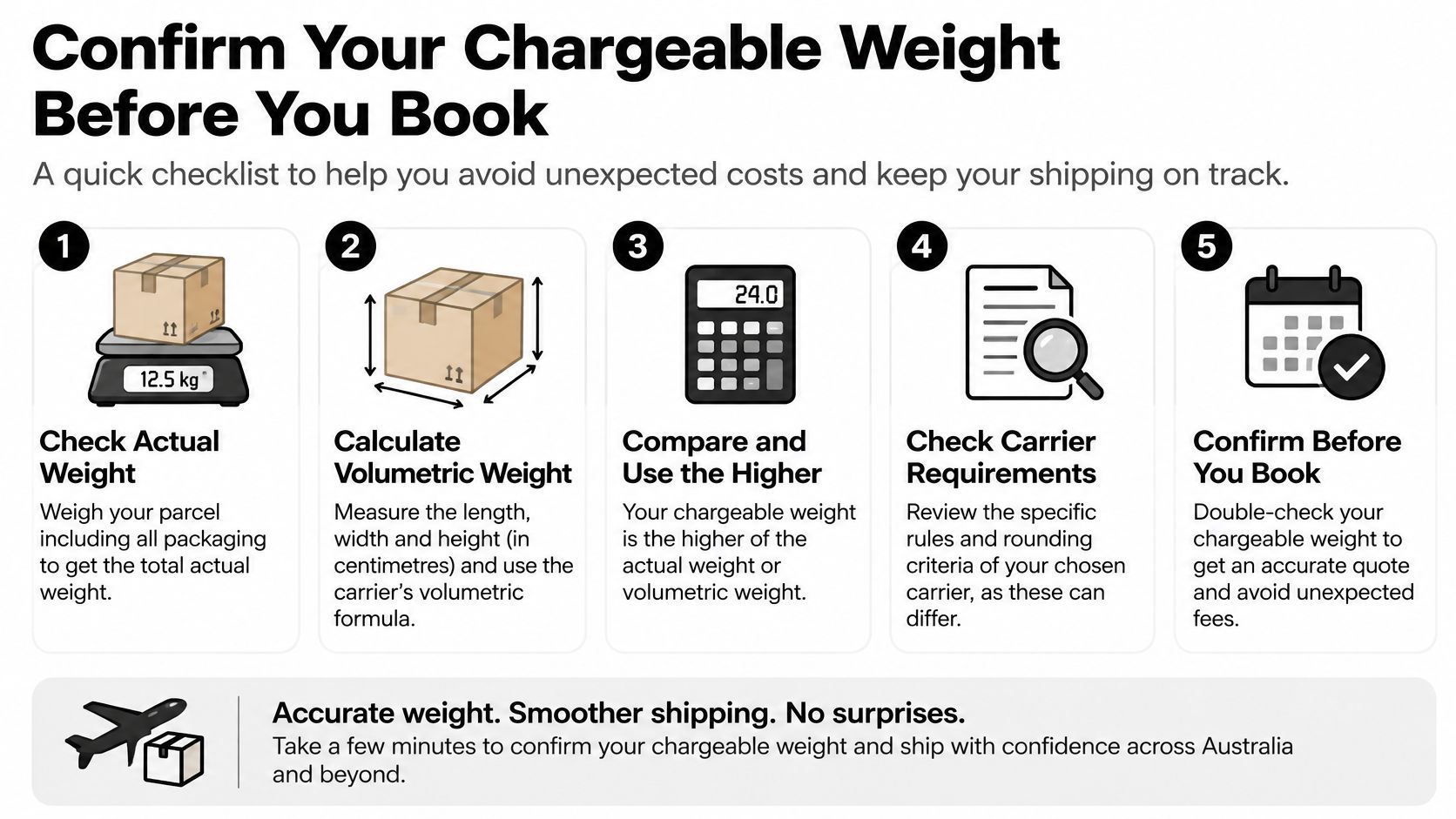
- Name the carrier and service, then confirm its current published conversion factor and rounding rule.
- Measure the packed parcel at its widest points, rounding each side up where that carrier requires it.
- Calculate cubic weight and weigh the parcel, then take the greater of the two as the chargeable weight.
- Check the acceptance limits for weight, length and cubic volume or combined size under that specific service.
- Compare quotes on identical measurements, because the same box prices differently across services and a per-kilogram comparison hides that.
Some goods need a rule check beyond size and weight before any of this matters. If you're sending bottles interstate, the SA wine delivery rules explained by McLaren Vale Cellars are worth reading alongside your packing plan, since licensing and packaging conditions shape what you can send and how.
For the comparison step, enter pickup and delivery postcodes, packed dimensions, weight and quantity to compare parcel and satchel quotes side by side. Parcel dimensions and weights can be saved and reused when booking, different box sizes can be added to one booking, and quantities can be used for identical parcels. Save your standard cartons, but re-weigh each time, because packed weight drifts with void fill and product changes.
Courier rates can vary with pickup and delivery locations, packed size, weight and number of items, the selected courier and service, collection timing, service availability and applicable surcharges. Treat the quote as a figure to verify against your measurements, not a fixed price you can assume. Our Australian shipping cost calculator guide walks through the inputs that move it.
Sendaparcel compares live courier quotes across Australian services using your packed dimensions, weight and quantity, so you can see what the same carton costs under different carriers before you book, with no monthly subscription and no volume tier to climb first. Measure your largest box, work out its chargeable weight, then put those figures into Sendaparcel and keep the carrier, service and factor written beside the result.