
You've got a box on the kitchen bench, a marker in one hand and a booking form open on your phone. The address is written on the side, the tape is somewhere in a drawer, and the only question left seems to be which courier is cheapest.
That's the last question, not the first. Posting a parcel in Australia usually goes wrong at one of two points: the item inside turns out to need special handling, or the packed box doesn't match the numbers typed into the quote. Everything after that, the label, the scan, the pickup window, is mechanics. Get the contents and the measurements right and the rest is admin.
Table of Contents
- Check Whether Your Item Can Be Posted
- Pack and Measure Your Parcel Correctly
- Choose Between Standard, Satchel and Same-Day Options
- Book Your Pickup With a Live Quote
- Track It and Handle Delays, Damage or Refusal
Check Whether Your Item Can Be Posted
The box isn't the problem. Open it and look at what's going inside, because the contents decide the packaging, the service and sometimes whether the parcel can move at all.
Australia Post's prohibited and restricted items packaging guide shows that most awkward items are not just allowed or banned. They fall into a middle group that requires specific packaging, transport, or quarantine conditions before a courier will accept them. That middle group is where nearly all avoidable failures occur.
| Item | Rule | What to do before booking |
|---|---|---|
| Liquids and creams | Allowed with packaging controls | Leak-proof inner container, strong outer container and absorbent material |
| Lithium batteries | Only inside a device | Keep installed and protect against accidental activation |
| Aerosols and perfume | Restricted in some cases | Check the prohibited and restricted list before packing |
| Plants and perishables | Transport or quarantine conditions may apply | Confirm with customer service before booking |
| Fragile items | Allowed with protection | Rigid packaging and padding for handling stress |
| Dangerous goods | Not through the standard parcel form | Raise with customer service before booking |
A sturdy satchel doesn't rescue a restricted item
This is the most common mistake. Someone buys a padded satchel, drops in a bottle of perfume or a lithium power bank, and assumes the packaging has solved the problem. It hasn't. The satchel is fine. The contents are the question.
Australia Post notes that parcels can be refused when packaging is inappropriate, reused and inadequate, or not protective enough for fragile contents. A refusal at the counter or the depot costs you the trip, the delay and sometimes the item, and a courier isn't obliged to compensate for goods you weren't entitled to send.
Liquids are the classic case. A leak-proof inner container, a strong outer box and absorbent material around it isn't fussiness, it's the difference between a parcel that arrives and one that contaminates everything in the same cage. Batteries follow a different rule again: they travel installed in the device, with the device protected against accidental activation, so a loose cell rattling in a jiffy bag fails on two counts at once.
Practical rule: if you can't describe the contents in one plain sentence, don't book it yet.
Dangerous goods don't belong on the standard parcel form at all, and if you're unsure what a substance is, raise it with customer service before you pay rather than after a scan stalls.
Three questions before you book
Ask these in order, and let the answers change what you do next.
- What is it, exactly? Not "a gift" or "some toiletries". Name the item and whether it's liquid, aerosol, battery-powered or perishable.
- Does it contain a battery or liquid? Either answer sets packaging requirements that a plain box won't meet.
- Is it fragile, perishable or crossing a state border? Fragile goods need rigid walls and padding that absorbs handling stress, and perishables or plants can attract quarantine conditions on interstate routes.
Pack and Measure Your Parcel Correctly
Two numbers decide whether a booking survives contact with the network. Each parcel can weigh up to 25 kg, and length plus width plus height can be up to 180 cm in total. Almost every re-quote traces back to someone guessing one of those instead of measuring it.
Have the parcel packed, sealed and labelled before the ready time for the confirmed collection date. If the label goes on late or the box is still open when the driver arrives, the slot can be missed and the whole job moves.
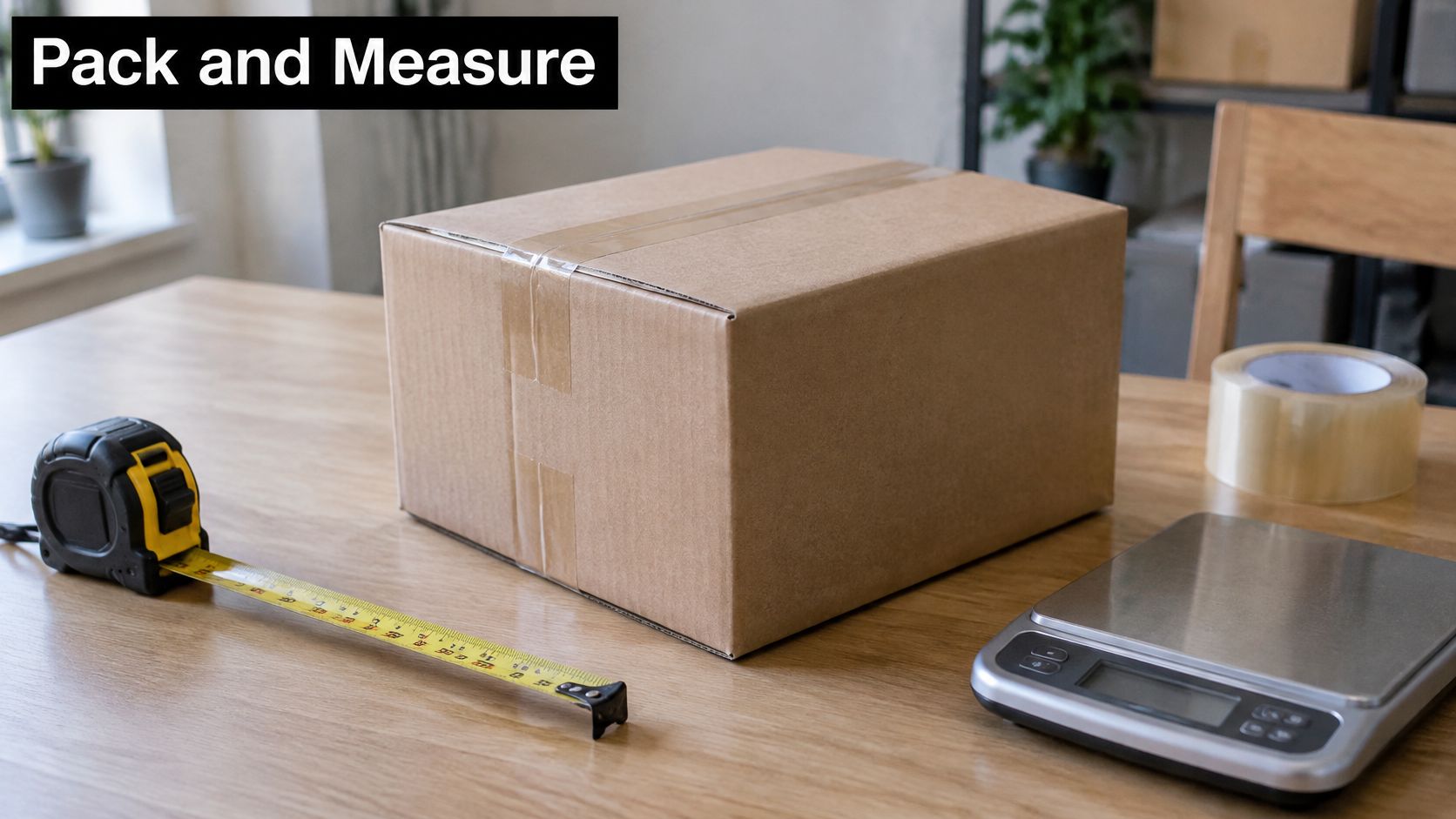
Run this routine before you book.
- Pack the item into the container it will travel in, then seal it. A box assembled after weighing never matches the number you paid for.
- Weigh the packed parcel, including the box, padding and tape, then round up. A box weighed empty understates the true weight, and a rounded-down figure is the usual reason a booking gets re-priced at the depot.
- Measure the longest length, widest width and tallest height in centimetres. Measure the bulges, not the flat panels.
- Add the three measurements together and check them against 180 cm. Leave a margin, because a box that swells in humidity or gets re-taped can nudge past a limit.
- Record every box separately. A multi-box booking needs its own weight and dimensions for each package, while identical boxes can share one entry with a quantity. If you send the same sizes often, save the dimensions and weights and reuse them when booking.
The fit test before the tape goes on
Shake the sealed box. If anything shifts, it is loaded rather than packed. Run a hand across the walls and corners as well: if you can feel the shape of the contents pressing through the cardboard, add another layer of bubble wrap or a rigid insert.
The reason is mechanical. Parcels in Australia move through automated sorting at scale, and Australia Post says a $33 million Adelaide facility opened in 2021 to process around 130,000 parcels a day, with a recorded peak of 150,000, in its corporate history. Machine-compatible packaging, a flat surface and a readable label carry more weight in that system than careful handwriting.
If the taping method matters to you, this is the sequence worth copying.
If you post every week and want branded packaging, set the dimensions first and artwork second, then compare mailer box print options so the finished box still lands inside the 180 cm total. A good-looking carton that fails the size check is still a bad carton.
Choose Between Standard, Satchel and Same-Day Options
| Option | Best for | Speed | Price notes |
|---|---|---|---|
| Standard parcel quote | Personal parcels, gifts and heavier items | Estimate shown at quote | Compare the total with GST and carrier adjustments |
| Satchel quote | Documents and light, flat items | Estimate shown at quote | Compare against the parcel quote on the same route |
| Same-day | Urgent parcels on eligible routes | Same day | Eligible routes within the same state only |
| Interstate courier | Parcels leaving your state | Estimate shown at quote | Quoted per route; check the estimate before paying |
The sender doesn't pick from that whole list. The route does the shortlisting. Enter a pickup postcode and a delivery postcode and the platform returns the carriers that serve that pair, so a local and an interstate run come back with different options at different prices. You then choose from what's available.
One decision rule per option
- If the recipient needs it today: check same-day first, and confirm the route is eligible. Same-day services only cover supported routes within the same state, so an urgent parcel to another capital city isn't a same-day job no matter what you pay.
- If it's light and flat: price the satchel against the parcel quote on the identical route. Satchels suit documents and slim items, and the gap between the two quotes is sometimes larger than people expect.
- If it's a gift, a personal parcel or something heavy: start with the standard parcel quote and work down on price only while the estimate still meets the recipient's date.
- If it's leaving your state: treat it as its own booking, quoted per route. Interstate transit estimates shift with distance and with how remote the delivery address is.
Compare totals, not headlines. Estimated prices typically exclude GST at first glance, and a carrier assessment afterwards can add to the figure, so the number that matters is what lands in your account.
Peak periods bend everything. Australia Post's 2025 annual report recorded a 2.6% rise in domestic parcel volumes in FY2025 and 102.8 million parcels delivered across the Christmas peak alone. If you're sending in December, book earlier than the estimate suggests and accept that a two-day window may become three.
If your parcel must land today, read up on same-day courier options before you promise a time to anyone.
Book Your Pickup With a Live Quote
Most failed collections trace back to the booking form, not the courier. A wrong suburb match, an unrealistic ready time or a missed payment leaves the parcel sitting on the bench while the booking expires. Fill the form in this order and the pickup holds.
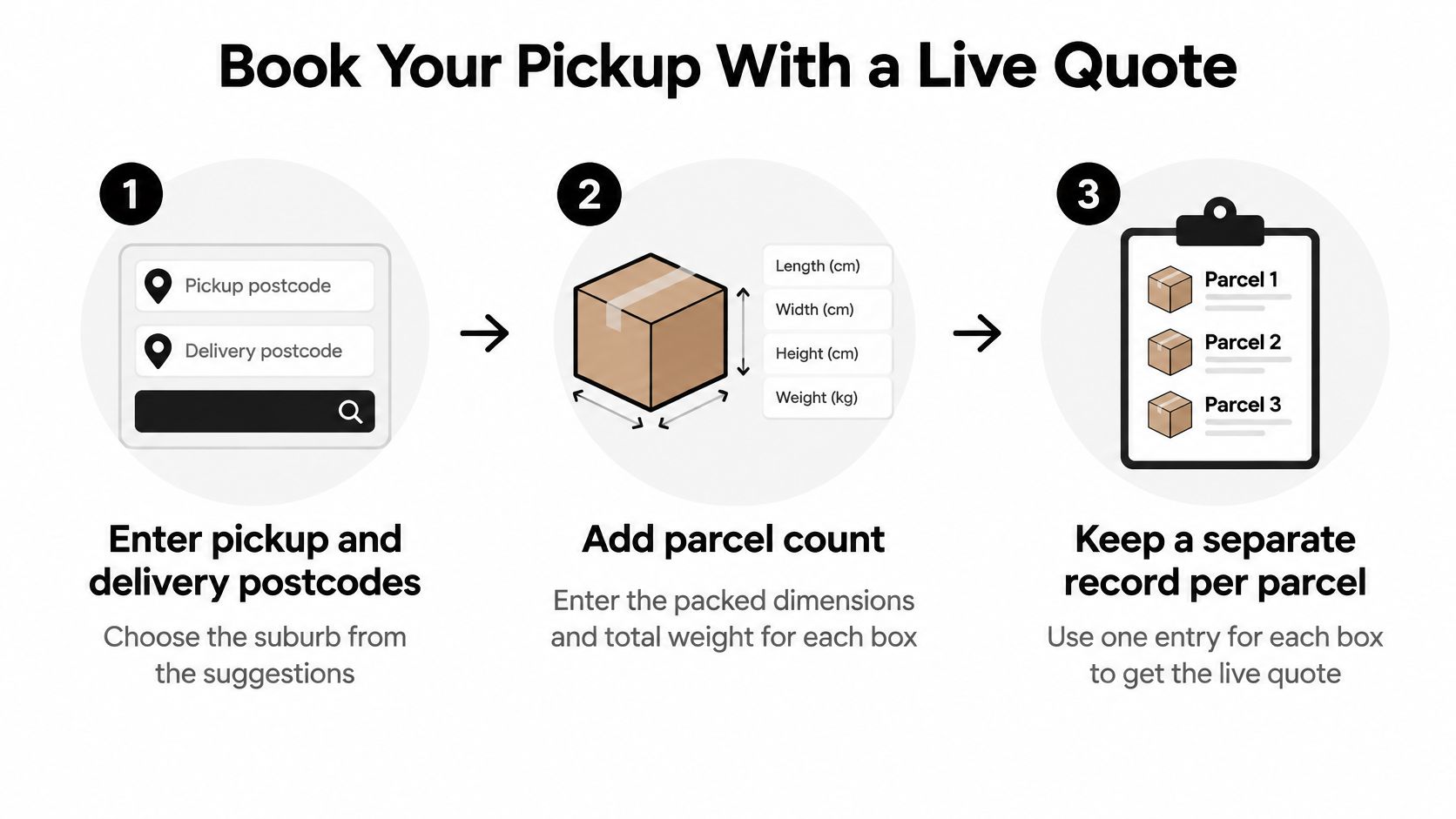
- Enter both postcodes and pick the suburb from the suggestions. A typed suburb that doesn't match the postcode is the quiet cause of failed collections.
- Add the parcel count, then the packed dimensions and total weight for each box. Keep a separate record per package rather than one combined figure.
- Choose the collection date you can meet. Ready time is local to the pickup address, and the parcels must be packed and labelled by then.
- Check the cutoff and delivery window against the recipient's need. Speed is one input, not the decision.
- Review the full total, including GST and any carrier adjustment, then pay. The courier booking is only created once payment clears, so leaving it in a cart doesn't hold a slot.
- Remove old labels, print the new one and attach it to every box. A box carrying two barcodes gets scanned into the wrong job.
- Keep the parcels accessible and save the booking reference. Photograph the handover if you can.
One compliance check belongs here too. If anything in the box is uncertain, raise it with customer service before booking rather than sending it through the standard parcel form and hoping.
Comparing prices first is free, and the full total is visible before you pay and book. If you'd rather build the job from a saved address and a favourite box size, create a free account and reuse them, since there's no monthly platform fee. Parcels under 25 kg with combined length, width and height up to 180 cm go through the standard form.
Practical rule: book the collection day you can hand the parcel over, not the day you hope to.
Booking speed isn't only about cost. Australia Post's 2025 research into online retail, cited in its key insights from the Online Retailer conference, found that 44% of shoppers would abandon a purchase when delivery takes more than two days, while 77% treated real-time tracking as a requirement. Your recipient is already holding you to that standard.
To sanity-check a quote before committing, this breakdown of the shipping cost calculator for Australia explains which inputs move the number most. Online stores running regular dispatch volume should also skim top shipping tools for online stores before settling on a workflow, because labels, tracking and reconciliation get painful fast at scale.
Track It and Handle Delays, Damage or Refusal
A tracking page that hasn't moved in three days causes more panic than a lost parcel. A scan sitting still through a weekend backlog, a remote-area route or a peak queue is common, and it clears on its own more often than senders expect.
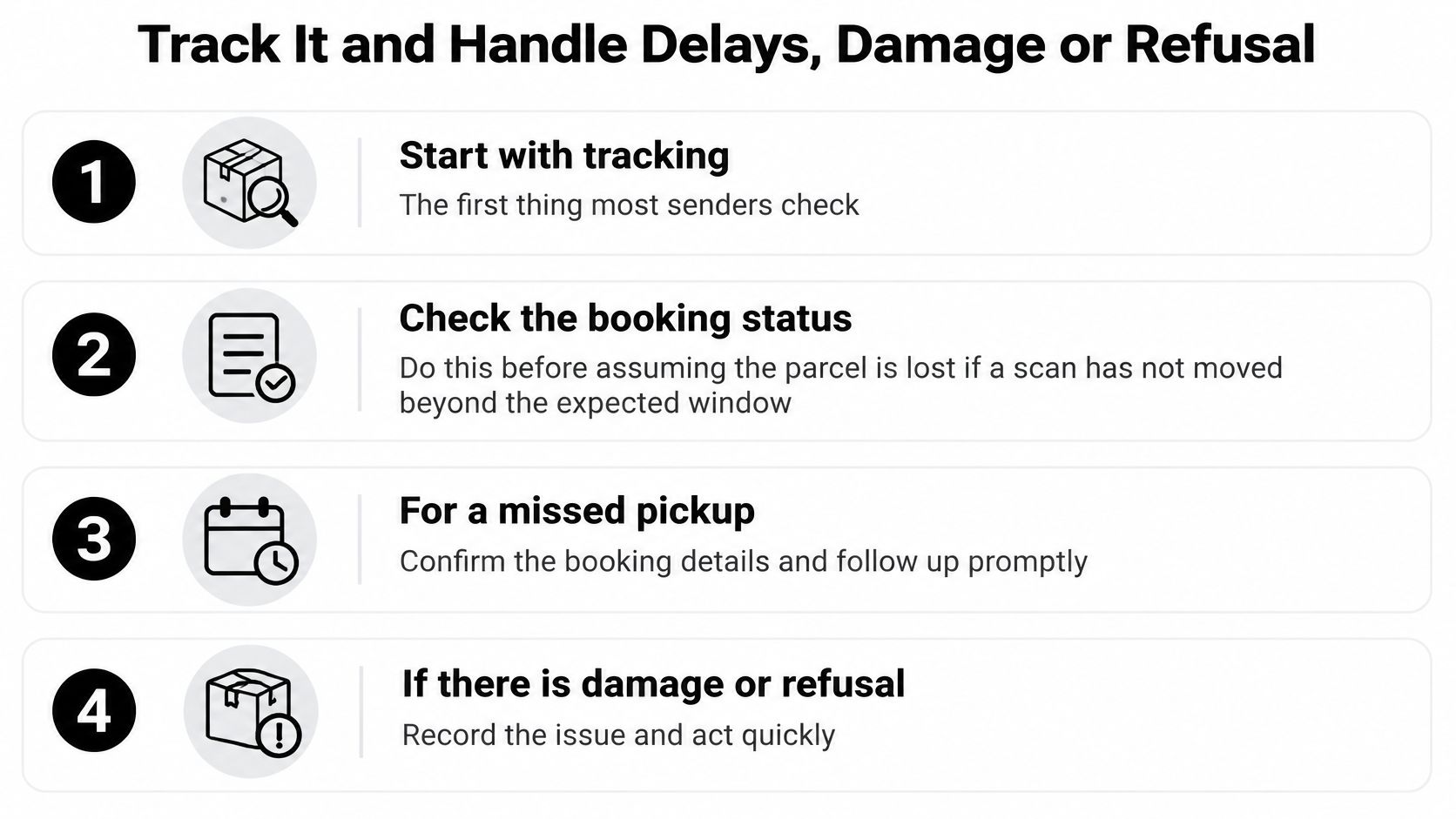
Check the booking status before you declare anything lost. Australia Post's domestic parcels guide directs anyone with a damage, delay or loss complaint to lodge full details, and it sets the bar a claim gets measured against: packaging has to protect contents from handling stress, climate extremes and leakage. If your carton wouldn't meet that standard on a good day, the claim is weak before anyone opens a file.
A missed pickup is a different animal. Confirm whether the booking shows as overdue, then contact customer service with the booking reference and the exact time the parcel was ready. Dispatch problems get fixed faster when you can say precisely when the box was on the bench.
| Problem | First action | Evidence to keep |
|---|---|---|
| Overdue pickup | Check the booking status, then contact customer service | Booking reference and the time the parcel was ready |
| Stalled tracking scan | Check tracking and allow for peak periods | Tracking reference and dates of each scan |
| Visible external damage | Photograph the outside before opening | Photos, packaging and contents |
| Delivery refused or address wrong | Confirm before changing the address | Shipment reference and address details |
| Loss or damage claim | Report promptly with a description of the issue | Evidence of value and photos |
Damage, refusal and the claims trail
Photograph the outside of a damaged parcel before you open it, then keep the packaging and the contents exactly as they arrived. Reports go in promptly with the shipment reference, a description of the issue, evidence of value and any photographs, and leaving out the reference or proof of value can stall the whole thing before it starts. Cover is included up to $150 while the parcel is in Sendaparcel's possession, subject to terms and exclusions, and there's no redelivery fee, though courier charges can still apply.
Keep the box until the claim is closed. A flattened carton in the recycling bin ends most investigations early.
Address changes after dispatch need confirmation, may attract charges, and may not be possible once the parcel is on its final delivery run. If the recipient has moved, ring them before you ring anyone else.
Eligibility matters here too. A claim gets harder when the contents were borderline for the standard booking form, so anything uncertain is worth raising with customer service before you book, while it can still be sent a different way. Flat prints and posters are their own case: they travel in rigid envelopes or tubes rather than cartons, and collector resources such as free UK shipping for collectors show how that niche handles them. Whatever the contents, work out where you stand on insurance for courier while you're still choosing a service, because the terms are much harder to act on after a parcel goes missing.
Act within the first day, keep the packaging, and keep the reference. Three small habits that decide most outcomes.
Sendaparcel lets you compare live courier quotes by postcode, packed dimensions and weight, then book, print labels and track every parcel from one dashboard, with included cover up to $150 and no monthly platform fee. It suits a one-off gift as well as a week of online orders, and same-day options are there when a route qualifies. Visit Sendaparcel to price your next parcel before you tape the box.