
You've packed a parcel, printed the label, and watched the courier drive away. Two days later the tracking stops, or your buyer sends a photo of a cracked item in a crushed box. Now comes the hard part. Who pays, who lodges the claim, and what proof do you need?
Most confusion about insurance for courier shipments starts with one mistake. People treat it as a single product. It isn't. Different cover types protect different people, at different moments, for different reasons. Once you sort them, the next step gets much clearer.
Table of Contents
- Which Cover Applies to Your Courier Shipment
- Who Is Responsible When a Parcel Goes Missing
- Exclusions and Limits to Check Before You Book
- Evidence That Supports a Courier Claim
- Doorstep Delivery and Theft After Delivery
- How to Lodge a Courier Claim
- Check Your Cover Before Your Next Booking
Which Cover Applies to Your Courier Shipment
Say a parcel leaves a warehouse in Melbourne and never reaches the doorstep in Brisbane. The sender wants a refund. The buyer wants a replacement. The courier points to its terms. Each person is asking the same question, but they're not covered by the same policy.
Australia's freight task shows why these layers exist in the first place. In the 2017-18 Survey of Motor Vehicle Use, Australian freight vehicles moved an estimated 214,789 million tonne-kilometres of freight, and articulated trucks accounted for 165,336 million tonne-kilometres, or 77.0% of that total, according to the Australian Bureau of Statistics road freight data. That's the wider road system, not parcel claims alone. It still shows the scale of vehicles, loading, transit and delivery where something can go wrong.
Start With the Table, Not the Headline
Cover types and the risks they respond to
| Cover type | Protects | Responds when | Key check |
|---|---|---|---|
| Compulsory third-party (CTP) | Injury to others from a vehicle accident | Mandatory for registered vehicles in every state and territory | Confirm the vehicle's CTP is current |
| Commercial motor | The van and business use | Damage, theft or accident, depending on policy wording | Declared use and vehicle class |
| Carrier legal-liability cover | Goods in the carrier's custody | Carrier is legally responsible for loss or damage in transit | Per-loss limit and custody window |
| Cargo or goods-in-transit cover | The Sendaparcel team's financial interest in the parcel | Accidental loss or damage, even without carrier liability | Insured value basis and exclusions |
| Home contents | Personal property at home | May not respond to a parcel stolen from a porch | Policy wording on delivered goods |
Read the rows by role. CTP is about injury from a vehicle accident. It doesn't repair a van or replace a parcel. Commercial motor is about the vehicle and its business use. Neither one means your goods are fully protected.
Registration compliance alone doesn't equal courier protection. A driver can meet CTP rules and still leave you exposed to a damaged van, damaged property, or a lost customer's goods. That's why you need to separate vehicle cover from goods cover every time.
Carrier Liability Versus Cargo Cover
Think of carrier legal-liability cover like a hotel storage room. If the hotel loses your bag because staff left the door open, the hotel may pay because it was at fault. If there's no fault, or the loss falls outside its terms, it may not pay.
Cargo cover works more like your own travel policy. It protects your financial interest in what you own. It can respond to accidental loss or damage even when the carrier isn't legally liable, subject to its own conditions.
Carrier liability asks who was at fault. Cargo cover asks what you lost.
That distinction is written into real policy wording. Zurich Australia's carriers cargo liability policy limits cover to liability for goods in the carrier's or subcontractor's custody and to the maximum liability stated in the schedule. In plain terms, custody and the stated maximum set the boundary. A headline that says cover is included doesn't tell you either one.
Say you send a $900 ceramic set as a hypothetical example, and the carrier's liability limit sits well below that value. Even a successful claim can leave most of the value unprotected. The gap isn't a trick. It's the limit doing exactly what limits do.
Before you book, check five things in writing. Check the insured value basis, meaning how the payout value is worked out. Check the custody window, the per-loss maximum, exclusions for packaging and prohibited goods, and whether delay or consequential loss is excluded. Our guide to what included insurance means for a booking is a useful place to confirm how included cover is described.
Find your row before you pay. If you're a personal sender, you're usually comparing carrier liability against cargo cover for your own goods. If you're an online seller, you're managing risk for goods you've sold. If you operate the vehicle, you're dealing with CTP, commercial motor, and carrier cover as separate jobs.
Who Is Responsible When a Parcel Goes Missing
Many guides blur shipping insurance, carrier liability, retailer duties and home contents into one bucket. That blur causes the runaround. The buyer calls the courier. The courier sends them back to the shop. Nobody lodges the right claim.
Australian consumer guidance draws a clear line for online orders. The retailer generally remains responsible to the buyer until the goods arrive, regardless of whether the buyer purchased shipping insurance, and the customer's contract is normally with the retailer while the retailer deals with the courier, as explained by Consumer Protection WA on shipping insurance. Buying extra cover at checkout doesn't move that contract to the courier.
Independent 2025 research cited in that guidance shows the cost of confusion. 22% of Australian shoppers who contacted a retailer or courier after a lost or damaged parcel were redirected between the two parties, 39% waited more than a fortnight for resolution, and the average affected parcel was worth $110.
Match the Scenario to the Claimant
Who usually pays and who lodges the claim, by scenario
| Scenario | Responsible to the buyer or Sendaparcel team | Who usually lodges the claim | Question to answer first |
|---|---|---|---|
| Online order lost in transit | The retailer, under Australian consumer guidance | The retailer, against the courier or transit cover | Who holds the contract with the buyer? |
| Personal parcel lost in transit | The courier, only if legally liable | The sender | Was carrier liability or cargo cover in place? |
| Damaged after the courier took custody | The party named in the carriage contract, tested against packaging evidence | The party bearing the goods risk | Was the condition recorded at collection? |
| Stolen after a delivery scan | The party named for that delivery method in the policy wording | Sender or recipient, as named in the policy | Was the drop signed, safe-dropped or left unattended? |
For a seller, this table changes the buying decision. You're not buying cover to please the courier. You're protecting yourself because you answer to your buyer first, then you pursue the courier or your transit policy second.
For a personal sender, there's no retailer in the middle. You hold the booking, you declared the contents, and you'll usually need to show the carrier was liable or that your own cargo cover applies. That's a heavier evidence burden, so keep your records from the start.
Use three questions in order. Who holds the contract with the person who lost money? Who held the risk at the moment of loss? Which evidence proves value, condition and custody? Shipping insurance doesn't remove Australian Consumer Law obligations for retailers, and it doesn't automatically guarantee reimbursement to a sender. Check notice deadlines and declared value before you lodge anything.
Exclusions and Limits to Check Before You Book
The cap catches senders first. Cover is included up to $150 while the parcel is in Sendaparcel's possession, subject to applicable terms and exclusions. If your item is worth more, treat that figure as a starting point for your own assessment, not as full-value protection.
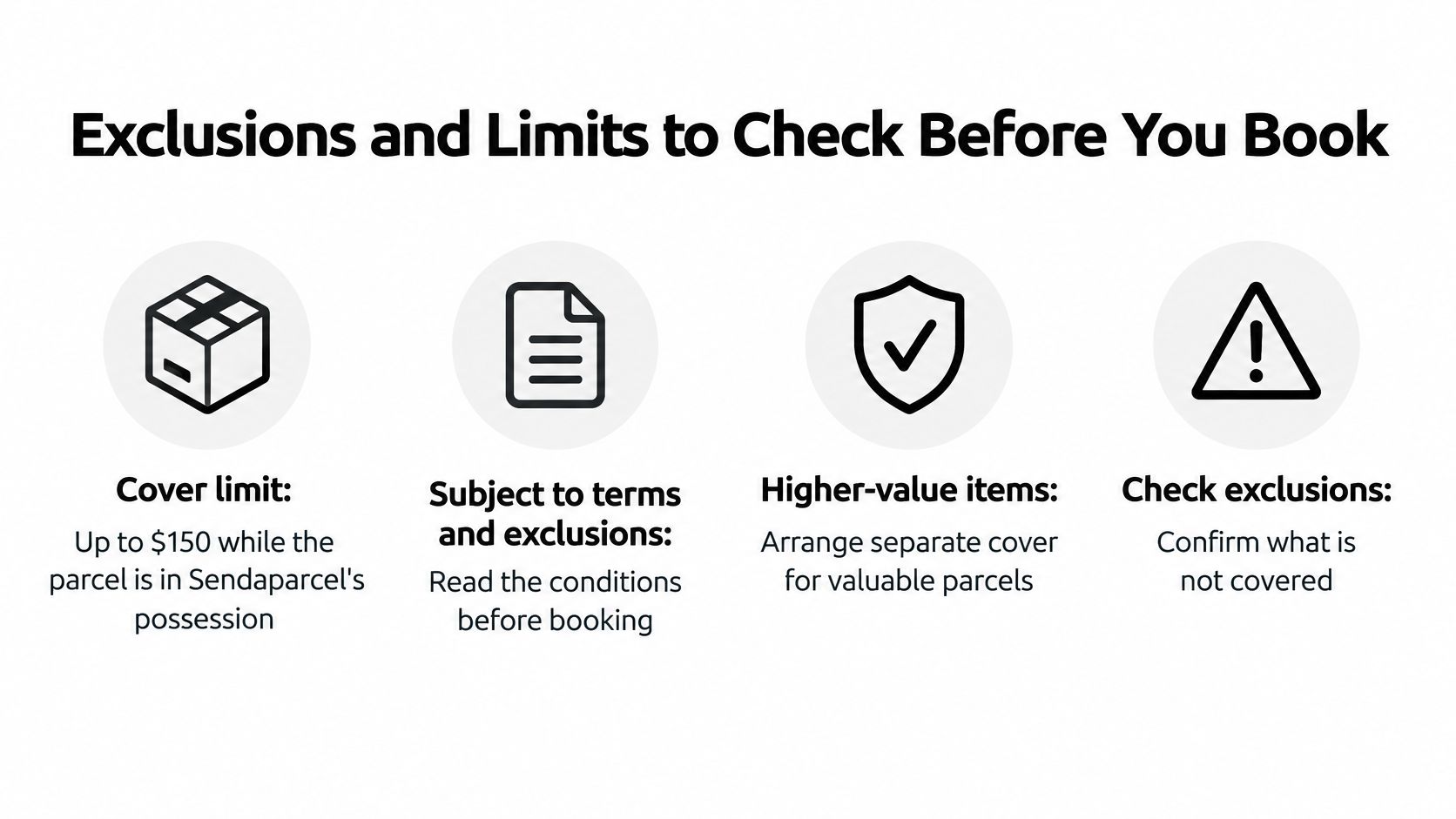
Work through the checklist in booking order. You'll spot most problems before you pay, when you can still change the parcel, the service, or the cover.
The Five Checks That Decide Most Claims
- Per-loss limit: Compare the maximum payout with the item's real value, not what you hope it's worth. Declare a value you can support with an invoice or receipt.
- Custody window: Cover tied to possession applies while the parcel is in that possession. Ask when that window starts and ends for your booking.
- Prohibited and dangerous goods: Dangerous goods must not be booked through the standard parcel form, and uncertain contents should be raised with customer service before booking. Don't guess and hope.
- Packaging: A box that can't survive normal handling can weaken or defeat a claim. Fragile goods need internal cushioning, not just a fragile sticker.
- Consequential loss and delay: Lost sales, a missed birthday, or a late event item are different from physical loss. Check whether delay, consequential loss and post-delivery theft are excluded.
Say you post a glass vase in a thin satchel with one layer of tissue. The cover amount might look adequate on screen. The packaging still fails the test. A claim assessor will ask whether the packing could survive sorting, stacking and a short drop onto a conveyor. Tissue in a satchel won't answer that well.
Use a rigid box instead. Wrap the vase so it can't move, fill voids, and keep it away from the box walls. Photograph it before you seal the lid. That photo later shows you packed for the journey the parcel takes.
Practical rule: Read the policy wording and the schedule, not the headline figure. The headline tells you a maximum. The wording tells you when you'll see it.
Fees can create a second surprise after a failed delivery attempt. We don't charge our own redelivery fee, although courier charges may apply, and our explainer on how redelivery fees work sets out that split. Keep cover questions and delivery-charge questions separate. They come from different terms.
Evidence That Supports a Courier Claim
A claim is won or lost on records, not promises. You need to show what you sent, what it was worth, how it was packed, and when custody changed hands. Without that chain, even a genuine loss becomes hard to prove.
Responsibility normally rests with the business carrying the goods, but the precise allocation is set by the contract between customer and carrier, as Marsh Australia explains for goods in transit. Your records show whether damage happened during insured custody and whether the parcel matched the risk the insurer accepted. Keep one folder per shipment, digital or paper, and add to it as you go.
What Each Record Proves
Evidence to keep and what it proves
| Evidence | What it proves | Where to find it |
|---|---|---|
| Booking reference | The shipment matches the claim | Shipment record or booking confirmation |
| Pickup timestamp | When custody began | Booking or collection record |
| Packed weight and dimensions | The parcel matched the risk accepted | Booking details |
| Declared value and invoice | The basis for any payout | Your invoice or receipt |
| Dated photos of packaging and contents | Adequate packing and condition at custody transfer | Your phone, taken before collection |
| Label data | The parcel's identity | Label record for the shipment |
| Tracking scans | Where and when the parcel moved | Tracking page for the booking |
| Proof of delivery | The handover and signature details | Courier delivery record |
Take packaging photos before collection, not after a problem. Show the contents, the internal cushioning, the sealed box, and the label in the same set. Keep the date visible in your phone's photo details.
Weight and dimensions matter more than people expect. If the booked size matches the parcel the courier collected, there's less room to argue you sent something different. If you guess the weight, you create a dispute you didn't need.
If you ship often, think in programmes rather than panic. Australian businesses can arrange cargo cover for individual consignments or an annual shipment programme, while carrier policies are built for operators carrying customers' goods. Treat any included carrier layer as limited, and confirm separate cover where your exposure is material.
Notify early and in writing. Tell the carrier and any insurer as soon as you find loss or damage, quote the booking reference, and state the date you found the problem. Then check the notice deadline in the wording. Late notice can damage a claim that strong evidence would otherwise support.
Doorstep Delivery and Theft After Delivery
The riskiest moment may come after a successful scan. Australian survey data reported parcels stolen from a property after delivery rose from 3.98% in 2024 to 6.33% in 2025, while parcels damaged in transit rose from 6.99% to 9.08%, in the Compare the Market 2025 delivery problems report. Transit cover and doorstep theft are not the same event.
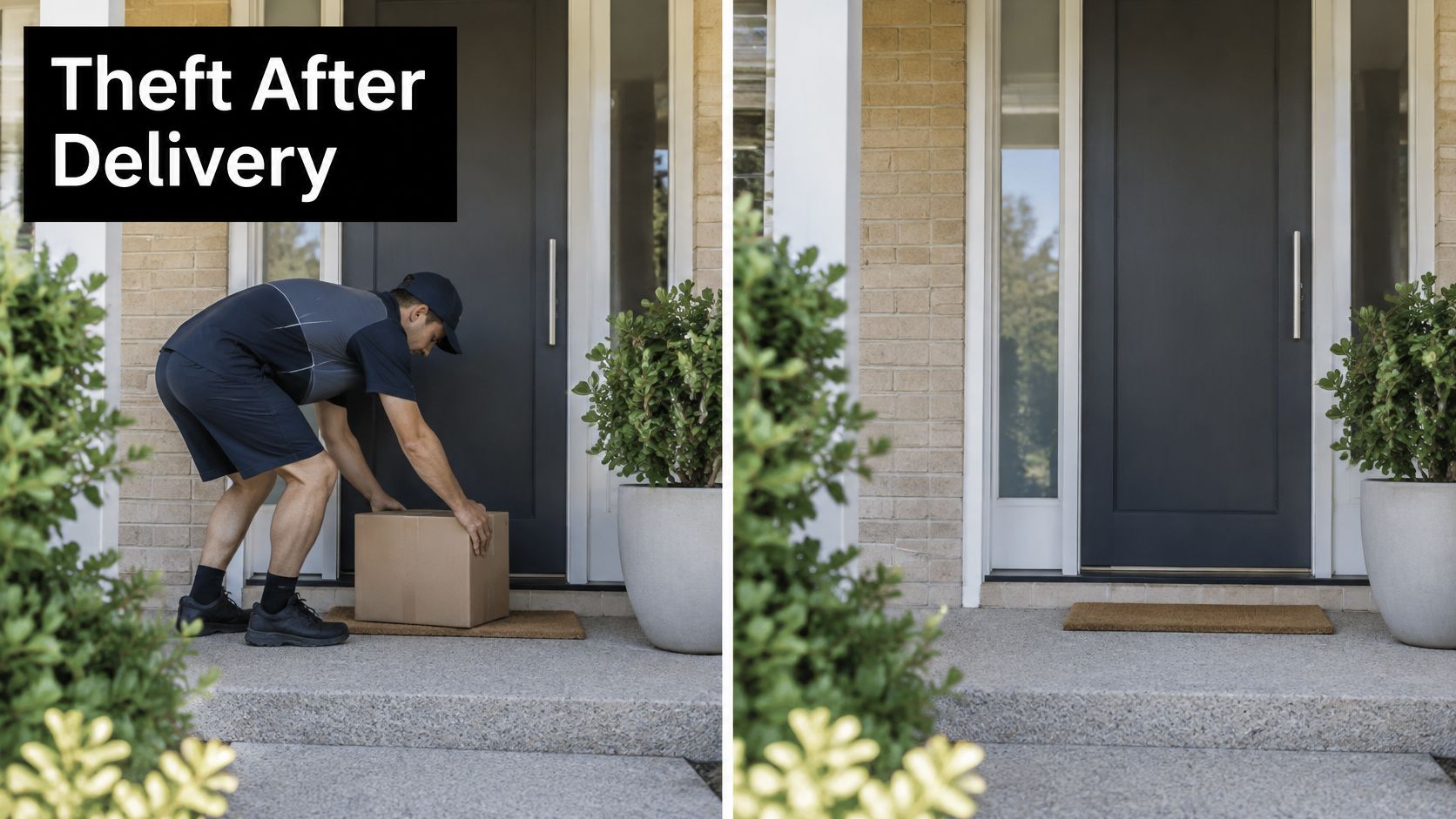
Your delivery choice sets when risk shifts and what evidence exists. A signature creates a handover record. A safe drop creates a photo and a scan. Authority to leave creates an instruction that will be read word for word if the parcel vanishes.
Where Risk Shifts by Delivery Method
Delivery method, where risk shifts and the evidence to keep
| Delivery method | Where risk shifts | Evidence to keep |
|---|---|---|
| Signature required | Risk ends at the signed handover | Signed proof of delivery |
| Safe drop or unattended | Risk ends at the drop scan | Delivery photo showing the drop spot |
| Authority to leave | Risk shifts under the exact instruction the recipient gave | Written instruction and timestamp |
| Missed delivery | Risk continues until the courier's next step is confirmed | Latest Tracking update and the courier's instructions |
Standard home contents cover may not respond to a parcel disappearing from a porch or letterbox. Don't assume it fills the gap. Read the wording on delivered goods, theft outside the home, and any requirement for forced entry.
Declining a signature can also make recovery harder. You're trading convenience for a weaker handover record. For a low-value refill, that trade may suit you. For electronics, jewellery, or anything easy to resell, it's a poor trade.
Say a sender ships a laptop with a safe drop. The driver photographs it beside the front door, and someone takes it minutes later. That photo, the scan time, the recipient's statement, and the original instruction decide whether there's a claim basis at all. Speed doesn't fix that gap. Our article on how last-mile delivery works explains why the final handover carries so much weight.
Choose the drop spot like a claim assessor will view it. Pick a concealed spot out of street view, name it clearly, and tell the recipient when to collect it. Faster delivery doesn't mean better protection.
How to Lodge a Courier Claim
Start the moment you find loss or damage. Notify the courier, and any insurer, in writing. Quote the booking reference and the date you found the problem, and keep a copy of what you sent.
Don't start by arguing about fault. Start by placing the loss in the right scenario, with the right claimant, before the deadline runs out.
A Seven-Step Claim Sequence
- Identify the scenario: Work out whether the claim goes to the retailer, the courier, or a policy you hold. Follow the contract, not the loudest voice.
- Check the deadline: Read the carrier terms and policy wording for the notice period. Diarise it the same day.
- Assemble the evidence set: Gather dated packaging photos, declared value, invoice, label data, tracking scans and proof of delivery in one file.
- Claim only what you can document: Use the declared value and invoice as your basis. Don't claim more than the item's proven worth.
- Ask for dispute reasons in writing: If liability is disputed, get the reason in writing. Check whether packaging, declared contents, or custody evidence caused it.
- Look for another layer: If the payout falls short, check retailer obligations for an online order or cargo cover for the gap.
- Log every contact: Record the date, the person's name, and any reference number for each call or email.
Keep the damaged item and its packaging until you're told you can discard them. Assessors often want photos of internal packing, not just the broken contents. Throwing the box away can remove your best proof.
Claims often stall when each party points to another contract. If that happens, return to the contract question and put it in writing. Ask who held the contract with the person who lost money, and ask for the next step and timeframe in the reply.
Check Your Cover Before Your Next Booking
Your next move changes with your role. Use the situation that matches you, then confirm cover at the booking step. A saved quote or imported order is not a courier booking, so don't treat a quote screen as proof that cover has started.
Three Situations, Three Next Moves
- Occasional personal sender: Compare the carrier's liability limit with the item's value before you book gifts or documents. Add cargo cover for anything above that limit, and photograph your packing.
- Online seller with regular orders: Treat your duty to the buyer as the baseline. Arrange transit cover that matches your typical order value, and record evidence for every dispatch, not just expensive ones.
- Business with its own courier account: Check that courier's liability terms and whether the account cover fits your freight. Our BYO Carrier option lets customers bring their own courier account, listed as free, but your account terms still govern that freight.
Sellers should build evidence into dispatch, not add it after a complaint. Weigh and measure the packed box, save the invoice with the booking reference, and keep tracking until delivery is confirmed. A routine that takes a minute per parcel saves hours when a buyer reports damage.
Personal senders can keep it simpler. Write down the item's value, pack it for normal handling, and keep the receipt and photos until the recipient confirms arrival. If the value makes you nervous, that's your signal to arrange separate cover or choose a signed handover.
List the value of each item, check the cover on the booking itself, and keep the evidence set for every shipment.
We let you compare courier quotes in one place before booking, which helps you weigh price against service. Questions about what a policy will pay still belong with the courier or an insurer who can read the wording with you. Don't let a cheap quote answer a cover question it was never asked.
Do those three actions on your next booking. You'll know which cover applies, who would lodge a claim, and which records you'd hand over. That's the point where insurance for courier shipments stops being a headline and starts being useful.
Before your next parcel leaves, compare courier quotes, check the cover attached to the actual booking, and keep your evidence set ready in one place. Visit Sendaparcel to compare available services for your pickup and delivery postcodes and book with a clearer view of value, limits and handover choices. If your item sits above the included limit, arrange the extra cover first, then send it with records that can support a claim.