
Australian freight vehicles moved an estimated 214,789 million tonne-kilometres of freight on the national road network in 2017-18, 5.0% more than in 2016-17, and articulated trucks carried 77.0% of that task, according to ABS road freight analysis. That figure frames every quote you'll ever compare. Parcels aren't priced by the logo on the satchel. They're priced by route distance, vehicle capacity, the state border in between, and whether the job is local or interstate.
Which is why the cheapest line on a quote screen is rarely the cheapest outcome. A standard service with a wide window can beat an express label that misses, and a premium price is not evidence of reliability. Comparing properly means pricing the whole job: the freight, the GST, the surcharges the carrier may add, and the odds that the first delivery attempt fails.
Table of Contents
- Choosing the Service Level for Your Shipment
- What Really Drives Your Courier Quote
- How Much to Trust a Delivery Estimate
- Regional and Remote Delivery Expectations
- How to Compare Courier Quotes Step by Step
- Confirm the Service Before You Book
Choosing the Service Level for Your Shipment
A live quote for an Australian parcel usually returns four kinds of option, and they differ in far more than the number on the right.
| Service level | Typical transit guide | Best for | Main trade-off |
|---|---|---|---|
| Standard | 2 to 5 business days, varies by route | Non-urgent personal parcels and gifts | Lowest cost, least certain arrival day |
| Express or next-day | Next business day target on supported routes | Time-sensitive orders and documents | Higher price, and next-day consignments can still run late |
| Same-day | Same day, within one state on supported metro routes | Urgent local deliveries | Eligibility, collection cut-offs and route limits apply |
| Regional or remote | Quote-specific estimate, often less certain | Outer-metro and rural postcodes | Surcharges possible, fewer pickup and redelivery options |
Standard carries most of the volume: personal parcels, gifts, returns, replacement parts, spare cables. It's the cheapest option on nearly every lane and the one with the widest delivery window, so you plan around a range of days rather than a date.
Express or next-day shortens the target without removing the risk. You pay for a faster guide, and the consignment can still arrive late, which the measured late rates further down make plain. Buy it when a day or two changes the outcome, not as insurance against a late packing job.
Same-day exists on supported metropolitan routes inside a single state. Direct Couriers same-day timeframes are indicative metropolitan service guides, subject to account terms, route and collection availability, so the true test is whether your parcel can be collected at all. If the box isn't taped when you book, the same-day label buys nothing.
Practical rule: every label on a quote is a guide. Plan your deadline around the estimate, not around the name of the service.
Regional or remote services are quoted per route, and the estimate carries more uncertainty the further you get from a capital city. Fewer collection points, longer handoffs between depots, and possible remote surcharges all affect the total you pay.
The commercial stakes sit behind those labels. The ABS retail trade release for December 2024 estimated total online retail sales at $4,411.2 million in seasonally adjusted terms, with non-food online retailing at $3,079.9 million against $1,331.2 million for food. Those are turnover figures, not parcel counts, so don't read them as shipment volumes. They do show how much commercial activity funnels into courier networks each month, and why service choice has to survive repetition rather than work once.
Match the shipment to the service
Five cases cover most of what people send. Each points to a different service to compare first.
- Occasional personal gifts and documents: compare standard first. Price matters more than a fixed hour, and a two-day window is usually enough when you book a week ahead.
- Regular online orders: set standard as the default and keep express as the backup for late dispatches. Frequent sending rewards saved box sizes and a repeatable route comparison more than any one-off discount.
- Urgent metro documents: look at same-day only if the pickup can realistically happen before the cut-off. A same-day quote accepted at 4pm for a collection window that closed at 3pm is a wasted booking.
- Urgent intrastate business deliveries: same-day or next-day, and only when both postcodes sit in the same state. Cross a border and the same-day option disappears.
- Interstate shipments: compare standard against express on the identical lane. Same-day doesn't apply across state lines, so the only question is what a day is worth to you.
Before you book any of them, confirm two things: the estimate lands before the date you need, and the surcharges are visible in the total. Then set a default service for a route only after comparing it with a faster alternative across several dispatches. Carrier-by-carrier prices and speeds come from the live quote for your route, not from a guide like this one.
What Really Drives Your Courier Quote
The cheapest quote is often not the cheapest outcome. Price follows five inputs, and only one of them is the carrier's rate card.

The five inputs behind a quote
- Route. Your pickup and delivery postcodes set the distance, and an interstate leg adds a border, a longer linehaul and often a different carrier panel. Melbourne to Perth is a different product from Melbourne to Geelong at the same weight.
- Packed weight and dimensions. The quote is built on the box as it travels, not the empty carton on your bench. A carton that is mostly void fill still bills at its outer dimensions, and packing guides make the same point: this walkthrough on how to cut costs on cube cartons shows a box priced by its measurements rather than its contents.
- Quantity. Identical boxes are quoted once with a quantity attached. Different sizes each need their own entry, which is why a mixed order of four sizes takes four lines and one of them usually gets missed.
- Collection readiness. The date you nominate and the time the parcel is ready both affect the quote, and both gate same-day eligibility.
- GST and surcharges. Estimated prices exclude GST, and further charges can follow carrier assessment, so the first number you see is not the amount that leaves your account.
Here's how those inputs combine on a live quote.
The rest is the cost that never prints on a quote. If the first delivery attempt fails, some services charge again for redelivery while others redirect the parcel to a collection point or book a second attempt, so a failed delivery can add cost or admin depending on the courier and the service. Sendaparcel itself charges no redelivery fee, though courier charges can still apply. Reliability also matters to your customer, not just your invoice: Australia Post's 2025 eCommerce Report found that 85% of Australian shoppers consider reliable delivery the most important factor in trusting online retailers over the next five years, and DHL's 2025 Australia research reports a similar pattern, tying basket abandonment to unavailable delivery options and missing returns choices. An unreliable service costs the retailer sales as well as freight.
Total cost formula: quote, plus GST, plus likely surcharges, plus the expected cost of one failed delivery. Rank services on that number, not the first one you see. Before you compare totals, it helps to know how parcel shipping costs are built.
How Much to Trust a Delivery Estimate
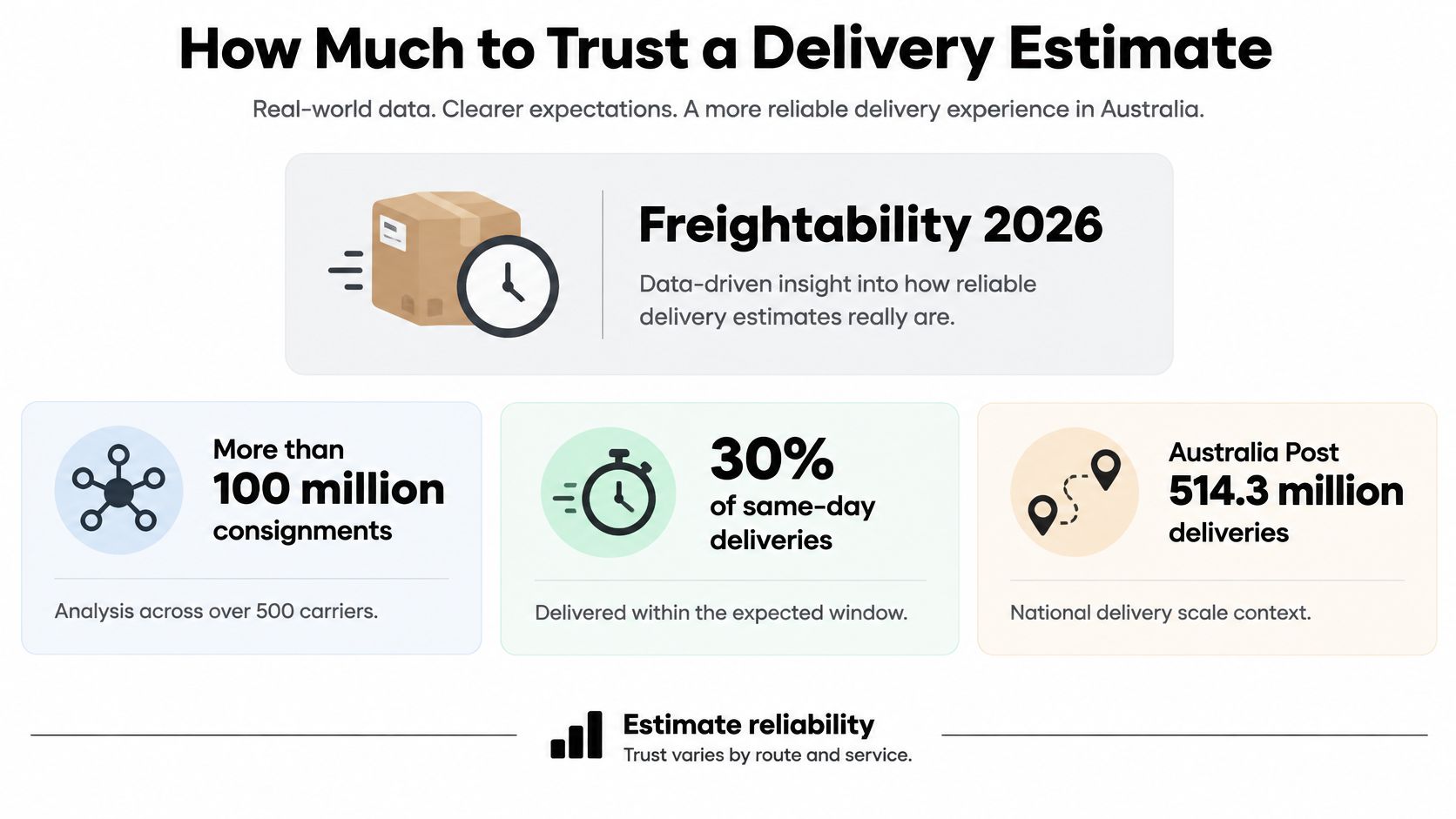
Treat the estimate on a quote as a working window, then price the risk around it. A 2026 Freightability analysis covering more than 100 million consignments across over 500 carriers reported that 30% of same-day deliveries and 27% of next-day consignments missed their promised timeframes, standard services had a 19% late rate, national on-time performance was 78%, and top-performing carriers exceeded 90%, as reported in RetailBiz's coverage of the Freightability findings.
| Service type or measure | Result |
|---|---|
| Same-day deliveries | 30% missed promised timeframe |
| Next-day consignments | 27% missed promised timeframe |
| Standard services | 19% late |
| National on-time performance | 78% |
| Top-performing carriers | above 90% on time |
The useful lesson sits in the comparison. A nominally faster service can underperform a standard one on the same lane, so the service label carries less weight than recorded performance for that route, parcel size and collection window. Delivery estimates remain guides, and the courier confirms the service conditions. If a late parcel would break a customer promise or a contract milestone, build slack into the shipment plan itself; the same buffer thinking behind building a more resilient supply chain applies at parcel level.
Turn the late rates into a booking rule
- Read same-day and next-day as target windows. They describe the service level being sold, and availability still depends on the route, collection timing and the courier's conditions.
- Book earlier than the estimate requires. For a fixed deadline, choose the level whose estimate leaves at least a full business day of buffer, then keep the savings on a standard service. Check express post cut-off times if you're squeezing a dispatch into the same afternoon.
- Use performance history where the record is thick enough. Sendaparcel uses shipment history to produce courier-performance statistics and guide selection, and a Preferred marker can help where enough measured live history exists. Those insights need sufficient comparable data and do not guarantee future performance or a delivery date.
- Match the buffer to the downside. For a personal birthday parcel, a day of slack may be enough. For stock needed on a job site or an order tied to a refund promise, price in a failed first attempt before choosing the cheapest label.
Say a parcel has to reach a regional Queensland address by Friday. Booking it on Wednesday with a standard service leaves two business days of runway and keeps express in reserve if tracking stalls. Booking the same parcel on Thursday leaves no room for a missed collection, and same-day options depend on that lane being supported at all. Watch the scans at each handover: pickup, linehaul, onboard for delivery. If tracking stops moving, the estimate has already done its job by telling you where to look next.
Regional and Remote Delivery Expectations
The question most comparisons skip isn't which courier is cheapest to a rural postcode. It's how much confidence to place in the estimate once it gets there. Australia Post delivered 514.3 million parcels in FY2025, with domestic parcel volumes up 2.6%, according to its 2025 Australia Post annual report, and it reported 102.8 million parcels during its 2025 peak period. That's sustained network demand, not a one-off spike.

Capacity is the other half of the picture. Independent 2025 labour-market reporting identified 3,706 open delivery-role positions nationally, an average of 13 vacancies per 100,000 people, with the Northern Territory carrying the highest regional exposure at 24.6 vacancies per 100,000 residents. Fewer drivers in a thin lane means fewer alternatives when something goes wrong.
- Check coverage against the exact postcodes. Australia-wide options reach metro, regional and rural destinations, but coverage depends on the specific pickup and delivery postcodes, not on a state-level map.
- Expect the route to change the answer. Courier availability varies by route and shipment, so a service that quotes cleanly to one regional centre may not exist two towns over.
- Budget for remote extras. Surcharges, longer handoffs and limited pickup or redelivery options are normal outside the major centres, and they change the total more than the headline rate does.
An express label buys very little when the bottleneck is the destination itself. Earlier dispatch, consolidating two parcels into one, collection-point delivery or accepting a wider window can cut failure risk more than paying for speed. If your lane crosses a border, a lane guide to NSW to QLD freight is worth five minutes before you compare.
Contingency rule for remote destinations: add a buffer to the expected arrival, then ring or message the recipient and confirm they can collect if the first attempt fails.
How to Compare Courier Quotes Step by Step
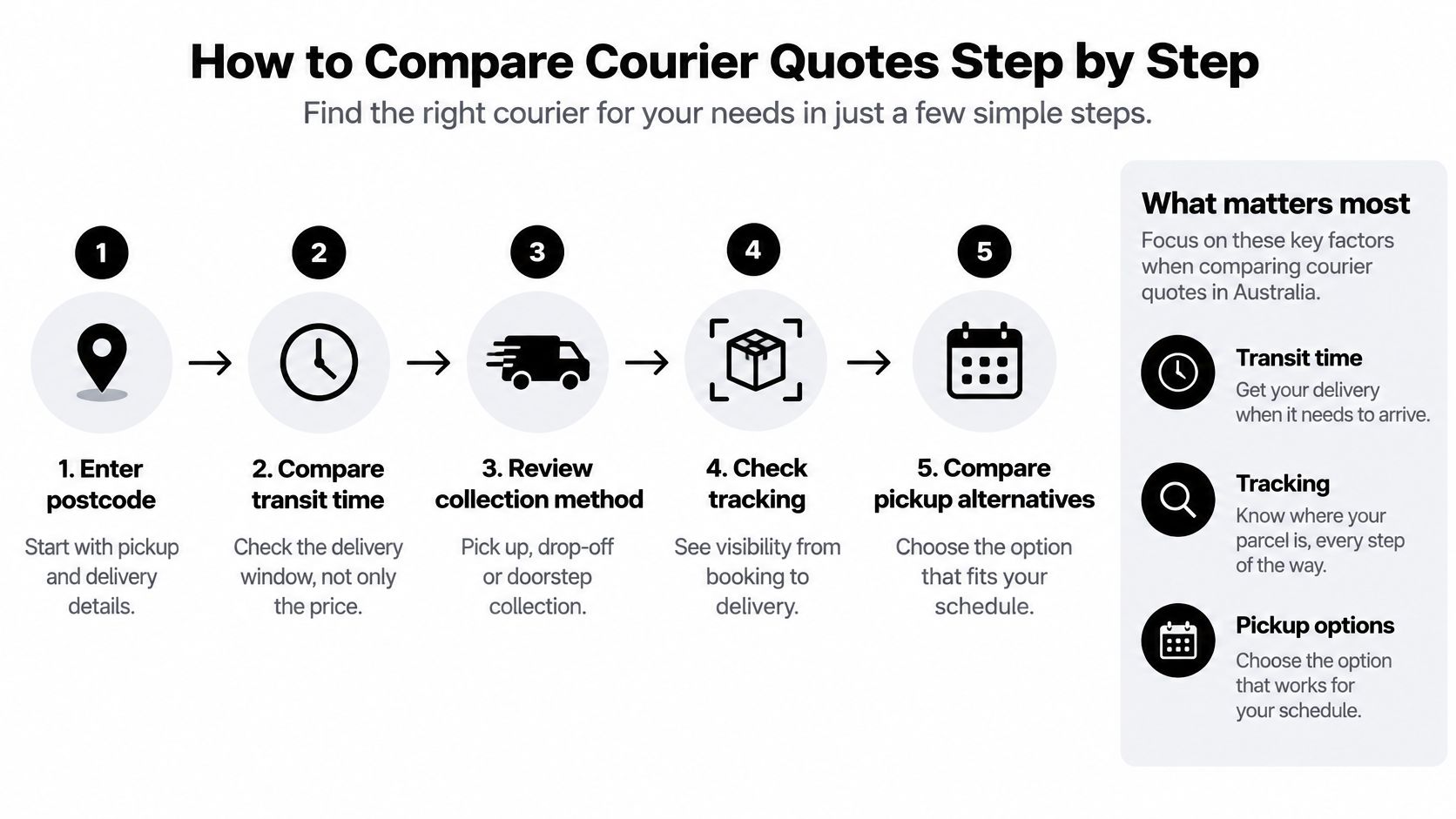
Delivery options now sit at the checkout, where shoppers expect a choice of speed and price before they commit. A useful quote shows transit time, collection method, tracking and pickup alternatives alongside the rate, which is what the flow below is built to surface. On Sendaparcel, live prices are compared for the route, packed size, weight and collection date you enter, and quotes are available from the first parcel with no volume tier to climb first. Read the results as a total-cost question: the lowest headline rate stops being the cheapest once GST, carrier surcharges and a failed first delivery are counted.
From postcode to tracking in eight steps
- Enter the pickup postcode and pick the suburb from the suggestions. The quote runs on the actual route, and a similarly named suburb (Richmond in NSW versus Richmond in Victoria) sends it down the wrong lane.
- Enter the delivery postcode the same way. Both ends set the distance, and a border between them changes the service panel.
- Choose Parcel or Satchel, then enter packed weight and dimensions as the box will travel. The common slip is accepting the default weight of an empty carton and being re-rated at the depot.
- Add a separate entry for each box size and use the quantity field for identical boxes. A three-size order priced as one line under-quotes and delays the booking.
- Set the collection date and ready time in the pickup location's local time. Setting a ready time before the box is taped is the fastest way to miss the collection.
- Compare service level, price and estimate together, adding same-day only where the parcel is urgent and eligible on the route. Where enough measured delivery history exists, a Preferred marker can shortlist a service, though recorded history never guarantees a future delivery date.
- Review the full total before paying. Estimated prices exclude GST and surcharges may apply after carrier assessment, so judge the final figure rather than the headline rate.
- Book, then track. If a delivery is missed, check the latest courier update in Tracking and follow that courier's instructions for the service you selected.
The cheapest quote is the one that costs least after the parcel arrives, not the one with the lowest number on the left. Sendaparcel charges no redelivery fee of its own, but courier charges can still apply after a failed attempt, so a slightly pricier service with a realistic estimate and a workable collection time often wins on total.
Confirm the Service Before You Book
Decide by deadline first. A fixed arrival date means the service level whose estimate leaves a buffer. A flexible parcel means the lowest total at the standard level. An urgent parcel within one state means same-day, but only if collection can happen in time.
Then run three checks.
- The total, not the headline. Confirm the amount you'll pay, with GST and any surcharge the carrier may apply, before you commit.
- The route. Courier availability varies by postcode and shipment, so a service that worked last month on a different lane tells you nothing about this one.
- The estimate. Delivery estimates are guides, and the courier confirms service conditions. For a remote destination, add a buffer and confirm the recipient can collect.
You can review the full total before paying and booking, which makes the comparison honest rather than approximate. Do that once and you'll never go back to guessing from a rate card.
The single action worth taking today: enter the pickup and delivery postcodes and the packed size of your next parcel, compare the live options against the date you need, and book the option that meets that date at the lowest total.
Sendaparcel prices local, interstate and same-day Australian courier services from the first parcel, with live quotes built on the route, packed dimensions, weight and collection date you enter. You can compare the totals for standard, express and eligible same-day services, review the full amount, then book and track from one dashboard with no subscription fee. Start at Sendaparcel and run the next parcel against your real deadline.