
The advice that surfaces first when you search for courier services near me is simple: pick the cheapest quote, or pay for the fastest tier if the parcel matters. Both rules break in the same place. The cheapest quote usually assumes a collection window you can't meet, and the fastest tier is a target rather than a promise, so a next-day label bought for a fixed date can still arrive late while a standard parcel booked with slack lands on time.
The right question isn't "what's cheapest" or "what's fastest". It's "what does a failed pickup or a late delivery cost me on this parcel", and that answer changes per shipment. A $9 satchel of samples to a regular customer barely registers a day late. A signed contract that has to be on a desk before a 9am meeting is a different problem, and the fee difference between standard and same-day is small next to the cost of missing the meeting.
This is a large system, not a cottage industry. The ABS reported sales and service income in Transport, Postal and Warehousing up 7.8% in 2024–25, with the Postal and Courier Pick-up and Delivery Services subdivision up 13.1%, adding about $3.1 billion (ABS Australian industry release). Options near you exist in volume. Choosing between them is the part that takes judgement.
Table of Contents
- Collection Options Near You, Compared
- What Drives the Price of a Courier Quote
- How Fast Each Service Level Really Arrives
- Comparing Carriers on Your Route
- When Paying for Speed Is Justified
- How to Book a Courier Pickup Without Delays
- Fixing Missed Pickups and Stalled Parcels
Collection Options Near You, Compared
| Collection option | Best for | Cost position | Main limit |
|---|---|---|---|
| Scheduled kerbside pickup | Regular senders with a set dispatch time | Mid-range, often bundled when booking several boxes | Collection window must match the packed-ready time |
| Drop-off at a depot or agent | Senders close to a depot who can avoid waiting | Often lower where offered, since collection is skipped | Requires travel and depot opening hours |
| Same-day pickup on supported routes | Time-critical parcels within one state | Highest of the standard options | Same state only, and before the booking cut-off |
| Bring your own courier account | Businesses with negotiated courier rates | Depends on existing account terms | Carrier terms apply; platform fee listed as free |
Scheduled kerbside pickup is the default for anyone dispatching regularly. You nominate a date and a ready time, the driver arrives inside the window, and the parcel enters the network without you leaving the building. The failure mode isn't usually the courier. It's the clock. If the ready time says 10am and the box is still being taped at 10.20am, the driver has already scanned the run and moved on, and you're rebooking tomorrow. Set the ready time to when the parcel is sealed, labelled and sitting by the door, not when you plan to start packing.
Drop-off at a depot or agent often prices lower where it's offered, because the courier skips a collection stop entirely. You pay that saving back in time: travel, parking, and counter hours that rarely stretch past a normal working day. It suits a sender whose depot is a five minute detour, and it punishes anyone who has to close a shop to get there.
Same-day pickup exists only on supported routes within the same state, before the booking cut-off, never interstate. Direct Couriers same-day timeframes are indicative metropolitan service guides, subject to account terms, route and collection availability. Same-day also skips the label in that setup, so the driver arrives with paperwork rather than scanning yours.
Bringing your own courier account fits a business already sitting on negotiated rates with a carrier it trusts. We list the connection of an existing account as free, so the deciding factor is your carrier's terms and conditions, not a platform subscription.
Why the option list changes by postcode
Coverage is decided by the exact pickup and delivery postcodes, not by the city name. A metro suburb and a rural postcode forty kilometres away can return different carriers, different service tiers and a different price for the same carton. Enter the suburb rather than typing a postcode from memory, so the route matching fills correctly and the options you see are the ones that really run.
What Drives the Price of a Courier Quote
A quote is only as accurate as the details typed into it. Courier rates move with pickup and delivery locations, packed size, weight and number of items, the selected courier and service, collection timing, service availability and applicable surcharges. None of that is exotic. Almost every surprise at payment time traces back to one of those inputs being entered loosely.
| Cost driver | How it changes the quote | How to keep it accurate |
|---|---|---|
| Pickup and delivery postcodes | Route distance and metro versus regional zones | Check which zone the delivery postcode falls in |
| Packed dimensions and weight | Size and weight bands decide which services apply | Measure after packing, not the empty box |
| Number of items | Each box is priced separately | Add a line for each size; use quantity for identical boxes |
| Collection timing | Cut-offs decide which services are offered | Set the ready time local to the pickup location |
| Surcharges and GST | Estimates usually exclude GST; assessment can add charges | Compare the full total before paying |
Distance and the metro divide
Route distance moves the price more than many senders expect, and the gap between metro and regional is wider still. The ABS estimated freight vehicles moved 214,789 million tonne-kilometres on Australian roads in the twelve months to 30 June 2018, with articulated trucks carrying 165,336 million tonne-kilometres, or 77.0% of that road freight task (ABS road freight analysis). A parcel from a capital city to a regional town shares that line-haul network, so the same box can price quite differently in each direction, and sometimes between carriers on the same lane.
Weight, dimensions and box count
Measure the packed carton, not the empty one. Bubble wrap, void fill and tape add centimetres, and a carton sitting one centimetre over a band limit moves into a more expensive service tier. Each box is priced separately, so three small cartons can cost more than one larger carton holding the same goods. Add a line for each size and use quantity only for identical boxes. The cheapest headline figure is not automatically the right booking either: a low quote built on an optimistic weight tends to grow once the carrier weighs the freight itself.
Timing, surcharges and the invoice total
Set the ready time in the local time of the pickup location, because collection timing decides which services the quote can offer at all. Estimated prices exclude GST, and additional charges can follow carrier assessment, which is where a headline figure and a final charge part company. If you want a structured way to compare carrier rates and surcharges on the same parcel before committing, the exercise is worth the few minutes it takes. For a quick sense of how the line items add up, this shipping cost calculator guide for Australia sets out the inputs.
Prices also drift independently of your parcel. The ABS recorded a 2.4% rise for postal and courier pick-up and delivery services in the September quarter of 2024, attributing it to higher parcel costs (ABS producer price index release). A quote that has crept up on an unchanged route is usually the market moving, not an error.
How Fast Each Service Level Really Arrives
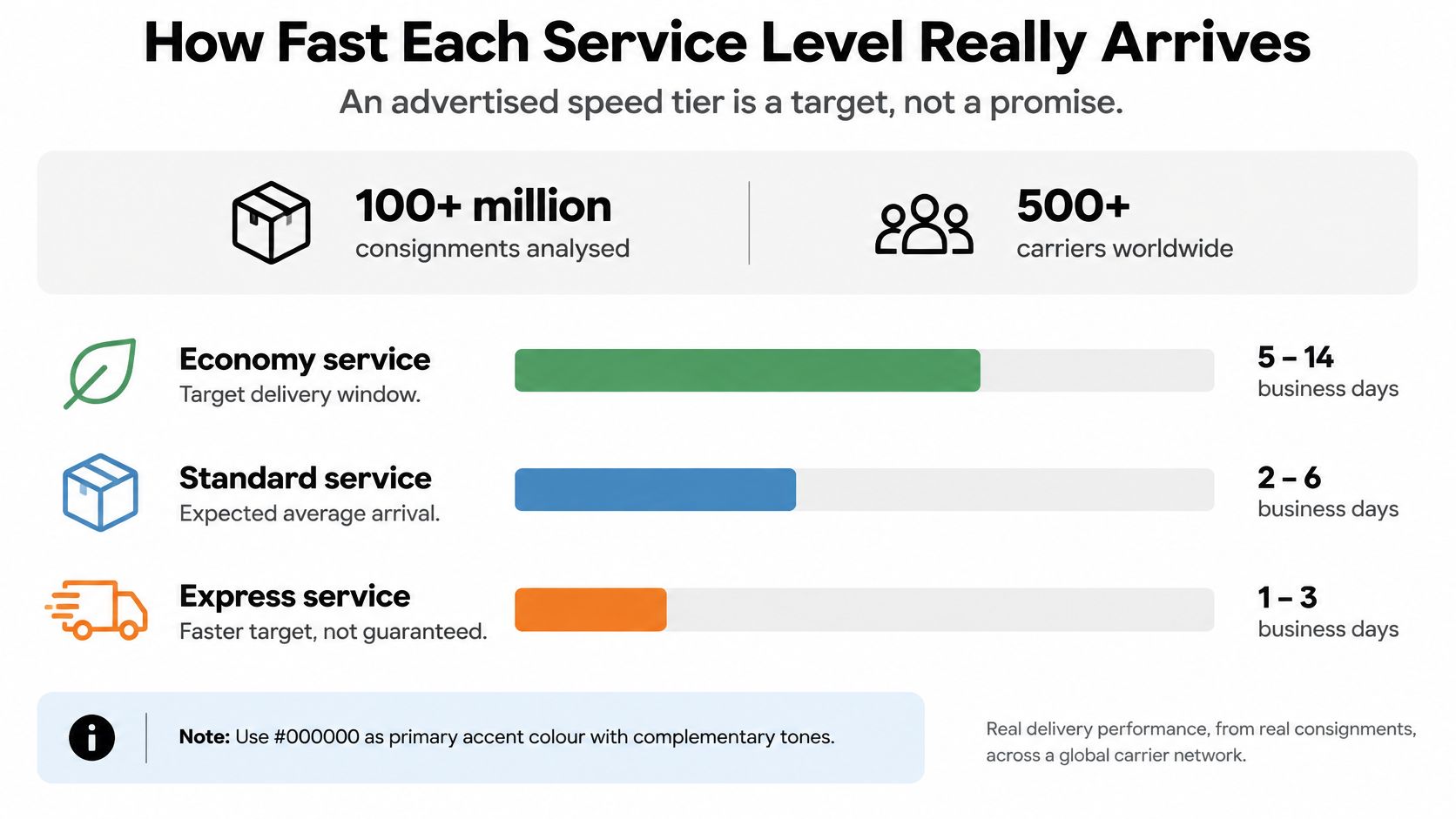
An advertised speed tier is a target, not a promise. A freight benchmark covering more than 100 million consignments across more than 500 carriers reported average delivery-in-full, on-time performance of 78%, and the failure rates split sharply by service: 30% of same-day deliveries and 27% of next-day shipments missed their commitments, against 19% for standard freight (FreightAbility benchmark report).
| Service level | Shipments that missed commitment | What it means for your choice |
|---|---|---|
| Same-day | 30% | Book only on proven in-state routes with slack in the deadline |
| Next-day | 27% | Treat as a target and book a day early for fixed dates |
| Standard | 19% | Lowest miss rate of the three, so often the most dependable for flexible deadlines |
A label that fails more than one time in four is a plan, not a guarantee. Read the next-day tier as "usually tomorrow" and book a day early whenever a fixed date sits downstream, whether that's a meeting, a birthday or a contract signature. The extra day costs less than a missed deadline.
Same-day is defensible on time-critical intrastate routes where the specific service has a strong record, and it's unavailable across state lines, so an urgent Melbourne to Sydney parcel can't use it no matter what the price. If you're weighing that tier, the practical detail sits in our same-day courier options breakdown rather than in a headline transit time.
What each failure rate changes
The 19% figure for standard freight is the useful one. It means the slowest, cheapest option misses least often, which inverts the instinct to pay up for reliability. What you buy with express tiers is speed, not certainty. Reliability comes from route history: how a particular carrier performs from your postcode to that destination on that service class.
Working rule: price the parcel on two service levels, then ask what the second one buys you. If the answer is "a day earlier, maybe", keep the cheaper one and move the deadline.
Volume is the other pressure. Australia Post delivered more than 110 million parcels during the November to December peak, averaging roughly 3,075 parcels per minute, with total parcel volume up 5.3% in the reported financial year (Australia Post annual report). Saturation shows up as slower depot scans, not as a changed delivery promise, so a December shipment needs more slack than the same shipment in March.
Comparing Carriers on Your Route
Carrier rankings flip from lane to lane. A service that is cheap from a Sydney warehouse to a Brisbane business address can price differently from a Geelong postcode to the same destination, because each carrier's network is stronger on some lanes than others. Any list that ranks national carriers overall is describing an average you do not ship in.
The carriers that appear in live quotes here are CouriersPlease, FedEx, StarTrack, Aramex and Allied Express, with Direct Couriers adding same-day options on supported in-state routes. Quotes can be compared before any volume-pricing tier, and BYO Carrier is listed as free if you want your own account rates measured in the same test.
| Carrier | Record on each route | Same-day availability | Collection timing to confirm |
|---|---|---|---|
| CouriersPlease | Full total, ETA and service name | Only where the quote returns an eligible same-day option | Available pickup window shown during booking |
| FedEx | Full total, ETA and service name | Only where the quote returns an eligible same-day option | Available pickup window shown during booking |
| StarTrack | Full total, ETA and service name | Only where the quote returns an eligible same-day option | Available pickup window shown during booking |
| Aramex | Full total, ETA and service name | Only where the quote returns an eligible same-day option | Available pickup window shown during booking |
| Allied Express | Full total, ETA and service name | Only where the quote returns an eligible same-day option | Available pickup window shown during booking |
| Direct Couriers | Full total and indicative metro guide | Supported in-state routes only, subject to route and collection availability | Same-day deliveries do not require a courier label |
The three-route test
- Pick three routes you ship weekly. One metro to metro, one metro to regional, and one lane that has already cost you a late parcel, a missed pickup or a difficult recipient call.
- Hold the parcel constant. Same packed dimensions, same weight, same ready time and same delivery instructions on every quote, otherwise the test measures your data entry rather than the carrier.
- Record price, ETA, service level, collection timing and same-day availability for each carrier on each route. Add one more column: what a failed delivery would cost the sender or recipient on that lane.
- Re-run it after a bad week. A carrier that misses collections or leaves parcels stalled has given you route evidence that a headline price cannot show.
The Preferred marker can shortcut that work where enough measured live history exists. Treat it as a starting point on unfamiliar lanes and as a check on lanes you already know. Performance insights are based on recorded history, need sufficient comparable data and do not guarantee a future delivery date, so weigh them beside price, cutoff and the cost of a miss.
The right carrier is the one whose estimate fits the deadline at the lowest total exposure: price, pickup risk and delivery consequence together.
If you want a structure for weighing those factors instead of chasing the lowest line, this carrier scoring matrix for rewards shipping shows how to weight reliability, cutoff and handling in one score.
When Paying for Speed Is Justified
Express is not the default answer, and Australian shoppers keep saying so. Australia Post's 2025 ecommerce report found 56% of shoppers generally prefer free delivery over faster delivery, and most were satisfied with delivery taking about 4.6 days (Australia Post ecommerce report 2025). Shoppers commonly expect delivery within two to five days. Speed is a tool for specific situations, not a quality signal.

| Situation | Recommended option | Why it fits |
|---|---|---|
| Customer order promised for today | Same-day on a supported in-state route | A missed promise usually costs more than the fee |
| Gift or document with a fixed date | Next-day or express, booked a day early | A buffer covers the chance of a late delivery |
| Routine stock with no deadline | Standard service | Lowest cost and predictable enough |
| Interstate parcel with no urgency | Standard or consolidated service | Same-day is unavailable across state lines |
| Low-value item to a regular customer | Standard service | Speed rarely changes the outcome |
The first row is where same-day earns its price. If you've told a customer the item arrives today, the fee is trivial next to a refund, a bad review or a lost account. Fast courier options for urgent parcels are available, and eligible same-day options can be reviewed for time-sensitive consignments, subject to route and cut-off.
The fourth row catches people out. An urgent Perth to Sydney parcel can't be solved with same-day, because that tier only runs within a state. Practical options there are an earlier booking and a carrier with a strong overnight record on that lane.
For anything with a hard date, a buffer beats a faster tier almost every time. A next-day parcel booked on Monday for a Friday deadline has three working days of tolerance built in. The same parcel booked Thursday has one, and the benchmark above says roughly one in four of those bookings misses.
The cost of lateness test
Ask one question before choosing a tier: what does a late parcel cost me here? If the answer is a shrug, book standard. If the answer is a rescheduled meeting, a missed statutory deadline or a customer you're trying to keep, the price gap between standard and express is the cheaper of the two numbers.
How to Book a Courier Pickup Without Delays
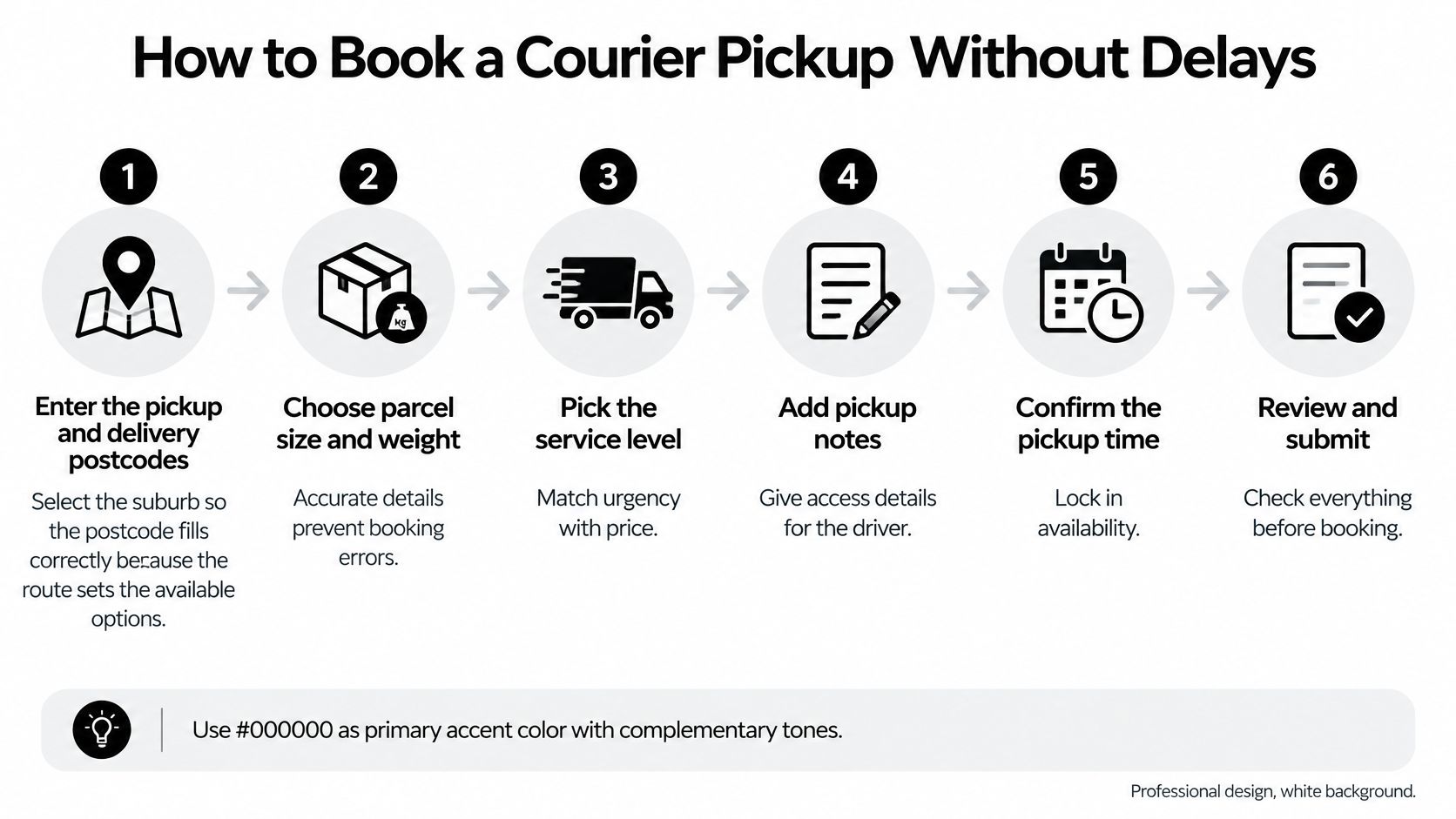
Most booking problems are entry problems. The parcel is fine, the carrier is fine, and the pickup fails because a postcode was typed from memory or the ready time was set to when you planned to start packing. Six steps, each with the reason it matters.
- Enter the pickup and delivery postcodes. Select the suburb so the matching postcode fills in, because coverage, available services and which carriers appear at all depend on the exact route.
- Choose parcel or satchel, then enter packed weight and dimensions. Add a line for each distinct box size and use quantity only for identical cartons, so the right size and weight bands apply. Satchel bands run up to 250 g, 500 g, 1 kg, 3 kg and 5 kg.
- Compare couriers, services and estimated delivery beside the price. Choose a same-day option only if the parcel needs it and the route supports it, since that tier runs on supported routes within the same state. Otherwise weigh the estimate against what a late arrival would cost, because the smallest number on the list earns nothing if delivery lands after the deadline.
- Review the full total before paying. Estimated prices exclude GST and surcharges may apply after carrier assessment, so the number that matters is the total, not the headline.
- Set the collection date and ready time. That time is local to the pickup address, and it needs to be the moment the parcel is sealed and labelled rather than the moment you start looking for the tape.
- Pay, then save the booking reference and label. Labels can be reprinted from recent bookings, and the reference is what turns a vague enquiry into a traced parcel.
Two habits that save bookings
A free account stores favourite addresses and box sizes, which removes most of the retyping that causes the step one and step two errors. It also keeps labels, tracking and payments in one place, so a missing label on a Friday afternoon is a reprint, not a crisis.
Before paying, check the full total rather than the first figure quoted, and check the parcel limits for the service selected. An overweight or oversized carton can stall at collection, so splitting it into two items at step two costs less than discovering the problem at the door.
Fixing Missed Pickups and Stalled Parcels
A cheap quote stops being cheap the first time a driver leaves a card and the recipient starts asking where the parcel is. DHL's 2025 country report on Australian ecommerce found 85% of shoppers may abandon a basket if their preferred delivery options are unavailable, and 53% prefer redirecting an unattended parcel to a safe place (DHL Australia ecommerce insights). The judgement lands on the sender when delivery control fails, even if the network caused the delay.
| Problem | What to check first | Next step |
|---|---|---|
| Nobody home at delivery | Latest update in Tracking and the courier's instructions for the service | Follow the courier's redelivery or collection instructions |
| Marked delivered but not found | Delivery time, safe-place notes and any proof available | Contact the courier with the booking reference |
| Tracking has stopped moving | Last scan date against the expected transit time | Raise a query before reshipping anything |
| Pickup missed | Collection date, ready time and pickup notes saved in the booking | Check the overdue-pickup reminder, then rebook |
| Unexpected extra charge | Whether GST was shown separately and the carrier reassessed the parcel | Ask the courier to confirm the assessed charge |
The recovery sequence
Work in order and do not jump ahead. First, open Tracking and read the latest courier update, because the scan history usually answers whether the parcel moved at all. Second, follow the instructions tied to the service you bought, since redelivery and collection rules differ between carriers and between service levels. Third, escalate with the booking reference and the pickup time, which gives the carrier something concrete to search against.
Sendaparcel charges no redelivery fee, though courier charges may apply for a second attempt, so ask before arranging one rather than after. If tracking looks frozen, compare the last scan date with the expected transit window for that route before you reship. A remote lane can pause longer than a metro linehaul leg; the trigger is a scan gap beyond the estimate for that route, not an arbitrary day count.
Liability starts before handover. Photograph the sealed carton, keep the booking reference and note the time the driver collected it, because that record is what separates a packing failure from a network failure when a claim is assessed. For the tracking side of this, the guide to reading a tracking number in Australia explains what each scan status means.
A consolidated standard service that arrives reliably in four days often beats an express parcel that arrives late and needs a second attempt.
Choosing a courier near you comes down to matching the option to the parcel's urgency and the cost of it going wrong, and Sendaparcel puts that comparison on one screen: enter the pickup and delivery postcodes, see live prices and delivery estimates from carriers including CouriersPlease, FedEx, StarTrack, Aramex and Allied Express, and book with saved box sizes and tracking in the same place. There is no platform subscription fee, and the full total can be reviewed before paying. Visit Sendaparcel to compare your route before the next parcel goes out.