
Same-day courier on an eligible metro route arrives the same day if it's collected in time, metro-to-metro express arrives the next business day, express between capital cities runs 1 to 2 business days, and express to a regional or rural postcode runs 2 to 5 business days. Every one of those clocks starts when the courier collects the parcel, not when you book it.
So why does a parcel you paid express freight on sit at a depot for two days while a standard satchel posted the same morning arrives first? Because the word express describes a service level on a booking screen, not a promise about your parcel. Search for express shipping AUS and you'll find pages of next-day claims, and very little about what has to go right for those claims to hold.
That gap is worth closing. An estimate tells you what the network usually does with a parcel like yours on a route like yours. A guarantee is a contractual commitment with conditions attached, and most of the disappointment in Australian express delivery comes from treating the first as the second.
Table of Contents
- Typical Express Delivery Times by Australian Route
- What Express Shipping Means in Australia Today
- Why Express Speed Varies by Postcode and Corridor
- When Express Shipping Is Worth the Extra Cost
- Failed Deliveries and the Last Kilometre Problem
- Booking Details and How to Compare Quotes Before You Book
Typical Express Delivery Times by Australian Route
Use these windows as planning guides, then confirm the one that applies to your postcodes before you pay for anything.
| Route type | Typical transit | Where it applies | Notes |
|---|---|---|---|
| Same-day courier | Same day if collected in time | Eligible metro routes within one state | Indicative guide, subject to collection availability |
| Express metro to metro | Next business day | Capital cities and major metro areas | Carrier cutoff times apply |
| Express interstate, capital cities | 1-2 business days | Major interstate city pairs | Weekends and public holidays extend the window |
| Express regional or rural | 2-5 business days | Regional and rural postcodes | Confirm the estimate for the exact postcode |
| Express remote | Confirmed for the exact postcode at booking | Remote postcodes | Carrier confirms service conditions before booking |
Read the table by route, not by carrier promise. A same-day booking works only when collection happens early enough for the courier to run the delivery on the same shift, and Direct Couriers same-day timeframes are indicative metropolitan service guides subject to route and collection availability. Metro-to-metro next-business-day depends on the parcel making the evening linehaul and clearing the sort before the morning delivery run.
Interstate capital-to-capital pairs usually involve a depot handover or two, which is exactly where the extra day appears. Regional and rural postcodes sit at the end of a linehaul that may run only a few times a week, so the estimate is only as reliable as the postcode you type in. Remote postcodes are a separate question: some carriers publish a service, others want the location checked before they'll commit to anything.
A parcel booked at 4pm on a Friday isn't moving on Saturday in most networks. It enters the system on Monday morning, and the count starts there. Weekends and public holidays don't count as transit days, so a Friday collection before a long weekend can turn a next-business-day estimate into a Wednesday arrival.
Three checks apply to any express quote, whatever the carrier:
- Confirm both postcodes. Enter the exact pickup and delivery postcodes, not just the suburbs or states, because route availability is decided at that level.
- Note the collection date and the cutoff. The pickup location's local time decides whether your parcel catches today's run or tomorrow's.
- Add the non-working days. Count weekends and public holidays into the window before you promise a date to anyone.
Treat the number you get as a guide to plan around, and read the selected courier's service conditions before you commit. That's the difference between booking express and expecting a guarantee.
What Express Shipping Means in Australia Today
Express shipping is a parcel service booked for a specific collection date and carried through a courier network on a faster timetable than standard delivery. That's the whole definition. Everything else is a variation on it.
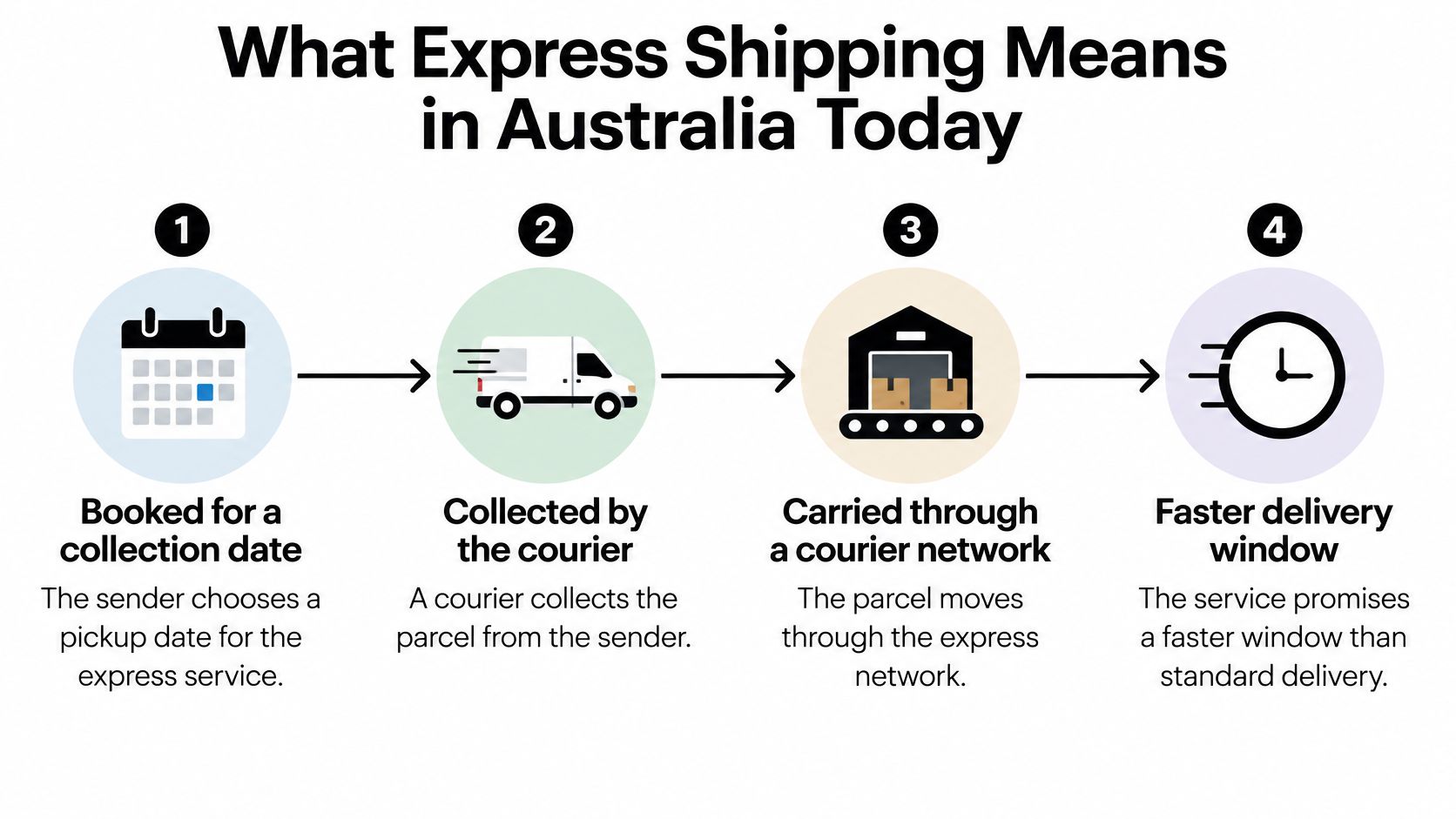
The label now covers three distinct products, and they behave differently. Same-day services run within one state on eligible metro or supported intrastate routes, where the collection window and final-mile route can be controlled. Next-business-day services cover metro-to-metro travel, leaning on overnight linehaul and an early sort. Multi-day express handles interstate and regional deliveries, where the service is faster than standard but still counted in days rather than hours.
Think of express as a reserved lane on a busy motorway, not a teleport. The lane moves faster. It still depends on distance, traffic and how many times your parcel changes vehicles, and a breakdown in the express lane blocks it just as thoroughly as any other.
The scale behind all this is considerable. Australian Bureau of Statistics figures show sales and service income for postal and courier pick-up and delivery services rose 12.0% in 2023–24, an increase of $2.5 billion, with the ABS attributing the broader transport expansion to stronger demand for freight services, passenger transport, and home and food delivery (Australian Bureau of Statistics). A market that size runs on volume, and volume is what produces the sort of variability a single booking screen can't show you.
Here's how the four steps look in practice, from booking through to the delivery window.
The takeaway is straightforward. Express describes a service level, and the wording on the booking screen matters far more than the label on the courier's van. Read the conditions attached to the specific product you've selected, because "express" on its own tells you almost nothing about what happens if something goes wrong.
Why Express Speed Varies by Postcode and Corridor
Two parcels booked on the same express service, collected on the same morning, can land a day apart. The difference is rarely the carrier. It's the corridor.
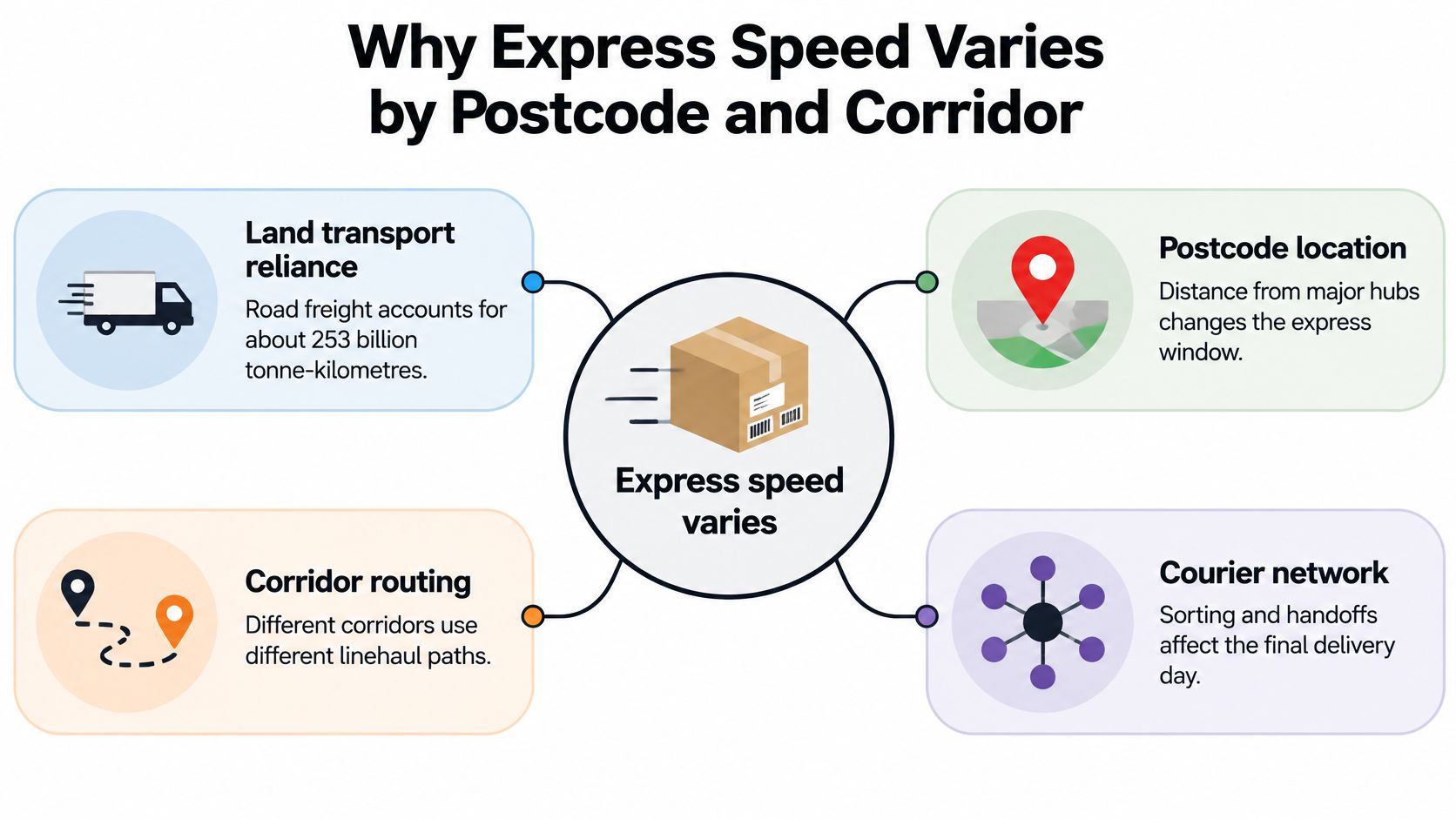
Start with the spine of the system. Australia's domestic freight relies heavily on land transport: in 2024–25, road freight accounted for approximately 253 billion tonne-kilometres while rail accounted for about 447 billion tonne-kilometres, which is why delivery performance tracks road-corridor distance, metropolitan congestion, depot handovers and the availability of direct intrastate routes (BITRE freight data). Your postcode pair sits at the centre of four connected variables.
- Distance decides how many hours of driving sit between collection and delivery, and whether a single driver can complete the run inside a legal shift.
- Handovers add time at every depot a parcel passes through, because each one means an unload, a scan and a reload onto a different vehicle.
- The final mile changes character entirely between a dense metro street grid and a rural route where the last delivery is 40 kilometres from the previous one.
- Network load determines whether your parcel gets on tonight's linehaul or waits for tomorrow's, which is why identical bookings behave differently in December than in February.
Load isn't a minor factor either. Australia's total domestic freight task was estimated at 786 billion tonne-kilometres in 2024–25, the highest level in the cited series, which is a large part of why outcomes vary by corridor, cutoff time and network load rather than by advertised service speed alone (BITRE statistics).
Same-day service is most technically plausible on dense metropolitan or supported intrastate corridors, where the final-mile route and collection window can both be controlled. An interstate express label should never be read as a same-day arrival, no matter how the checkout page phrases it.
The lever you control is shipment accuracy: parcel count, dimensions, weight, pickup readiness and postcodes. Those five fields decide vehicle type, depot handling and whether a service is even offered. If you're sending beyond the metro fringe, our guide to rural parcel delivery walks through the postcode-level checks that catch most surprises early. Retailers publishing route and delivery detail on product pages face the same discipline, and the principles behind answer engine readiness for DTC brands apply equally to a delivery page that has to state real windows rather than hopeful ones.
When Express Shipping Is Worth the Extra Cost
Speed is not the default goal, even though most delivery advice treats it as one. The better question is narrower: does paying for a faster window change the outcome for this particular parcel?
| Situation | Express usually worth it? | Reason |
|---|---|---|
| Gift with a fixed date | Yes | A missed date costs more than the fee |
| Replacement part stopping work | Yes | Downtime outweighs the freight cost |
| Documents with a deadline | Yes, if the cutoff is met | A late collection removes the benefit |
| Customer order, recipient flexible | Usually no | Standard delivery meets most expectations |
| Low-value item | Usually no | The express fee can exceed the item value |
Australian shoppers split on this in a way that's worth understanding. Australia Post's ecommerce reporting found 56% of shoppers generally prefer free delivery over fast delivery, while 57% say time sensitivity makes fast delivery more important than free delivery (Australia Post quarterly ecommerce update). The same reporting shows shoppers are happy to wait an average of 4.6 days, while younger shoppers increasingly want delivery within three days.

Both numbers are true because they describe different shipments. A birthday gift and a restocking order are not the same decision, and treating them as one is how people end up paying express freight on things nobody was waiting for.
Run the arithmetic on one parcel
Say you're sending a $40 accessory and the express fee is $25. That fee is 62% of the item price, which is a poor trade if the recipient would have been perfectly happy three days later. It's a sound trade if a missed date puts a $300 sale at risk, because you're spending $25 to protect $300.
The test is the same every time: add the express fee to the cost of a missed date, a lost sale or a complaint you'd have to resolve, then compare that total against the standard option. When the standard option wins on both price and adequacy, choose it without guilt.
Practical rule: if you can't name what a late parcel would cost you, you probably don't need to pay for speed.
Two things can erase the benefit. A cutoff time missed at the collection end pushes everything back a day, and a remote postcode or a public holiday does the same thing at the delivery end. A faster collection or transit estimate is not a guaranteed arrival, so build the decision per shipment and per route rather than defaulting to express across the board.
Failed Deliveries and the Last Kilometre Problem
The fastest service in the country is worthless if nobody is at the address to receive the parcel. That's the question Australian express content rarely answers, and it's the one that decides whether your urgency gets rewarded.
Shoppers are explicit about this. In DHL's 2025 country report, 85% of Australian shoppers abandon a basket when their preferred delivery options are unavailable, 64% say high delivery costs frustrate them, and their preferred alternatives when an option is missing include redirecting to a safe place or changing the delivery day (DHL eCommerce Australia report). The same research finds 42% of consumers don't yet know about Parcel Lockers, though 74% of those aware would consider using one, and out-of-home delivery is growing about 17% year over year.

The options that protect speed are unglamorous and effective: a safe-place instruction, a Parcel Locker, a business address with a reception desk, an authority-to-leave setting, or a redirection arranged before the first attempt. Our guide to last-mile delivery goes deeper on how these choices interact with transit estimates. Business senders tracking a part from approval through to arrival can also browse the requisition-to-delivery workflow, because the last kilometre is one stage in a longer chain and delays upstream usually surface here.
The checklist before you choose express
- Name a reachable recipient. Confirm someone can take the parcel on the expected day, or that a safe place exists.
- Write access instructions. Apartments, gated sites and workplaces with loading docks all need detail the driver can act on.
- Check the postcode early. Regional and hard-to-access locations deserve a quote check before you commit to a fast service.
- Know the cover. Sendaparcel includes cover up to $150 while the parcel is in our possession, subject to applicable terms and exclusions.
- Know the redelivery position. Sendaparcel charges no redelivery fee, though courier charges may apply.
Keep the two rulebooks separate in your head. Carrier policies govern what happens on a failed delivery attempt, while the platform's booking estimate governs what you were quoted and what you pay. Knowing which one applies saves an argument later.
Choose express only when a reachable recipient can take the parcel on the day it's expected. Otherwise you've bought speed the parcel can't use.
Booking Details and How to Compare Quotes Before You Book
An express estimate holds or falls on the details you enter, so start with the limits that decide eligibility. Get these wrong and the quote you're comparing isn't for your parcel at all.
| Booking input | Limit or check | Why it affects speed |
|---|---|---|
| Weight per parcel | Up to 25 kg | Parcels over the limit cannot be booked on the platform |
| Combined length, width and height | Up to 180 cm | Oversized boxes fail eligibility and delay the quote |
| Pickup and delivery postcodes | Exact postcodes | Route availability and transit depend on them |
| Collection date and time | Local to the pickup location | Sets the cutoff for same-day and next-day services |
| Pickup readiness | Packed and ready before collection | Late packing pushes collection to a later run |
| Identical boxes | Enter once with a quantity | Keeps quotes accurate for multi-box shipments |
Three details people get wrong
Measure the packed box, not the empty carton. A box that measures 40 cm flat will measure more once it's taped shut with padding inside, and the combined dimension is what the quote runs on.
Enter the actual packed weight each time. A saved default from your last shipment can describe a completely different load, which produces a price that won't survive the carrier's own assessment.
Confirm the parcel will be ready before the cutoff. Booking a collection for a parcel still being packed at the stated time is the most common way a next-day estimate turns into a two-day delivery.
How to run a quote, step by step
- Enter the pickup and delivery postcodes. This is the first field for a reason: route availability is decided here before price means anything.
- Add packed weight and dimensions for each box. Multi-box shipments need every box entered, because handling requirements change with volume.
- Choose Parcel or Satchel, or switch to the Same day tab for eligible metro routes within the same state.
- Compare service, estimated delivery and price side by side. The point of a comparison is to see the cost of each extra day, not to pick the top row.
- Check the collection date and the time your parcel will be ready. Match both against the express post cut-off time that applies to your pickup location.
- Pay to create the courier booking. Payment is what converts an estimate into an actual pickup.
Rates move with pickup and delivery locations, packed size, weight, item count, the selected courier and service, collection timing, availability and applicable surcharges. Estimated prices exclude GST when first shown, so compare like with like before you decide one service is cheaper than another.
You can compare prices and delivery estimates without creating a shipment at all, which makes it practical to check three options before committing. Courier availability varies by route and shipment, and Australia-wide coverage extends to metro, regional and rural destinations depending on the exact postcodes you enter. One small operational note for urgent dispatch: Direct Couriers same-day bookings don't require a courier label, which removes a step when you're against the clock. Teams shortlisting carriers under time pressure often compare staffing vendor options with the same scorecard approach, weighing written criteria over impressions.
A free account saves favourite box sizes and addresses and keeps labels and tracking in one place, with no volume tier to reach before you can compare quotes. If a collection is missed, you can request a rebooking with a shipment selection or tracking number rather than starting the whole booking again.
Decision rule: choose the cheapest option that still meets your deadline and has a reachable recipient at the other end. Anything faster is money spent on a window you didn't need.
Sendaparcel lets you put same-day, next-business-day and multi-day express options side by side for your exact pickup and delivery postcodes, with the packed dimensions and collection timing that decide whether the estimate holds. You'll see the freight price before you commit, then book the pickup, print the label and track the parcel from the same dashboard, with no monthly platform fee. Head to Sendaparcel and run a quote on your next urgent parcel before you assume express is your only choice.