
Rural Parcel Delivery in Australia: How It Works and What to Expect
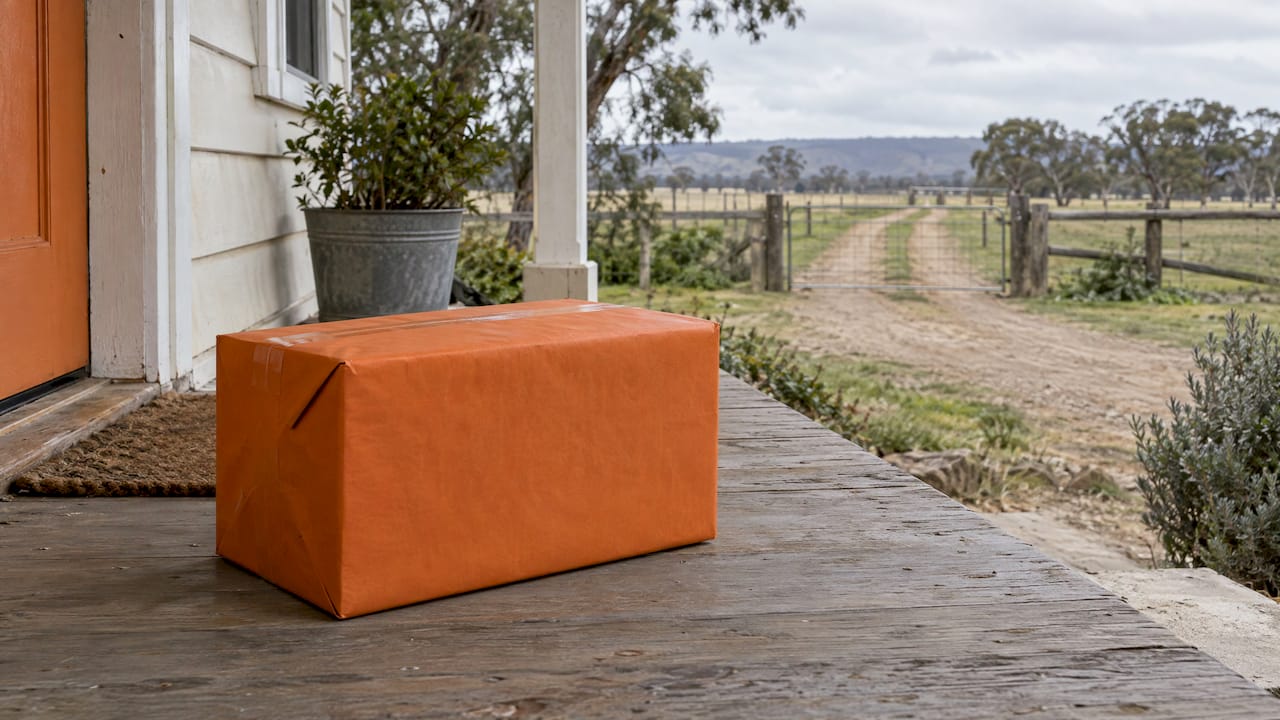
Parcels do reach rural and remote Australia, but the way they arrive differs from a city doorstep drop: the delivery point, the timing and the pickup rules all change with distance and road access. The best way to send one is to compare live quotes for your exact route before you book, so you see the total price and the service level up front. That is what we built Sendaparcel for: you enter the pickup and delivery addresses, compare courier options side by side, and book with no platform booking fees.
This guide explains how rural and remote delivery works, what slows it down, how to address and pack a parcel so it arrives, and how individuals, online sellers and frequent shippers can keep costs predictable.
SendaparcelCompare Rural Delivery OptionsCheck real-time quotes for your route and compare courier options with clear price breakdowns and no platform booking fees.VisitTL;DR
- Parcel services with Australia-wide coverage exist, and Parcel Post covers all addresses within Australia, but delivery to country addresses is often slower than to capital cities.
- On rural roads the delivery point may be a letterbox cluster or a Post Office, not the front door, so tell your recipient what to expect.
- A correct, guideline-compliant address is the single biggest thing a sender controls.
- Compare real-time quotes for your route on Sendaparcel, with insurance included, transparent price breakdowns and no platform booking fees.
- Sellers can use Excel bulk uploads, Shopify, WooCommerce, eBay and Wix integrations to ship regional orders in volume.
Table of Contents
- Does parcel delivery reach rural and remote areas?
- How the last stretch works at a country address
- How long does rural delivery take?
- What affects the cost
- How to send a parcel to a rural or remote address
- PO Boxes and the most remote addresses
- If a parcel goes missing or cannot be delivered
- Shipping regional orders as a seller or frequent sender
- Book your rural parcel with clear pricing
- Our perspective
- FAQ
- Sources
Does parcel delivery reach rural and remote areas?
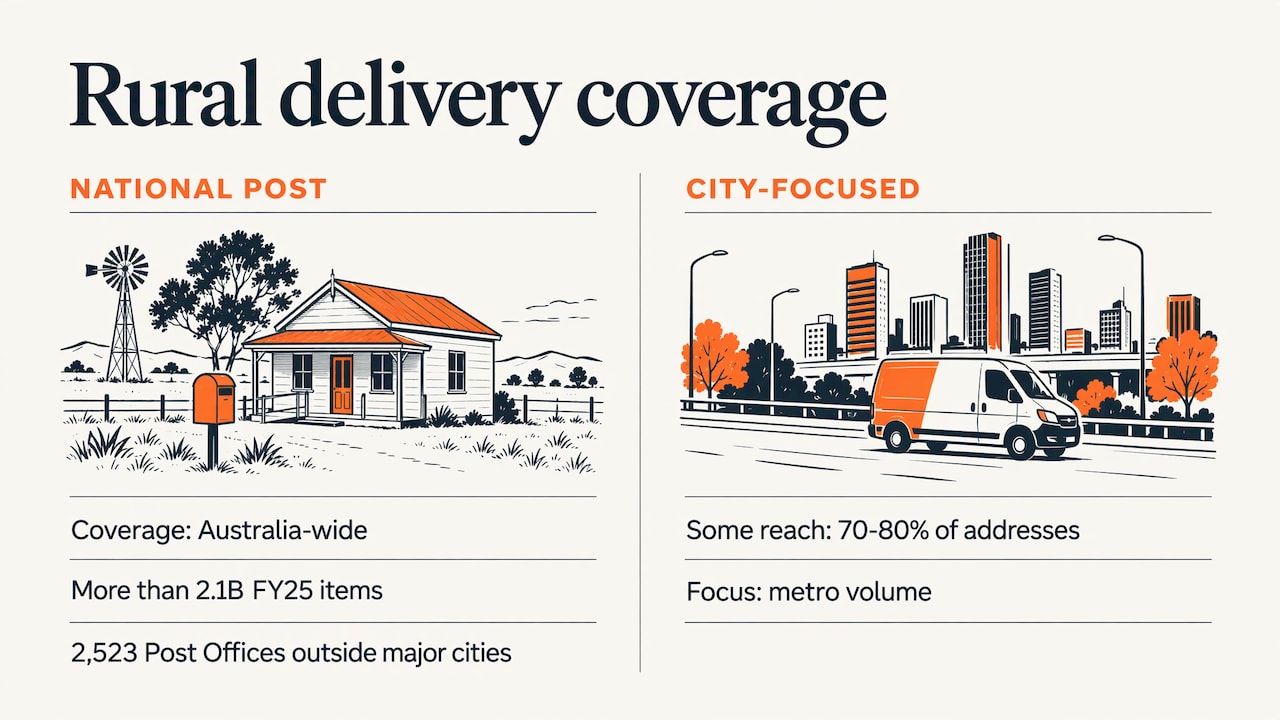
Yes. The national postal network publishes Australia-wide coverage for both Parcel Post and Express Post, and it has a stated commitment to provide parcel delivery in every part of the country, including regional and remote areas, as set out in its Statement of Corporate Intent. That network delivered more than 2.1 billion items in FY25 and runs 2,523 Post Offices outside the major cities.
Not every courier works the same way. Press coverage in September 2025 noted that newer, city-focused delivery businesses concentrate on metro volume, with reach figures of roughly 70 to 80 per cent of Australian addresses quoted for some of them. In practice this means your postcode decides which services are worth considering, and that is exactly why a live comparison matters. A quote tool that checks your actual pickup and delivery addresses shows you which options are genuinely available, rather than leaving you to guess from a brochure.
Residential, rural and remote: what is the difference?
Residential delivery means the parcel goes to a home address rather than a business. In a suburb that usually means the front door. In rural and remote areas, the home might sit at the end of a long unsealed road, behind a gate, or on a private track. The parcel still gets there, but the last metres follow different rules, which the next section covers.
How the last stretch works at a country address
Delivery rules are set out in the national Point of Delivery Requirements. The parts that matter most for rural recipients:
- Residential parcels are generally left at the front door or a safe place (a safe drop) without a signature, or delivered to a letterbox, cluster letterbox or nominated delivery location.
- Roadside delivery applies in medium to low population density areas. Mail goes only to a letterbox or a group of letterboxes at a central spot, such as the end of an unsealed road. There is no door service.
- Items needing a signature on a roadside route are carded, which means the recipient is left a notice and collects the item from the closest Post Office.
- Private roads get delivery to each property only if the road is named, signposted, unrestricted and sequentially numbered. Otherwise the parcel goes to a cluster letterbox at the junction with the public road.
- Safety comes first. Delivery teams need safe and reasonably unobstructed access, and where a safety or security risk exists, the arrangements may be adjusted.
If you are sending to someone on a station, farm or bush block, ask them where their delivery point is before you book. A parcel too large for a letterbox cluster will be carded, and the recipient needs to know that a trip to town is likely.
What happens if nobody is there to receive it?
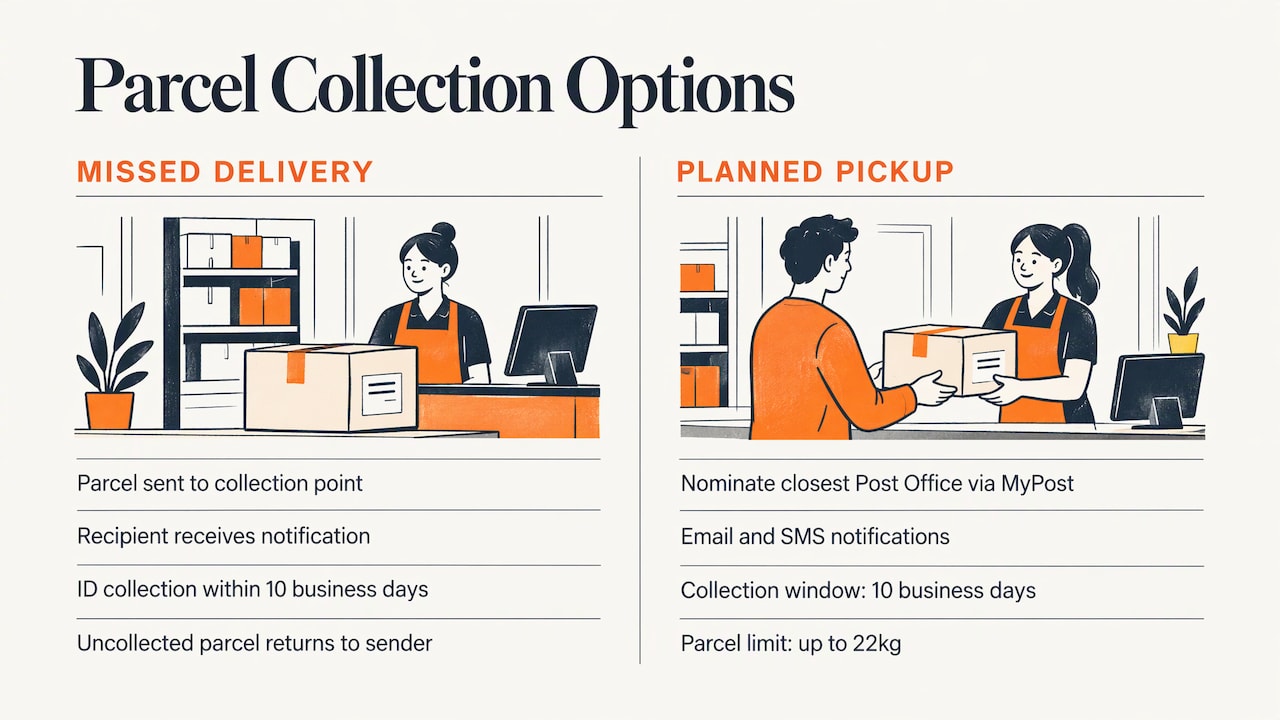
When no one is home to sign and there is no safe place to leave the parcel, it goes to a collection point and the recipient is notified. Under the General Terms and Conditions (July 2026), the recipient has 10 business days to collect it with ID before it is returned to the sender. For a remote recipient who lives hours from town, that window is worth flagging when you send.
Recipients can also choose a pickup point in advance. A free MyPost account lets you nominate the closest Post Office as the delivery address, with email and SMS notifications and a 10 business day collection window. Parcels up to 22kg and 105cm in one dimension are accepted. For people on roadside routes, this is often the most reliable plan.
How long does rural delivery take?
Plan on more time than a metro-to-metro send. Published guidance gives these ranges:
| Route or service | Typical timeframe | Source |
|---|---|---|
| Parcel Post, same state | 2 to 4 business days | Delivery speeds and coverage |
| Parcel Post, interstate | 3 to 6 business days | Delivery speeds and coverage |
| Express Post, same state | 1 to 2+ business days | Delivery speeds and coverage |
| Express Post, interstate | 1 to 3+ business days | Delivery speeds and coverage |
| Capital city to country location | Up to 4 business days | Domestic parcels guide |
| Between country locations, same state | Up to 5 business days | Domestic parcels guide |
The domestic parcels guide is dated October 2019, so treat its figures as a long-standing guide rather than a promise, and check the live quote for your route. The same guidance for merchants adds that regional and rural locations may take longer than the standard windows.
For sellers, the practical lesson is to set delivery expectations by postcode. A buyer in a country town who is told “2 days” and waits 5 is a refund request waiting to happen.
What affects the cost
Several things move the price of a rural or remote parcel:
- Size and weight. Satchels and small parcels are the cheapest category. Heavier parcels are charged by weight or cubic weight, which is the space a parcel takes up, and by destination.
- Distance and destination. A country or remote delivery point is further from the main network than a suburban one.
- Service level. Express is faster and costs more than standard.
- Pickup method. Door pickup, drop-off at a depot or a Post Office counter each price differently.
- Extras. Cover for loss or damage, and any fee if a delivery has to be repeated.
For a sense of scale, the national postal operator’s prepaid satchel prices for parcels up to 5kg on the Parcel Post page run from $10.55 (extra small) to $24.95 (extra large). Larger parcels from 5kg up to 22kg are priced by weight or cubic weight and destination. Published prices change, so use them as a ballpark and rely on a live quote for your actual job.
There are also special rural schemes. Reduced rates exist for medical and educational supplies sent to eligible remote postcodes, limited to parcels of 5kg or under, and some items such as dietary supplements, vitamins and veterinary supplies are excluded. A separate Local Country service applies only to Parcel Post parcels lodged over the counter at the Post Office that delivers them, in designated country postcodes, according to the domestic parcels guide.
If your goal is the lowest total, our guides on the cheapest way to send a parcel in Australia and cheapest parcel postage walk through the levers in more detail.
How to send a parcel to a rural or remote address
Here is the routine, step by step, with where each one tends to go wrong.
1. Get the address exactly right
Senders must supply a correct postal address that follows the national addressing guidelines. An item can be refused if the address is illegible or marked in a way that could delay or misdirect delivery, as the General Terms and Conditions set out. Rural addresses go wrong when the rural road number is missing, the property name replaces the number, or the postcode belongs to the nearest town rather than the delivery area. Ask the recipient to read their address from a recent delivery or bill. Our address book on the dashboard lets you save a confirmed address once and reuse it.
2. Weigh and measure the parcel
A quote based on a guess is the most common reason a final price differs from the first one. Measure length, width and height, and weigh the parcel packed. Frequent senders can save common parcel sizes in the dashboard so every booking starts with the right dimensions.
3. Compare quotes for the real route
Enter pickup and delivery addresses on Sendaparcel and you see real-time quotes from multiple carriers with a transparent price breakdown. That shows which options serve your recipient’s postcode and what each costs, with no platform booking fee added on top. Insurance is included, so you are not hunting for an add-on at checkout. For a wider look at options, see our courier comparison for Australia.
4. Choose speed and pickup
If the recipient is a long way out, a faster service shortens the wait but cannot change the delivery point. For urgent local jobs in a regional centre, check same-day courier options. If you cannot get to a depot, doorstep pickup saves the trip.
5. Pack for a longer journey
Rural routes involve more handling and more kilometres. Use a sturdy carton or satchel, fill the voids, and seal every seam. Put the delivery address and a return address on the outside and inside the parcel.
6. Tell the recipient what is coming
Share the tracking details and the likely delivery point. If it is a roadside route, let them know a signature item will be carded and where they will collect it. Tracking is part of the dashboard, so you can follow progress and pass on updates.
If you want the basics of lodging a parcel from scratch, our step-by-step guide to posting a parcel covers it.
PO Boxes and the most remote addresses
Some properties cannot be reached by a regular delivery run. Under its community service obligations, the national operator must provide a letter service reasonably accessible to all Australians. Where it cannot deliver directly to a property, mail can be collected from the nearest Post Office, a PO Box (possibly at a reduced rate) or the nearest delivery point on an existing mail run, per the Mail delivery policy. That is the letter service, so for parcels confirm the delivery point with the recipient.
Parcels to PO Boxes and remote locations have their own constraints, which we cover in our guide to PO Box and remote parcel delivery.
If a parcel goes missing or cannot be delivered
Undeliverable items found in the mail are returned to the sender where possible. If a parcel has not arrived, a non-delivery enquiry is accepted when you can describe the parcel and give lodgement details, enough time has passed, you can show reasonable evidence of posting, and the enquiry is made within six months of lodgement, per the domestic parcels guide. Keep your receipt and booking confirmation. Included insurance on a Sendaparcel booking is designed to give you cover from the start, and redelivery fee clarity means you see what a repeat attempt involves before you commit.
Shipping regional orders as a seller or frequent sender
Sellers know the problem: a country customer orders on Friday, and shipping costs and timing are unpredictable. A few habits help:
- Show delivery estimates by postcode so buyers know a regional order takes longer.
- Connect your store. Our integrations with Shopify, WooCommerce, eBay and Wix pull orders in so you are not retyping addresses.
- Upload in bulk. An Excel upload lets you book many shipments at once.
- Use your own courier accounts. Our bring-your-own-account option lets you keep rates you already hold and still manage everything in one dashboard.
- Earn rewards. Regular shipments earn rewards on Sendaparcel.
If you ship a lot between cities as well, cheap interstate couriers and overnight options and next day parcel delivery explain what to expect on the main corridors.
Book your rural parcel with clear pricing
With Sendaparcel you compare real-time courier quotes for parcels and satchels in one place, with same-day options, insurance included, transparent price breakdowns and no platform booking fees. Enter your pickup and delivery details on our home page to see what is available for your route, or explore courier services first.

For shorter local runs, our local courier comparison shows nearby options.
Our perspective
Rural delivery is where unclear pricing hurts most. Distances are longer, delivery points are less predictable, and a sender who guesses ends up surprised by the final bill or the wait.
That is why we put the price breakdown in front of you before you book. You compare carriers for your exact route, see what is included, and pay no platform booking fee. Insurance is included by default, so a long trip to a remote address does not leave you exposed.
We also think regular senders should be rewarded. If you ship every week to regional customers, your bookings add up, and so should the benefits. Between address books, saved parcel sizes, bulk uploads and store integrations, the repeat work shrinks and the shipping gets simpler.
Aeros
FAQ
Do couriers deliver to rural areas in Australia?
Yes. Services with Australia-wide coverage exist, including Parcel Post and Express Post. Delivery to a country address may take longer than to a capital city and may end at a letterbox cluster or Post Office rather than the door. A live quote for your route shows what is available.
How long does a rural parcel take?
Published guidance gives up to 4 business days from a capital city to a country location and up to 5 days between country locations in the same state. Parcel Post interstate is generally 3 to 6 business days. Regional and rural locations can take longer than the standard windows.
What should I put on the address for a remote property?
Use the full postal address exactly as the recipient receives mail, with the rural road number, locality, state and postcode, and make sure it is legible. A missing or unclear address can lead to an item being refused or delayed. Add a phone number so the carrier can reach the recipient.
What if the recipient is not home?
If nobody can sign and there is no safe place to leave the parcel, it goes to a collection point and the recipient is notified. They have 10 business days to collect it with ID before it is returned to the sender. Telling them in advance avoids a missed window.
Do I pay a platform fee on Sendaparcel?
No. We charge no platform booking fees. You pay the courier charge shown in your quote at checkout, with a clear price breakdown, and insurance is included.
Sources
- Parcel Post | Australia Post
- Delivery speeds and coverage | Australia Post
- Australia Post Statement of Corporate Intent 2025/26
- Dragonfly, iMile compete for city parcels as rural areas left out | The Canberra Times
- Point of Delivery Requirements | Australia Post
- General Terms and Conditions (July 2026) | Australia Post
- Parcel Collect | Australia Post
- Domestic parcels guide | Australia Post
- Helping you send the right delivery message | Australia Post
- Medical and educational deliveries | Australia Post
- Mail delivery policy | Australia Post