

Express parcels within Australia typically arrive in 1 to 3 business days, with next business day as the target on eligible express-network routes and same-day delivery only on supported same-state routes. Those figures are route-specific estimates counted in business days, not in hours, so the number you see at checkout depends on where the parcel starts and where it's going.
Demand for that speed has exploded. An ACCC-commissioned productivity analysis found the quantity of Australia Post express services was 13 times higher in 2023 than in 1992, with express parcel volumes growing by an average of 11.0% per year from 2015 to 2023 (Quantonomics report on Australia Post's productivity). More parcels are moving fast than ever before.
Most confusion about timing comes from one mistake: reading a transit estimate as total time from checkout to doorstep. The courier controls only the middle of that clock. Packing, labelling, pickup windows and cut-offs sit on either side, and they're frequently the slower half.
Table of Contents
- Typical Express Shipping Times in Australia
- Is Express Worth the Premium Over Standard
- How Your Postcodes Change the Express Estimate
- Where the Delivery Clock Starts Before the Courier Moves
- Why Express Estimates Are Not Guarantees
- Confirm the Estimate Before You Book
Typical Express Shipping Times in Australia
Book express on a Monday morning in Sydney for a Melbourne address, and the parcel usually lands on Tuesday. Book the same lane from a regional town, and Wednesday is more realistic. Both are "express." The difference is the lane, which is why the honest answer to how long express shipping takes is always a range tied to postcodes rather than a single number.
The benchmark senders plan around is 1 to 3 business days nationwide, with next business day as the target where both postcodes sit inside the express network. The Australia Post domestic parcels delivery estimator breaks that down further, at roughly 1 to 2+ business days for same-state deliveries and 1 to 3+ business days for interstate deliveries. Most courier quotes you see are built on those lanes.
Here's how the tiers sit next to each other.
| Service or route | Typical transit | Clock counted in | Main factor that extends it |
|---|---|---|---|
| Same-day, supported same-state routes | Same business day, indicative metropolitan guide | Day of pickup | Route, collection availability and not available interstate |
| Express Post, eligible express-network routes | Next business day (service target) | Business days | Both postcodes inside the network and booking before cut-off |
| Express, same state | 1 to 2+ business days | Business days | Remote postcodes, weekends and public holidays |
| Express, interstate | 1 to 3+ business days | Business days | Regional transport legs and line-haul frequency |
| Standard, same state (baseline) | 3 to 4 business days | Business days after posting | Lodgement timing and public holidays |
| Standard, interstate (baseline) | 5 to 7 business days | Business days after posting | Distance, regional legs and public holidays |
Two things in this table deserve a closer read, because they cause most of the confusion senders run into.
What the plus sign is telling you
The "+" in 1 to 2+ and 1 to 3+ is doing real work. It's the carrier saying the estimate holds for the standard lane and can run longer for remote destinations, non-metro routes, weekend-affected movement, public holidays, late lodgement or a missed collection cut-off. Read it as a target with a known tail. The figure without the plus is what the lane achieves when everything lines up; the plus is the carrier reserving room for everything that often doesn't.
Why business days, not hours
Most networks don't move parcels on Sundays, and a parcel lodged after the daily cut-off usually enters the system the next business day. Counting in hours makes a Friday afternoon booking look like a 48-hour delivery when it's really a Tuesday arrival. Count in business days and the arithmetic matches reality: lodge before the cut-off on Monday, and a next-business-day lane delivers Tuesday; miss it by ten minutes, and Tuesday becomes the day it starts moving.
A test you can run in five minutes
The useful answer starts with your own postcodes. Put your pickup and delivery postcodes into a quote, read the estimated date shown for express, then compare it with the matching row above. If the quoted estimate is more than a day slower than the row suggests, ask why before you pay, because the gap usually traces back to a regional leg, a remote destination or a cut-off you've already missed.
One more timing factor sits outside the courier's hands entirely. If you're sending apparel or printed goods, production and packing time can matter as much as the freight tier. The Raccoon Transfers overnight shirt guide shows how much of an overnight shirt order is production time rather than transport, and the same arithmetic applies to any parcel that isn't packed and ready when the collection window opens.
Is Express Worth the Premium Over Standard
Standard post is the bus route that stops everywhere. Express is the direct train between major stations on its line. Both reach the destination. One does it with far fewer stops, and you pay for the stops it skips.
The baseline is well documented. The ACCC's 2024 assessment of Australia Post's price notification records standard parcel delivery of about 3 to 4 business days within the same state and about 5 to 7 business days interstate, measured after the day of posting. Express is chosen when that timeframe is too slow. The question is whether the gap between the two is big enough to matter for your deadline.

Two worked examples make the rule obvious.
A parcel crossing one city, needed in two days. Standard same-state sits at 3 to 4 business days, so standard misses the deadline outright. Express at 1 to 2 business days clears it. The premium buys the whole outcome.
A parcel heading interstate with a week of leeway. Standard interstate at 5 to 7 business days fits comfortably. Express saves a couple of days you didn't need. The premium buys nothing.
Practical rule: if the express estimate for your actual route saves at least two business days against the standard baseline, the premium usually pays for itself. If it saves one day or less, check whether standard still meets the deadline before spending.
Apply the rule to the estimate for your real postcodes, not your state, and remember same-day is a separate service category that isn't included just because you booked express. If you want to see how the services stack up on cost against speed, compare courier services by route before committing.
How Your Postcodes Change the Express Estimate
Express speed is a route outcome. Two parcels booked on the same day, in the same box, on the same service can land a day apart because one destination sits on a dense line-haul lane and the other doesn't. Courier availability varies by route and shipment, which is why the postcode pair matters more than the state name.

Three scenes show the spread.
Suburb to suburb, same city. Both ends sit on the same metro sorting and delivery network. This is the lane the next-business-day target was designed for, and it's where the headline numbers come from.
City to a regional town, same state. A line-haul leg gets added between the metro depot and the regional depot. If that leg runs daily, you might lose a day. If it runs three times a week, you lose whatever the timetable says, and no express sticker changes it.
Crossing state lines to a distant northern town. Multiple line-haul legs, thinner depot coverage and often a road-dependent final stretch. The transit time is still measured in business days, but the count is longer and the tail behind the plus sign is longer still.
Expectations aren't uniform across the country
Australia Post reporting cited in IMARC's analysis of the same-day delivery market shows 26% of Australian consumers expect same-day or next-day delivery when an order is time-sensitive, while broader expectations usually sit between two and five days. That gap isn't just metro versus rural. Cut-off time, pickup location, line-haul frequency, road or air dependence, depot coverage and the receiving postcode each move the result.
Same-day delivery is available only on supported routes within the same state, never interstate, and same-day timeframes from Direct Couriers are indicative metropolitan service guides subject to account terms, route and collection availability. Don't assume a same-day option exists on your lane until the quote shows it.
The exceptions that outrank the service tier
Remote-area surcharges, missed delivery attempts, weather events, ferry access and public holidays can each cost more time than the difference between standard and express. A parcel that misses a delivery attempt goes back to the depot, and the redelivery can wipe out every hour the express tier saved. If you're shipping into Brisbane and want to see how those lanes behave, next-day delivery to Brisbane breaks down the local timing.
Where the Delivery Clock Starts Before the Courier Moves
The wait a buyer feels is a sum: order processing, the collection window, then express transit. The timer starts when the order is confirmed, not when the van pulls away. Pay for a one-day transit and you still hand the customer every day spent picking, packing and waiting for a driver.
The calculation: order processing time + collection window + express transit time = the wait your customer actually experiences.
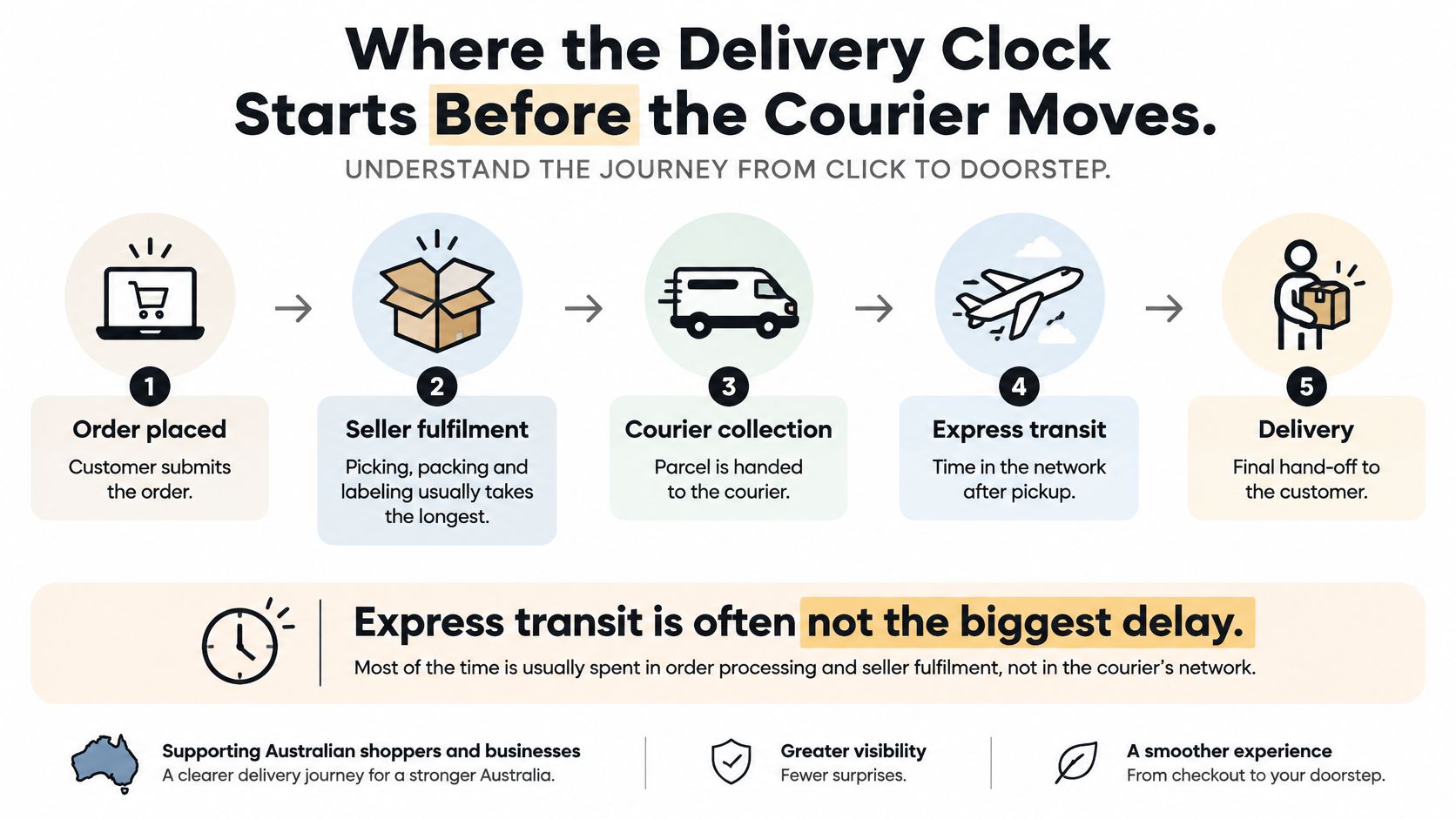
Australia Post data indicates most businesses take two days to fulfil an order and add about one extra day during peak periods, while shoppers are generally satisfied with delivery within 4.6 days (Australia Post quarterly ecommerce update, October 2025). Stack two fulfilment days in front of a one-day express leg and the premium transit is about a third of the total wait.
The six stages, named
- Order confirmed and picked. Stock is located, checked and pulled. For many businesses this is the two-day stage, and peak periods stretch it further.
- Packed and labelled. Parcels must be packed and labelled by the ready time for the confirmed collection date. Miss that ready time and the courier arrives with nothing to collect.
- Collected. On Sendaparcel the standard pickup window is 9–11 am, and the booking needs one hour's notice. A later request moves to the next working day at 9 am.
- Enters the network. The first scan has to land before the carrier's cut-off. After the cut-off, the parcel waits for the next departure.
- Transit. This is the stretch the express premium buys, counted in business days between the pickup and delivery postcodes.
- Delivery attempted. The driver hands the parcel over, or leaves a card and takes it back to the depot.
A worked example
An order lands on Thursday afternoon and the seller packs it on Monday. Collection is booked for Tuesday inside the 9–11 am window, and express transit is one business day. The parcel arrives Wednesday. The express service ran to plan. Two days of fulfilment before the pickup changed the calendar more than the line-haul did. That is why cut-off times for express post sit on the critical path: a late pack that also misses the cut-off costs another working day before the paid transit starts.
Label date and collection date
Personal senders and small retailers often run different pickup schedules, so the same express service can show a different arrival day for two parcels leaving the same suburb. Check that the dispatch date on your label matches the collection date you booked. Ship Restrict on shipping date compliance sets out what that shipping date is there to record.
A day lost before collection is a day taken out of the window the buyer was told to expect.
Why Express Estimates Are Not Guarantees
Next-day speed only shows up when both postcodes sit inside the express network and the parcel is accepted before that route's cut-off. Express Post between locations inside that network is targeted for next-day delivery. Broader domestic parcel timing varies by weight, size and destination. Network eligibility is a yes-or-no gate. A nationwide express quote also has to cover regional legs, line-haul schedules, sorting capacity and last-mile distance.
An express estimate tells you the likely window, not the moment the parcel will arrive.
A delivery estimate is not a guaranteed arrival time. Estimates are guides, and the courier confirms the service conditions. An estimate works like a station timetable: it shows the planned run, while weather, a full depot or a truck that leaves only once a day can still move the parcel to a later business day.
If a parcel runs late
Check the tracking history first. Note the last scan and whether the parcel is still in yesterday's transit status. On Sendaparcel, overdue pickups and parcels that stay in the same transit status too long are flagged. The threshold is two days by default and can be set by the user. Slow movement and a stopped scan are different problems.
Confirm what you booked. Check the collection date and the ready time. The parcel must be packed and labelled by that ready time for the confirmed collection date. A box still on your bench was never inside the express count, so the quoted days were not running.
Quote the shipment reference when you contact customer service. Ask as soon as you can. A change or cancellation request is not confirmed until it is accepted. Pickup rebooking can be requested with a shipment selection or tracking number.
Where the quoted days begin
See whether the transit count starts at booking, at pickup or at the first carrier scan. Those business days usually describe movement after the courier has the parcel, so packing and the wait for collection sit outside the quote. Booking today does nothing for a box that misses the cut-off. Parcel size and a correct address decide whether collection happens in the cycle you planned.
A route can run past its typical estimate without the courier breaking its terms. Late is not automatically a failed delivery.
Confirm the Estimate Before You Book
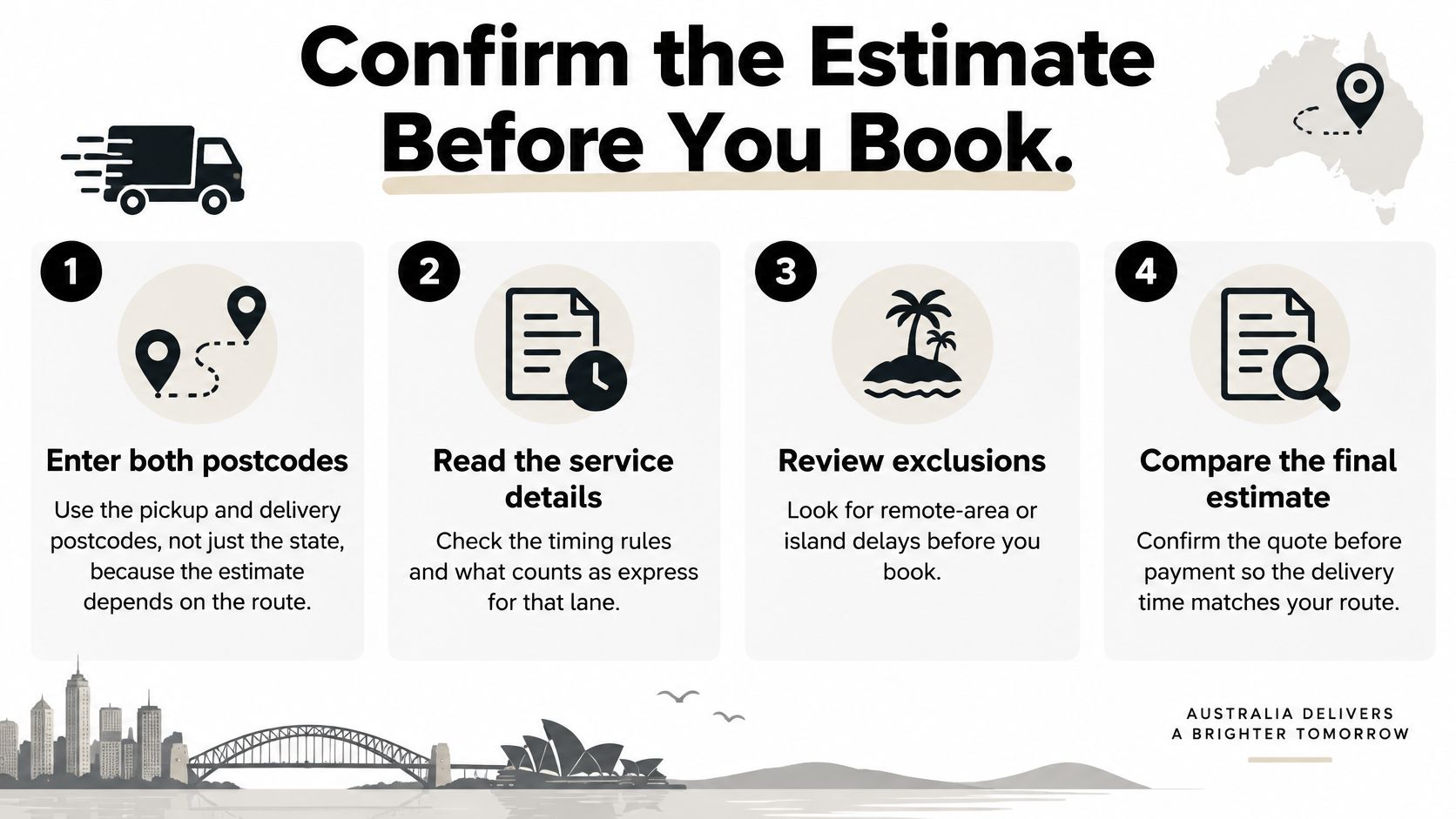
A quoted express window works like a train timetable. The time between stations is only part of the trip. You still have to reach the platform with the parcel ready. On a shipment, that platform is the ready time: packed, labelled, and available for the driver. The hours before the courier moves often eat more of your deadline than the express transit itself. Checking the estimate before you pay shows whether that timetable even fits your two postcodes.
Seven checks, each stopping a different surprise:
- Enter both postcodes. Use the pickup and delivery postcodes, not just the state. The estimate comes from that route, not from a national average.
- Read the estimated delivery date for each service. Compare it with the baseline for the same route, not with a headline figure you remember from another booking.
- Check whether same-day appears for your route. Same-day is offered only on supported routes within the same state, not interstate. Remote postcodes and ferry access can lengthen transit, so read the estimate for your lane before you pay.
- Confirm the ready time and collection date. The parcel must be packed and labelled by the ready time for the confirmed collection date. Miss that window and collection moves to the next working day.
- Work backwards from the deadline. Subtract the transit business days first, then the time you need to pack and label. The date left is your real dispatch-by date. Express transit is often the smaller slice of that sum.
- Add one buffer business day. Weekends, public holidays and remote postcodes sit outside a plain weekday count. One extra business day costs nothing next to a missed deadline.
- Note the courier and service you selected. Delivery estimates are guides, and the courier confirms the service conditions. Record the service you booked in case you need to follow it up.
When the date doesn't work
You have three levers, and only one of them costs more money. Choose a faster service if your lane offers one. Pack tonight and move the collection date earlier. That is free, and it often recovers more time than paying for a quicker service. Or keep the standard estimate and reset the expectation with whoever is waiting. Booking express does not make the date bend.
Sendaparcel shows live delivery estimates next to each quote, so you can compare express and standard pricing for your actual pickup and delivery postcodes before you commit. Parcels need to be packed and labelled by the ready time for the confirmed collection date, and same-day options appear only on supported routes within the same state. Visit Sendaparcel to run a quote for your next parcel and see the estimate for your lane.