
Four variables help explain why parcel quotes differ: packed external dimensions, cubic weight, destination postcode, and the pricing date on the rate card. Before comparing them, though, check whether your parcel qualifies for flat-rate pricing. That determines which pricing rules apply.
Understanding parcel postage rates in Australia starts with this dividing line. For eligible national flat-rate parcels, parcel weight sets the price within the applicable packaging rules. Other consignments are assessed using their packed measurements and route. A box therefore works like a pricing input, not just protection for its contents.
Price updates also need to match the service you are buying. The Australia Post pricing update concerns letter pricing, so its increases should not be applied to parcel quotes.
Compare the same shipment, not just the headline price.
Use the finished parcel's weight and external dimensions, the same destination postcode, and rates applicable on the same date. Separating flat-rate parcels from assessed parcels makes it easier to recognise a pricing threshold and compare delivery services on equal terms before paying.
Table of Contents
- Flat Rates and the Weight Bands Where They Stop
- Why Cubic Weight Can Beat Scale Weight
- Choosing Between Parcel Post and Express Post
- Remote Postcodes and Why Estimates Can Understate Costs
- How to Compare Parcel Quotes Like for Like
- Why a Quote Changes After Booking
- Book the Cheapest Rate That Meets Your Timing
Flat Rates and the Weight Bands Where They Stop
A flat rate works like a toll booth: once your parcel qualifies, the route matters less than the class it enters. If your parcel sits inside eligible Australia Post packaging and stays within the flat-rate weight limits, destination stops driving the price. Under the Australia Post Parcel Post schedule effective 1 July 2026, postage-only flat rates run across five fixed weight bands that apply anywhere within Australia.
| Weight band | Postage only | Note |
|---|---|---|
| Up to 250 g | $10.20 | Lightest eligible band |
| Over 250 g to 500 g | $11.70 | Band ends at 500 g |
| Over 500 g to 1 kg | $16.00 | Price steps up at 500 g |
| Over 1 kg to 3 kg | $20.25 | Mid-weight parcels |
| Over 3 kg to 5 kg | $24.45 | Top of the flat-rate range |
Notice how sharply the cost jumps at each band edge. A parcel weighing 500 g pays $11.70, while a parcel weighing 510 g steps up to $16.00, an extra $4.30 triggered by ten grams of tape, bubble wrap or cardboard. That cliff effect is why weighing an unwrapped item on kitchen scales gives misleading estimates.
Postage Versus Prepaid Packaging
Many senders confuse postage-only rates with the price printed on a counter satchel. Postage and packaging are priced separately, so prepaid satchels cost more because they bundle the satchel with the delivery fee. Under the Australia Post Parcel Post schedule, prepaid Parcel Post satchels cost $10.55 for extra small, $12.05 for small, $16.40 for medium, $20.70 for large, and $24.95 for extra large.
If you supply your own non-eligible cardboard carton or poly mailer instead of qualifying Australia Post packaging, the national flat-rate schedule no longer protects you. Any parcel in non-eligible packaging is assessed on its actual weight or cubic-weight equivalent, whichever is greater, even if it weighs well under five kilograms.
Packing reality check: Always weigh the finished parcel after adding cushioning, inserts, tape and the printed label. A few grams of packing material near a band boundary can bump a consignment into the next price tier.
Where the Flat Rate Ends
The national flat-rate ceiling stops cleanly at 5 kg. According to the Australia Post Parcel Post Guide, domestic parcels heavier than 5 kg, up to the domestic maximum of 22 kg, leave the flat-rate table behind and move into assessed pricing based on the greater of actual or cubic weight plus the shipment's destination.
Size ceilings sit alongside that weight limit. Under the Australia Post Parcel Post schedule, standard domestic parcels have a maximum length of 105 cm and a maximum cubic volume of 0.25 m³. Crossing any single boundary pushes the shipment out of simple flat-rate pricing.
Take a practical break-point scenario. Say an online homewares seller packs a ceramic dinner set that weighs 4.9 kg inside an eligible Australia Post flat-rate box. That consignment can sit inside the top national flat weight band regardless of whether it travels across town or interstate. Add a heavier gift box that nudges the parcel to 5.2 kg, or move the same items into a bulkier non-eligible carton, and the shipment shifts into destination-sensitive pricing where postcode and dimensions dictate the bill.
Four Checks Before You Assume a Flat Rate
Before you quote a customer or budget for a personal delivery using the flat-rate table, run through four quick checks in order:
- Weigh the packed parcel. Place the sealed, padded package on accurate scales and record the total grams or kilograms, never the bare product weight from a supplier sheet.
- Confirm packaging eligibility. Check that the satchel or box is an eligible Australia Post flat-rate product rather than a plain recycled carton or third-party mailer.
- Measure the longest side and volume. Use a tape measure on the outside edges to confirm the longest dimension stays at or below 105 cm and total volume sits within 0.25 m³.
- Verify every threshold together. Make sure the packed weight sits at or under 5 kg and the packaging qualifies before treating a flat-rate figure as your final postage price, keeping in mind that carrier-assessed measurements at lodgement can still revise the charge.
Why Cubic Weight Can Beat Scale Weight
Think about how an airline sells a cabin seat. You pay for the space that seat occupies on the plane whether you bring a light backpack or a full carry-on bag. Parcel carriers run their vans and linehaul trucks on the exact same economics, because a delivery vehicle can run out of floor space long before it hits its axle weight limit.
Before comparing couriers, take a close look at how a standard parcel is weighed at pickup or lodgement.
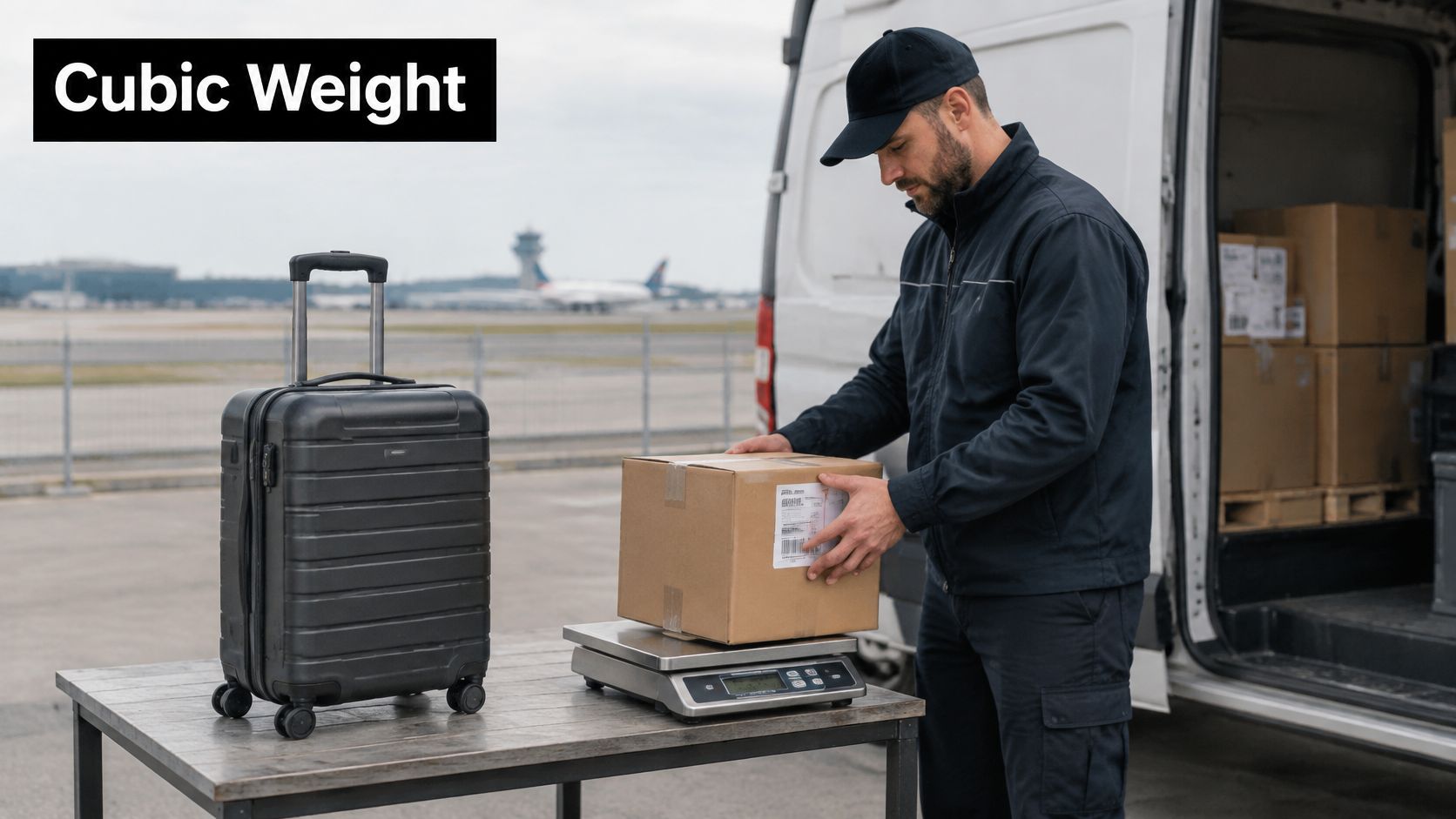
A lightweight but bulky carton shows how fast space overrides kilograms. Say you pack a winter puffer jacket and a couple of pillows into a sturdy cardboard box measuring 0.50 m × 0.30 m × 0.40 m. Even if the parcel barely moves the needle on bathroom scales, that carton takes up 0.06 m³ of van space and carries a cubic weight of 15 kg, which means it can be priced as a 15 kg consignment.
Under the Australia Post postage calculation guide, domestic postage for applicable parcels is calculated using the greater of physical weight and cubic weight. To find cubic weight, multiply the parcel's external length, width, and height in metres, then multiply that cubic volume by a conversion factor of 250 kg/m³. If you want to test your own cartons before booking, you can walk through the maths step by step in our guide on how to calculate cubic weight.
Look at what happens when the exact same 3 kg of goods sits inside three different cardboard boxes. Nothing about the contents changes, yet every box produces a different chargeable weight.
| Box (L × W × H) | Actual weight | Cubic weight | Chargeable weight |
|---|---|---|---|
| 50 × 30 × 40 cm | 3 kg | 15 kg | 15 kg |
| 30 × 30 × 30 cm | 3 kg | 6.75 kg | 6.75 kg |
| 25 × 25 × 20 cm | 3 kg | 3.125 kg | 3.125 kg |
Even the smallest carton in that table (25 × 25 × 20 cm) works out to 3.125 kg on volume, nudging just past the 3 kg scale weight. Moving the same 3 kg order into a 50 × 30 × 40 cm box multiplies the chargeable weight five times over, purely because you paid to ship empty air.
Packing Choices That Lower Chargeable Weight
Seeing how carriers measure cartons in real time makes it much easier to spot wasted centimetres before you seal the tape.
You don't need specialist software to control dimensional charges. Four practical packing adjustments keep cubic weight close to actual weight:
- Measure external edges, not internal specs. Cardboard walls and bulging flaps add centimetres to every side, and carriers scan the widest external points of each parcel.
- Calculate every box separately. When an order uses multiple cartons, work out actual and cubic weight per box rather than adding everything into one rough guess.
- Test splitting instead of consolidating. Combining two odd-shaped items into one oversized master carton reduces handling, yet it often pushes total volume over a dimensional threshold where sending two snug boxes costs less.
- Trim void fill on low-density goods. Apparel, plush toys, cushions, and soft homewares compress safely inside tighter cartons or tough mailers, cutting dead air without risking damage.
Before you book any non-flat-rate shipment, compare two box sizes for the exact same item. Swapping a loose spare carton for a tighter fit routinely saves more money than switching carriers.
Choosing Between Parcel Post and Express Post
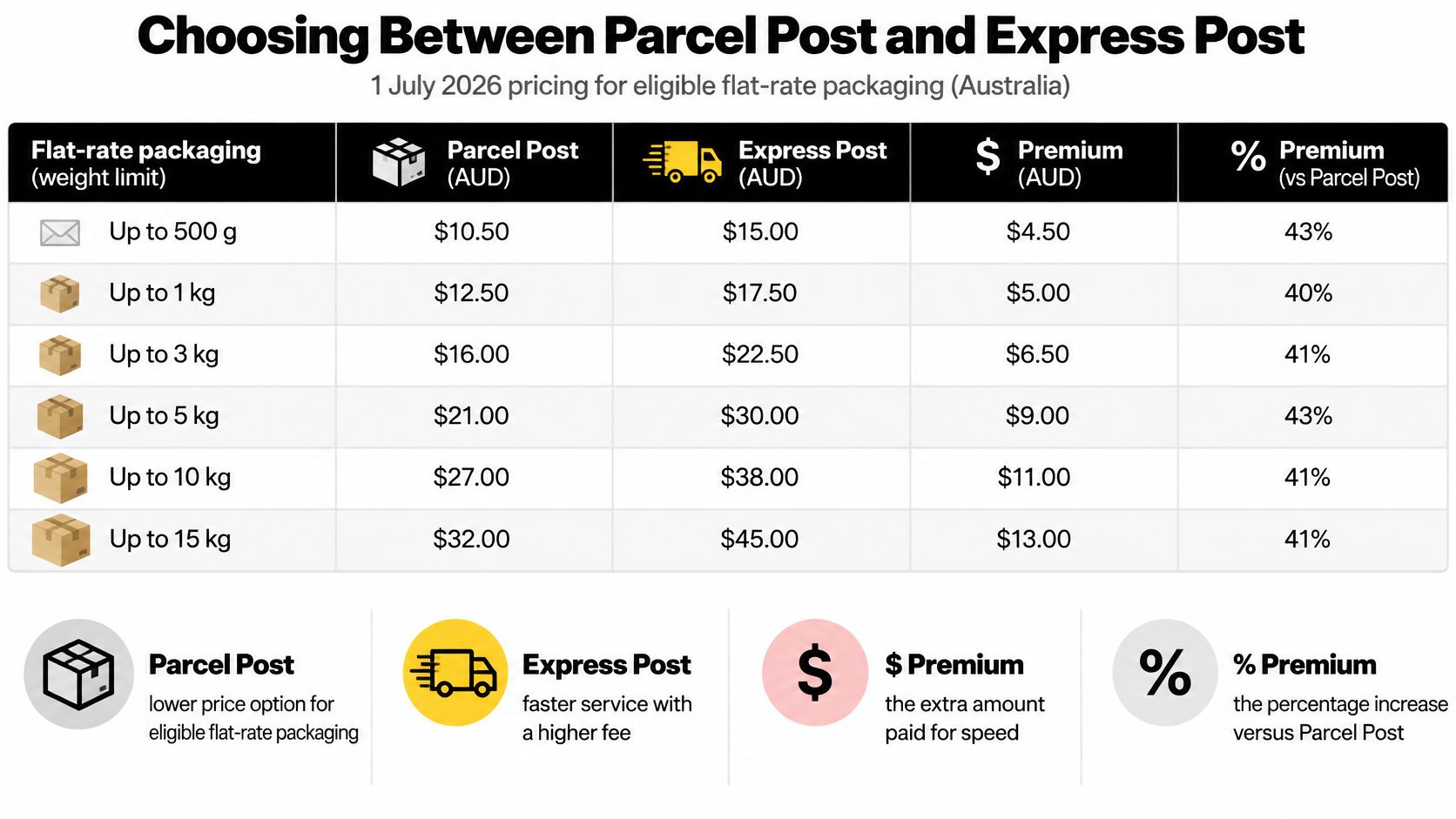
For eligible flat-rate packaging, the weight band sets the postage price, while your choice of Parcel Post or Express Post determines the premium for faster delivery. The Australia Post Express Post pricing schedule, effective 1 July 2026, lists the following postage-only comparison across all five weight bands.
| Weight band | Parcel Post | Express Post | Dollar premium | Percentage premium |
|---|---|---|---|---|
| Up to 250 g | $10.20 | $13.20 | $3.00 | 29.4% |
| Up to 500 g | $11.70 | $15.20 | $3.50 | 29.9% |
| Up to 1 kg | $16.00 | $20.00 | $4.00 | 25.0% |
| Up to 3 kg | $20.25 | $24.75 | $4.50 | 22.2% |
| Up to 5 kg | $24.45 | $32.95 | $8.50 | 34.8% |
Read the dollar premium as the extra amount you pay for the service upgrade. The percentage premium shows how large that addition is relative to Parcel Post. Those columns answer different questions: the dollar amount affects your shipping budget, while the percentage helps you judge the size of the upgrade against the standard price.
The gap grows in dollars as you move down the table, but the percentage doesn't rise steadily. Choose using your parcel's band rather than assuming Express always adds the same proportion.
When Express Post Pays Off
Start with the consequence of a delay. Paying for faster transit makes more sense when late arrival would disrupt an event, hold up work or disappoint a customer who selected Express.
- Hard calendar deadlines: Birthday gifts, wedding attire and event supplies have a clear arrival target. Compare the premium with the consequences of missing that target, then check whether the service suits the deadline.
- Time-sensitive paperwork or parts: Signed contracts, replacement keys and urgent equipment spares can leave someone unable to proceed. Faster handling may be worth more than the postage saving.
- High-urgency customer orders: When buyers select and pay for Express, your dispatch timing matters too. Check the Express Post cut-off time before lodging so a missed daily collection doesn't undermine the upgrade.
Express is a timing decision. Paying more doesn't remove the need to check the delivery estimate for the destination.
When Parcel Post Is Enough
Standard Parcel Post is a practical choice when earlier arrival brings little benefit. Making Express the default can reduce margins without improving the recipient's experience.
- Routine stock replenishment: Non-urgent household items, books and pantry refills can suit standard delivery when the recipient has allowed enough time.
- Low-margin online orders: If you absorb shipping costs, compare the upgrade with the profit left on the order. Even a modest premium can make that sale less worthwhile.
- Flexible delivery windows: When there is no fixed arrival deadline, keeping the postage saving is often the more useful trade.
Before paying, match the service to the deadline and check the premium for the correct weight band. For parcels outside eligible flat-rate packaging, use a quote based on packed dimensions, weight and postcodes, and compare prices from the same pricing date.
Remote Postcodes and Why Estimates Can Understate Costs
A remote postcode can change the price even when the parcel stays exactly the same. A headline national rate is a starting point, not confirmation that every address qualifies for the cheapest advertised service. For regional households and online retailers, that distinction can mean a higher checkout total or a shortfall absorbed by the sender.
Special remote-area concessions can add to the confusion. Australia Post lists a medical and educational remote-area parcel service at $10.95 for parcels up to 5 kg, restricted to eligible senders and defined remote postcodes in its Australia Post Sydney Parcel Post Guide. That price applies to qualifying medical and educational consignments, rather than ordinary personal parcels or retail orders.
For everyday freight, remote delivery can cost more because the destination is further from major transport hubs or requires additional road, barge or regional air connections. Depending on the carrier and service, fuel surcharges and extended-area fees may sit above the base freight price.
The postcode acts like a routing instruction: it helps determine which network can deliver the parcel and what additional handling the journey requires.
Consider identical boxes leaving the same metropolitan warehouse on the same afternoon. One goes to a nearby inner-city suburb; the other heads to a remote Outback or island address. Their scale weights and packed dimensions match, but the delivery zones and available services differ. Outside eligible flat-rate arrangements, weight alone does not explain the price. Packed dimensions, cubic weight, postcodes and the pricing date all matter.
For online sellers, fulfilment costs and direct-delivery costs also need separate treatment. The agentcentral FBA fee breakdown concerns Amazon fulfilment fees; direct domestic orders require their own destination-specific courier quote. Validate remote postcodes before setting a delivery charge customers will rely on.
Use this postcode check before committing to a regional or rural shipment:
- Verify the exact delivery postcode: Confirm the postcode and suburb spelling, rather than substituting a nearby regional town.
- Check remote or extended status: Establish whether the selected courier serves the address and applies an extended-area or rural surcharge.
- Account for island or PO Box rules: Check address eligibility and any access requirements using the guidance on parcel delivery to PO Boxes and remote Australia.
- Separate concessionary rates from retail rates: Confirm eligibility before applying a special remote-area price to a personal parcel or commercial order.
- Validate the full total before paying: Review freight, GST and applicable surcharges using the packed measurements.
Sendaparcel offers Australia-wide courier options for metro, regional and rural destinations, with coverage dependent on exact pickup and delivery postcodes. Estimated courier prices are in Australian dollars and exclude GST; applicable surcharges can affect the final charge.
How to Compare Parcel Quotes Like for Like
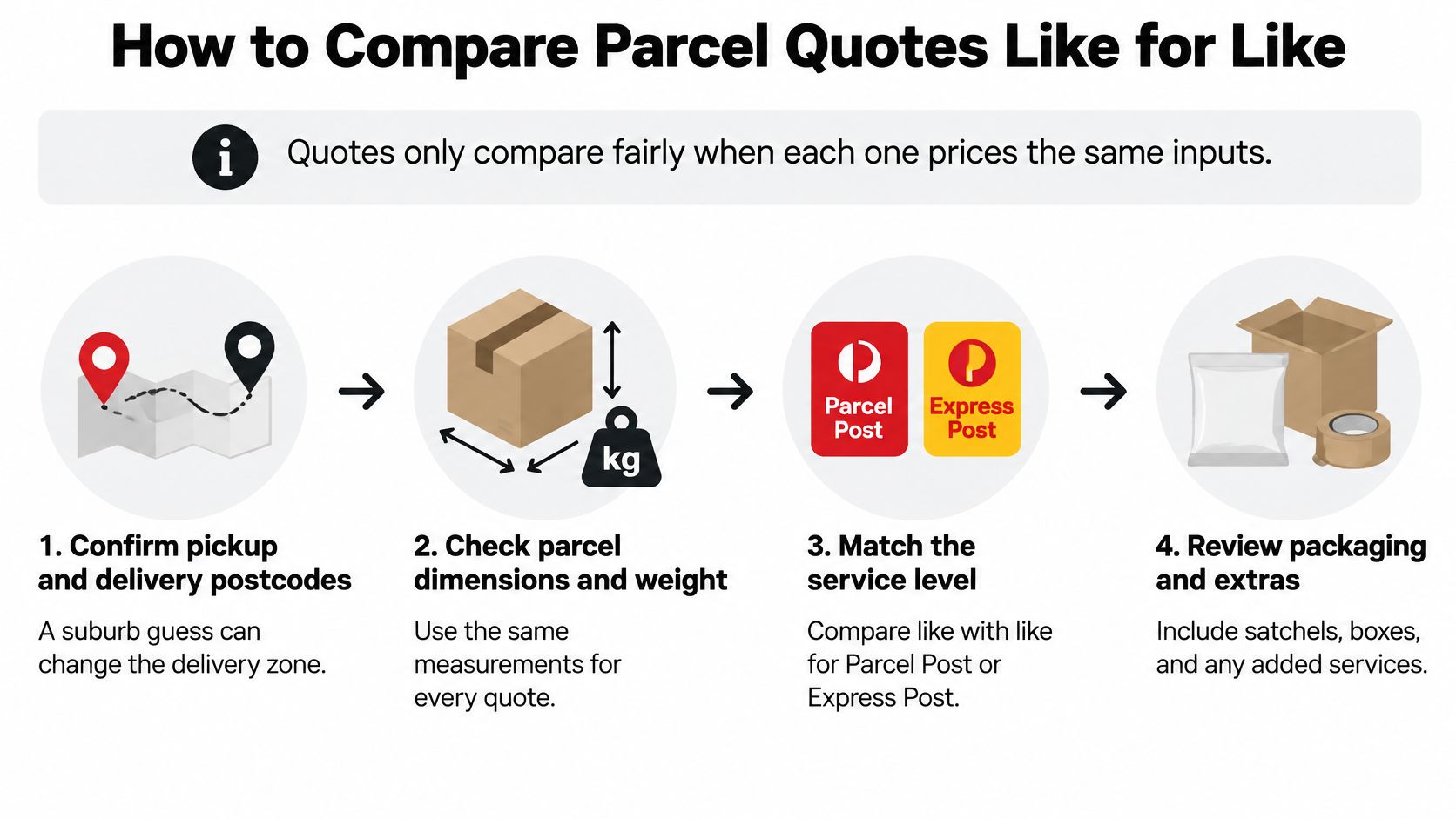
Comparing two shipping quotes only works when both carriers are pricing the exact same parcel under the exact same conditions. Feed one site an estimated weight without box dimensions and another site a measured carton with an Express speed tier, and you aren't comparing carriers at all, you're comparing mismatched inputs.
The visual workflow below maps the core inputs that keep every carrier quote aligned from start to finish.
Eight Steps for an Apples to Apples Quote Check
Follow these eight steps in sequence so every price on your screen reflects the true cost of moving your box:
- Confirm exact pickup and delivery postcodes. Entering a neighbouring suburb or guessing a regional postcode can shift the delivery zone and trigger unexpected area fees. Accurate postcodes ensure every carrier prices the exact route your parcel will travel.
- Weigh each packed box on accurate scales. Measure the complete carton with void fill, inner boxes, and packing tape already sealed inside. Loose product weights routinely miss the extra grams that push a parcel across a billing threshold.
- Measure external length, width, and height in centimetres. Run a tape measure along the widest outside points of each side and note the longest dimension. Carriers scan exterior dimensions through automated conveyor tunnels, so any bulging side counts toward the billed size.
- Work out chargeable weight before quoting. Convert your packed dimensions into cubic weight and take whichever figure is higher between cubic weight and actual scale weight. Doing this upfront stops a bulky, lightweight carton from producing an artificially cheap estimate.
- Check flat-rate packaging eligibility. Verify whether your parcel fits inside an eligible flat-rate satchel or box and stays under the flat-rate weight ceiling. If you're using a standard brown carton or oversized box, compare assessed courier rates directly rather than assuming a flat national rate applies.
- Enter every box separately and match service levels. Input each carton individually with identical weights and dimensions across every carrier, pairing standard road services against standard services and Express options against Express options. Mixing a multi-box order into one combined weight or comparing standard delivery to priority air distorts the price gap.
- Compare the landed total, not the headline rate. Add packaging costs, GST, fuel levies, and residential or remote surcharges before deciding which quote wins. A cheaper base freight figure often finishes more expensive once taxes and extras appear at checkout.
- Log the quote date, reference, and inputs. Save a screenshot or spreadsheet line showing the exact date, postcodes, dimensions, weight, and booking reference. Having those numbers on hand lets you spot rate-card updates or challenge revised invoices immediately.
If you run an online store and notify buyers when orders dispatch or update delivery expectations, pairing clean quoting habits with solid customer messaging practices such as these SMS compliance tips for merchants helps keep post-purchase alerts clear and compliant.
A shipping quote is never more accurate than the measurements and postcodes you type into the form. Spending two extra minutes with a tape measure and scales protects you from overpaying on booking day and from surprise adjustments afterwards.
Why a Quote Changes After Booking
It's common to hear the same frustrated question when an invoice jumps: "Why did my quote change even though the parcel weight stayed the same?" In nearly every case, the kilograms on the scale never shifted, yet one of the other inputs behind the price did.
A freight price depends on the information supplied and the service selected, so incorrect measurements, weight, addresses, or service details can result in a revised charge once a carrier processes the consignment. Automated depot scanners re-check dimensions and weight on the conveyor belt, billing teams verify whether a postcode sits in an extended delivery zone, and new rate schedules replace expired quotes once a pricing update takes effect.
| Symptom | Likely cause | Fix |
|---|---|---|
| Price rose after weigh-in | Measurements or weight were understated | Re-measure and rebook with accurate dimensions |
| Higher price for one address | Postcode is remote or extended | Confirm the postcode and service listing before paying |
| Total above the estimate | GST and surcharges added | Compare totals including GST and surcharges |
| Price differs from an older quote | Pricing update took effect | Check the date on every saved quote |
| Express costs more than expected | Faster service selected | Compare Parcel Post first unless timing requires Express |
| Unexpected charge after dispatch | Address changed after dispatch | Confirm any change before the parcel is dispatched |
Habits That Prevent Re-Pricing Surprises
Each row in that table points to a fix you can control before the parcel leaves your desk. Re-weighing and measuring with a rigid tape rather than eyeballing a carton removes the biggest source of post-lodgement adjustments. Checking whether a destination sits in a remote zone and reviewing totals with GST and surcharges included eliminates checkout sticker shock.
Pay close attention to address accuracy before the driver collects the parcel. Address changes after dispatch need confirmation, may attract charges, and may not be possible once a parcel is on its final delivery run. Likewise, whenever an annual carrier price update takes effect, older saved quotes won't match current booking screens, so refresh saved rate spreadsheets whenever carriers announce scheduled increases.
Audit habit: Keep a simple dispatch log with the quote date, pickup and delivery postcodes, packed dimensions, weight, and selected service level. If a revised charge ever arrives, check it line by line against your saved inputs before accepting the difference.
Store owners who want hands-off fulfilment without constant billing headaches often build these measurement and address checks directly into their packing workflow, much like the operational checklists covered in these supply chain tips for passive store owners. Catching an extra two centimetres or a mistyped postcode on your packing bench takes seconds; sorting out a re-billed invoice after transit takes far longer.
Book the Cheapest Rate That Meets Your Timing
Choosing the right Australian parcel service doesn't require memorising dozens of rate cards. Four plain decision rules cover almost every domestic shipment:
- Use flat-rate Parcel Post as your baseline whenever your packed item fits eligible Australia Post packaging and stays within the flat-rate weight ceiling.
- Expect assessed pricing the moment a box is heavier, bulkier, or packed in non-eligible cardboard, and compare carriers using whichever is greater between actual weight and cubic weight.
- Verify remote or regional postcodes before paying so extended-area fees or access limits never catch you after checkout.
- Pay for Express Post only when the dollar premium is worth the earlier arrival for that specific parcel's deadline.
What to Have Ready Before You Quote
Keep five details beside your keyboard so you can run the exact same shipment across every available carrier in one pass:
- Pickup postcode and suburb where the parcel will be collected or lodged.
- Delivery postcode and suburb verified against the recipient's confirmed address.
- Packed weight for each individual box, weighed after sealing.
- External length, width, and height measured in centimetres on the widest edges.
- Required delivery timing so you compare standard services against standard services and faster options against faster options.
Once those inputs are ready, compare live prices on the full total rather than stopping at an initial estimate. Estimated courier prices exclude GST, and surcharges may apply, so reviewing the complete breakdown before checkout matters. With Sendaparcel, the platform is free to use with no monthly platform fee; customers pay the freight, GST, and any applicable delivery charges shown for their shipment, while live prices can be compared for the route, parcel size, weight, and service needed so the full total can be reviewed before paying and booking.
Keep in mind that published delivery timeframes remain estimates rather than guarantees, and the selected courier confirms its own service conditions once booked. Pair accurate measurements with a like-for-like quote check, and you'll consistently book the lowest rate that still arrives on time.
Compare live Australian courier quotes side by side using your exact pickup postcode, delivery postcode, packed weight, and external carton dimensions before you pay a cent. With no monthly platform fees and clear visibility over freight, GST, and applicable delivery charges for local and interstate routes, you can choose the service that fits your parcel and your deadline in minutes. Visit Sendaparcel to compare live rates and book your next domestic shipment with confidence.