
Delivery cost matters more than speed for many shoppers: in 2024, 48% of surveyed Australian consumers identified delivery cost as the most important factor when shopping online, while 44% were unwilling to pay for premium delivery, according to the Auctane and Retail Economics report reported by Retailbiz. That's the right starting point for same-day clothing delivery in Melbourne: not how fast a courier can move, but whether paying for speed solves your actual problem.
An outfit for tonight, damaged workwear and a routine wardrobe restock need different delivery decisions. Check the route, establish the collection date, then price the possibility of a return before committing.
Table of Contents
- Which Melbourne Routes Qualify for Same Day Clothing Delivery
- When Same Day Clothing Delivery Is Worth the Premium
- Cutoffs and Collection Windows That Decide the Same Day Result
- How to Pack Clothing So It Is Ready for Same Day Collection
- Booking Details and Labels Before Collection
- Fit, Returns and Missed Deliveries After Dispatch
Which Melbourne Routes Qualify for Same Day Clothing Delivery
Same-day clothing delivery in Melbourne works only on supported routes within the same state. Both the pickup and delivery postcodes must be in Victoria. Metro Melbourne to metro Melbourne is the most likely match, but a Melbourne address alone doesn't establish eligibility.
We offer local and interstate courier delivery, but interstate parcels can't use our same-day services. A garment leaving Melbourne for Sydney or Brisbane needs a comparison of next-day or standard options instead.
Check the actual dispatch location
Start with where the garment is physically held, not the retailer's head office or the location shown in its branding. A Melbourne shop might fulfil online orders from another warehouse, and stock displayed online isn't necessarily ready for local collection.
Australia Post's 2026 eCommerce Report found that 26% of consumers expected same-day or next-day delivery for time-sensitive or special-occasion purchases, while 43% were willing to pay extra for same-day or next-day service. That explains the demand for urgent clothing delivery, not eligibility for any particular address.
Same-day eligibility by Melbourne route
| Route | Same-day status | What to check |
|---|---|---|
| Metro Melbourne to metro Melbourne | Eligible when a same-day option is shown | Confirm both postcodes at booking |
| Melbourne to regional Victoria | Available only on supported regional routes | Enter the exact destination postcode before choosing a service |
| Melbourne to interstate, such as Sydney or Brisbane | Not available as same-day | Compare next-day or standard services |
| Melbourne CBD pickup or delivery | Eligible on supported routes, with access delays possible | Allow extra time for loading and access |
Regional Victoria needs particular care. Being in the same state is a requirement, but it isn't proof that a same-day service operates between those locations. Don't substitute the nearest large town's postcode for the recipient's actual address.
Establish eligibility before making a promise
For a retailer, the useful customer promise starts with confirmed stock and a supported postcode pair. For someone sending clothing personally, it starts with the parcel's real pickup location and the recipient's complete address.
Use the local courier booking checklist to prepare the route details rather than relying on suburb lists. Include the unit, building or business name where relevant, so the address describes the actual handover point.
Direct Couriers' same-day timeframes are indicative metropolitan service guides, subject to account terms, route and collection availability. They aren't a universal arrival commitment.
Enter both postcodes at booking and see whether a same-day option appears. If it doesn't, change the delivery plan rather than assuming a faster service can be added afterwards.
When Same Day Clothing Delivery Is Worth the Premium
Pay for same-day delivery when a garment is needed within hours and a delay has a real consequence. Don't pay the premium because it's offered. Routine purchases usually leave more room to choose on cost.
Australian retail findings summarised in Australia Post's fashion report show that 39% of consumers accept three-to-five-day delivery, while 40% expect three days or less. Those expectations leave plenty of room between urgent delivery and an unnecessarily slow service.

Compare against the consequence of waiting
An event outfit has a hard deadline. Replacement workwear might prevent a disrupted shift. A weather-related purchase can be urgent if you need suitable clothing before leaving, but less urgent if something already in the wardrobe will do.
When same-day clothing delivery is worth it
| Clothing situation | Same-day worth it? | Alternative to compare |
|---|---|---|
| Event outfit needed within hours | Usually yes, if the route qualifies | Next-day courier if the event is tomorrow |
| Replacement workwear after damage | Often yes | Next-day courier or store pickup |
| Gift needed for a same-day occasion | Yes, if the route qualifies | Store pickup if stock is local |
| Last-minute activewear for an event | Usually yes | Store pickup if a store is nearby |
| Routine wardrobe restock | Usually no | Standard service or click-and-collect |
| Purchase that can wait three to five days | No | Standard courier |
Store pickup deserves a proper comparison. It can let you inspect the colour, feel the fabric or try on the garment, but travelling across Melbourne has its own cost in time, parking and interrupted work.
Next-day delivery is useful when today's urgency is mostly anxiety rather than an actual deadline. Check the expected arrival against when you'll leave home, not merely the date of the event.
Decision rule: Choose the least expensive option that gives you a workable margin before you need to wear or hand over the garment.
Before booking, test the deadline, route eligibility, stock readiness and return tolerance. If the garment isn't available at the proposed pickup point, a faster courier won't resolve the stock problem.
Use a like-for-like courier quote comparison with the same parcel details and addresses. Compare the final payable amount, not just the first estimate, and don't assume that an express label means delivery before your particular deadline.
I'd favour store pickup when fit is uncertain and the shop is practical to reach. A courier is the stronger choice when the garment is already selected, the route qualifies and collecting it yourself would disrupt something more important.
Cutoffs and Collection Windows That Decide the Same Day Result
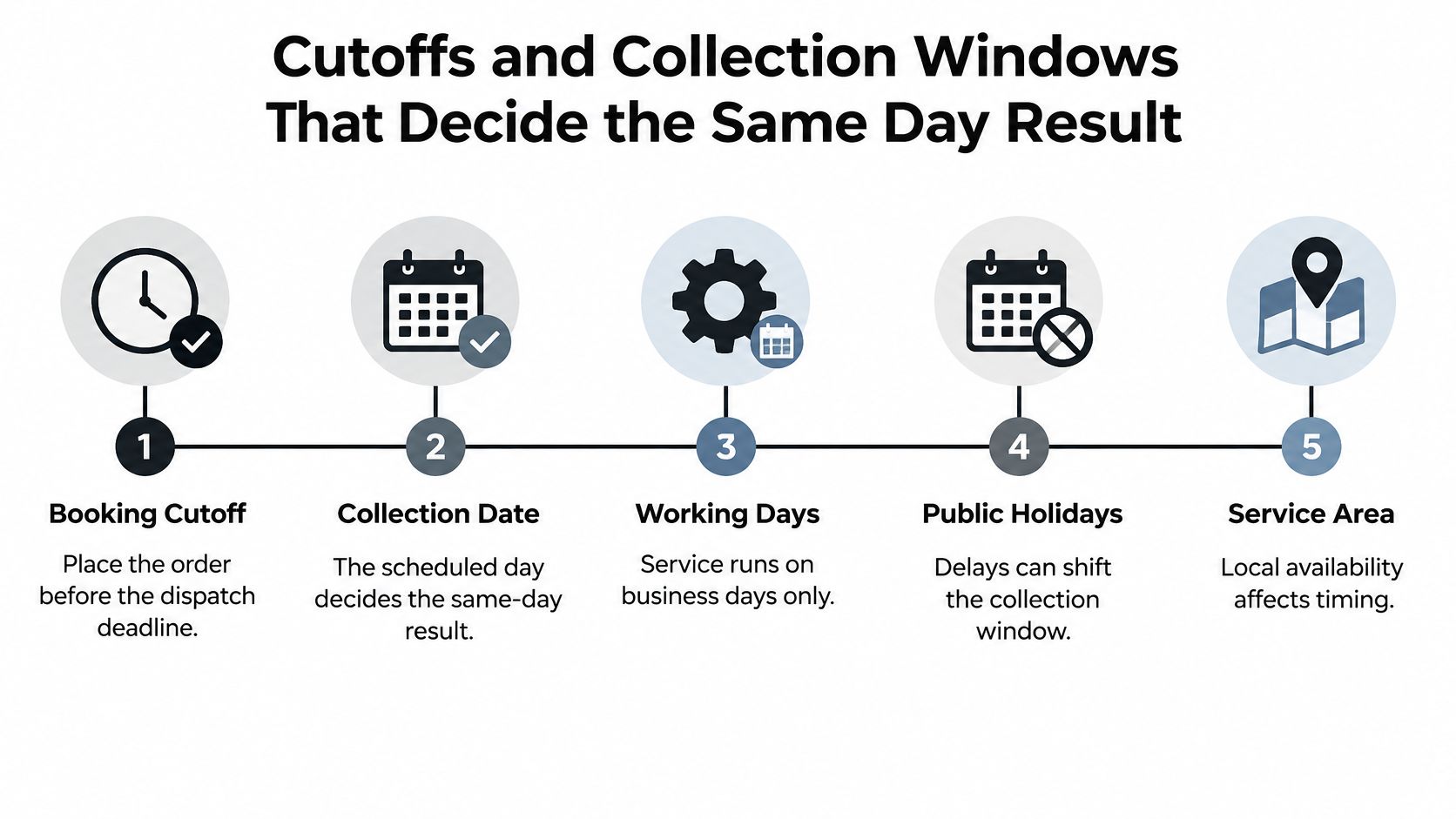
The collection date decides whether delivery today is still possible. Transit time only becomes useful once the courier can collect the parcel. Our collection dates follow booking cutoffs, working days, local public holidays and service availability.
Our standard pickup window is 9 to 11 am with one hour's notice. Later requests move to the next working day at 9 am, so a late booking can shift the entire delivery plan even when the route supports same-day service.
Read the collection date before the transit estimate
Say a clothing order is packed before the required notice period and booked into the confirmed morning collection window. It can proceed towards same-day delivery if the selected route and service support it.
Now take the same garment, address and courier request made late in the afternoon. Under the standard pickup arrangement, collection moves to the next working day. The garment being nearby doesn't turn that booking into delivery today.
Collection outcomes by booking timing
| Booking or readiness situation | Collection outcome | Same-day result |
|---|---|---|
| Booked with one hour's notice for the 9 to 11 am window | Scheduled for 9 to 11 am on the confirmed date | Same day if the route shows a same-day option and service conditions are met |
| Booked after the standard cutoff | Moves to the next working day at 9 am | Next eligible day at the earliest |
| Parcel not packed and labelled by the ready time | Collection may move to the next eligible day | Today's delivery can no longer be relied on |
| Booked on a weekend or public holiday | Follows working days and local public holidays | Earliest eligible working-day collection must be confirmed |
The ready time means ready for handover, not the time someone starts finding the item. Retailers should finish picking, checking and packing before that point, rather than expecting a driver to wait while staff complete the order.
Leave room for CBD access
A published discussion of urban freight conditions identifies more than 10,000 freight vehicles undertaking daily delivery and pickup activity in Melbourne's CBD, against about 850 on-street loading spaces. That imbalance makes loading access a practical constraint, not a minor administrative detail.
Give the driver the correct loading entrance, reception location and building access instructions. Confirm whether staff can accept the parcel at the nominated point rather than sending the driver between a shopfront, concierge and loading dock.
Book against the time the parcel can actually leave, not the time the customer clicks purchase.
For clothing needed before an evening departure, leave room for access delays and handover. Book early and keep a margin between the confirmed collection arrangements and the wearer's hard deadline.
How to Pack Clothing So It Is Ready for Same Day Collection
Clothing needs protection from moisture, snagging and unnecessary movement, even on a short local journey. A decorative shopping bag isn't a secure courier parcel, and a thin garment sleeve shouldn't be treated as the outer packaging.
Prepare the parcel before taking its final measurements. A quote based on loose clothing can become inaccurate once you add a carton, protective sleeve or cushioning.
Pack in the order that prevents rework
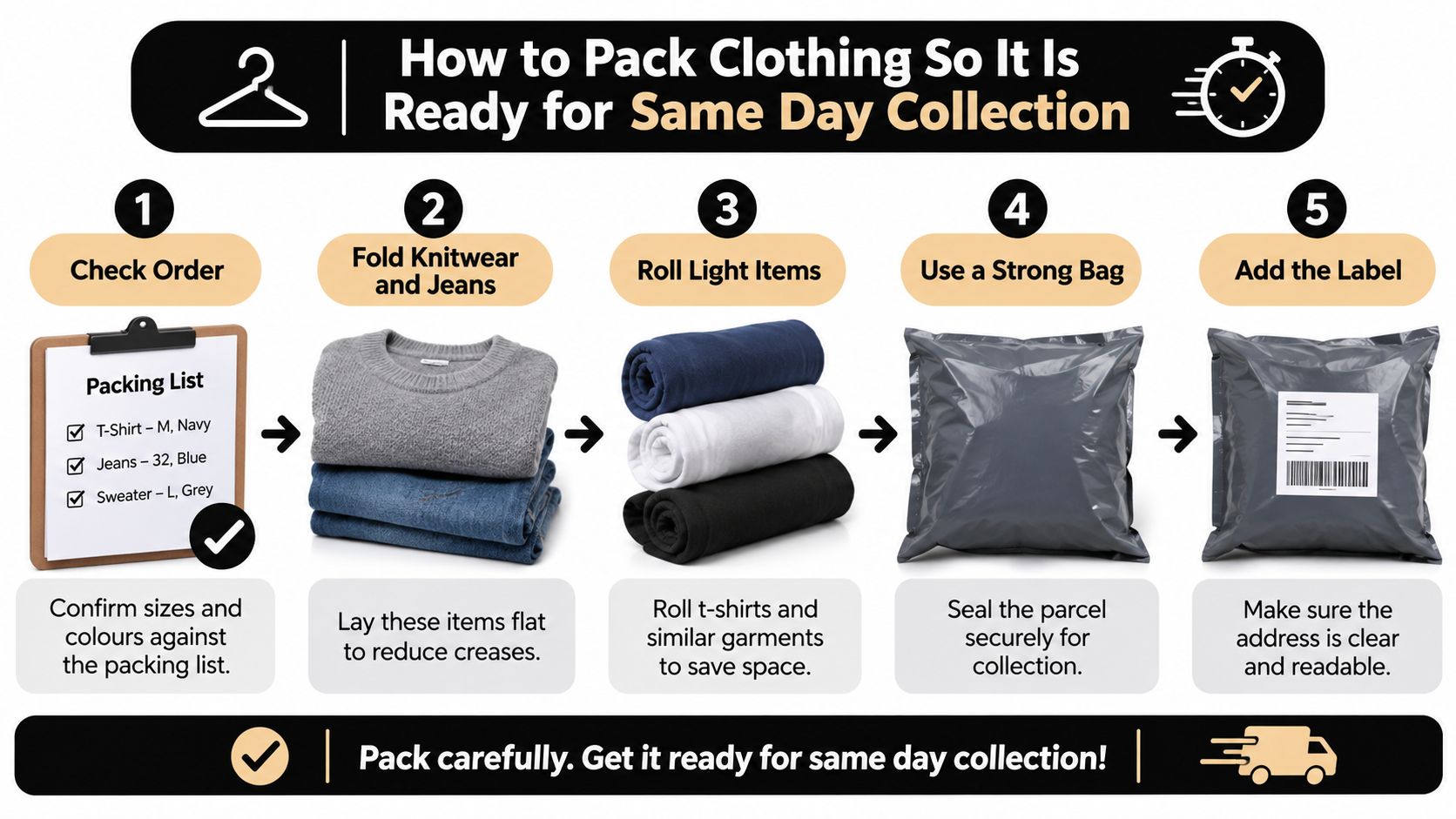
Check the order before sealing. Match garment style, size, colour and quantity against the packing list, including accessories that might be stored separately. Keep swing tags attached where they're needed for a return.
Fold heavier pieces flat. Lay knitwear and jeans neatly without forcing thick seams into a tight bundle. Roll light items such as T-shirts when suitable for the fabric, but don't promise crease-free arrival.
Add a clean inner barrier. Put the order in a clean garment bag or poly mailer and gently press out excess air before sealing. Keep paperwork away from exposed fabric so edges or ink don't mark the clothing.
Protect delicate or structured garments. Wrap silk and beaded pieces in tissue, then use a rigid sleeve or suitable carton to resist bending. Don't compress a structured jacket merely to fit a smaller satchel.
Choose close-fitting outer packaging. Use a strong satchel for soft, resilient items or a carton for garments needing shape protection. Fill empty space with clean paper so the contents don't slide around.
Weigh and measure the finished parcel. Use parcel scales and a tape measure to record the packed weight, length, width and height. Include the outer packaging and any protruding edges.
Seal and stage the order. Tape carton seams securely, attach any required courier label and remove old shipping labels. Place the parcel at the agreed collection point before the ready time, somewhere dry and accessible to staff.
Use packed weight, not garment count
Our individual parcel limit is 25 kg, with combined length, width and height no greater than 180 cm. Heavy multi-garment orders may need splitting into separately booked parcels.
Garment count isn't a reliable substitute for weighing. A padded jacket, denim bundle and lightweight jumper can occupy similar-looking bags but produce quite different packed weights and dimensions.
For retailers, a saved packaging size is useful only if the actual order fits it without bulging or distortion. Don't squeeze a larger order into a familiar bag just to reuse the previous booking details.
Packing check: The parcel waiting for the driver should match the weight, dimensions and quantity entered in the booking.
If you change the packaging after obtaining a quote, measure it again. That final check is quicker than resolving a collection problem caused by an undersized or understated booking.
Booking Details and Labels Before Collection
Resolve the label requirement before collection day. Direct Couriers same-day deliveries don't require a courier label, while most standard courier services usually do. Some same-day services display No label required at booking, so follow the instruction for the selected service rather than applying a blanket rule.
No courier label doesn't mean no address information. Keep the recipient's details and booking reference available for the handover, and make sure staff can identify the correct parcel.
Label requirements by service type
| Service situation | Label needed | What to do |
|---|---|---|
| Direct Couriers same-day booking | No courier label required | Confirm the service shows no label step |
| Some same-day services | Shown as No label required | Follow the service detail shown at booking |
| Most standard courier services | Usually required | Print and attach the label before collection |
| Any service with an unclear label step | Confirm before handover | Check the courier's instructions before collection |
Enter details from the finished parcel
Enter the pickup and delivery postcodes, then the packed weight, dimensions and number of boxes. Choose the preferred collection date and a ready time you can confidently meet, rather than the earliest time the form accepts.
Identical boxes can be entered together. Saved addresses and reusable box sizes can reduce repeat entry, but check the recipient's current details and weigh each new load rather than assuming yesterday's booking still fits.
A workplace delivery needs the business name and a usable receiving point. A residential unit needs the unit number, access details and a recipient who can respond if the courier needs help finding the entrance.
Check the commitment before paying
Compare the same-day quote with next-day and standard options using the same inputs. Allow for GST and applicable surcharges when assessing the total, since our estimated courier prices exclude GST unless stated otherwise.
Delivery estimates are guides, and the courier confirms service conditions. Don't interpret a displayed transit estimate as a guaranteed appointment, especially when a garment must arrive before the recipient leaves.
Complete a final check of the collection date, address, parcel quantity and label instruction. Parcels must be packed and, where required, labelled by the ready time for the confirmed date.
Make the final comparison before the cutoff, while you still have a practical choice. That keeps the booking grounded in the supported route, achievable collection and total cost rather than urgency alone.
Fit, Returns and Missed Deliveries After Dispatch
An on-time parcel doesn't mean the garment fits. Same-day delivery resolves a transport deadline, not uncertainty about sizing, fabric or cut. An urgent purchase can still leave you without something wearable.
Australia Post figures summarised by EightX's Australian ecommerce returns guide indicate that 41% of Australian online shoppers returned at least one item in 2025, while 69% wanted a broad range of delivery options including out-of-home collection and returns. Before ordering, establish how you'll send an unsuitable garment back, not just how quickly it can reach you.
Check return eligibility before wearing
Compare the garment's size chart with your measurements and read the fit notes. Stretch, lining and the intended cut can matter as much as the size printed on the tag.
Fashion represented 53% of returned online-order items in the dataset cited by the Grant Thornton and Power Retail report, which identifies wrong size or fit as the primary return trigger. A familiar brand size still deserves checking against the particular garment.
Before paying, check whether sale items are eligible for returns, whether tags must remain attached and whether the retailer permits refunds or only exchanges. Don't assume that buying something for an event makes returning it after wear acceptable.
Delivery problems and first actions
| Problem | Why it happens | First action |
|---|---|---|
| Wrong size or fit | Sizing or cut doesn't suit the wearer | Confirm return eligibility, then arrange return collection from your address |
| Missed delivery | Recipient unavailable or an access issue | Check the latest update in Tracking and follow the service instructions |
| Redelivery needed | The first delivery attempt couldn't be completed | Check the cost before rebooking, as no Sendaparcel redelivery fee applies but courier charges may apply |
Price the whole delivery sequence
After a missed delivery, check the latest courier update in Tracking and follow the instructions for the selected service. Don't assume another attempt will happen automatically or that every service offers the same collection alternative.
We charge no redelivery fee, although courier charges may apply. Our redelivery fee explanation helps distinguish those charges before you make another booking.
For a retailer arranging a return, use the customer's address as the pickup location and your own receiving address as the destination. Confirm return approval and packing instructions before arranging collection so the parcel can be accepted when it arrives.
Calculate outbound delivery, return freight and replacement delivery separately. If the original garment is wrong, another urgent shipment can erase the value of choosing the cheapest initial quote.
The useful outcome isn't just a parcel delivered today. It's the right garment, available before the deadline, at a total cost you're prepared to pay.
Sendaparcel offers live courier comparisons, booking and tracking for local and interstate parcels, including same-day options on supported intrastate routes. Visit Sendaparcel with both postcodes and your packed parcel details to compare eligible clothing delivery options before the collection cutoff.