

Shipping Policy Template for Australian Online Stores

A good shipping policy answers five questions before a customer asks them: where you ship, how much it costs, how long it takes, who to call when something goes wrong, and what rights they keep. Below is a template you can paste into your store and edit, plus the Australian rules behind each clause and a practical way to price shipping so a free-shipping offer does not eat your margin. Because we quote real-time courier prices from multiple carriers with no platform booking fees, the numbers you put in your policy can come from actual quotes rather than guesses.
SendaparcelSet Shipping Costs With Real QuotesCompare real-time courier prices from multiple carriers to help price your store’s shipping policy without hidden platform fees.VisitTL;DR
- Your policy needs delivery areas, processing time, delivery estimates by region, shipping fees, tracking, a lost or damaged parcel process and your contact details.
- Under Australian Consumer Law (ACL), the seller, not the courier, is responsible when a paid parcel is late, lost or damaged. Write the policy around that.
- Show shipping costs before payment and label delivery times as estimates counted from dispatch.
- A free-shipping threshold set a little above your typical basket protects margin better than sitewide free shipping.
- Price the policy from real quotes at your own parcel sizes and destinations, then review it when fees or carriers change.
Table of Contents
- What a shipping policy has to do
- The shipping policy template
- Why each clause is worded this way
- How to charge for shipping
- How to offer free shipping without losing money
- Publish it where customers will see it
- Make the policy easy to keep
- Send with Sendaparcel
- Our perspective
- FAQ
- Sources
What a shipping policy has to do
A shipping policy is a plain-English page that tells shoppers how their order gets from your shelf to their door. It also sets expectations that you can be held to. business.gov.au advises that delivery information on your store must align with Australian Consumer Law, and that if you can’t supply a product a customer has paid for within a reasonable time, you must offer a solution such as a refund or replacement.
So the page does two jobs. It reduces “where is my order?” emails, and it keeps your promises consistent with the law. A policy that says “delivery in 2 days” when your carrier usually takes five is a liability, not a help.
The shipping policy template
Copy the text below and replace everything in [square brackets]. Each clause is explained in the sections after it.
1. Where we ship
We deliver across Australia to residential, business and [PO Box] addresses. We [do / do not] ship to [remote areas / specific postcodes] and we [do / do not] ship internationally. Some items, such as [dangerous goods], cannot be sent by post.
2. Processing time
Orders placed before [cut-off time, e.g. 2 pm AEST] on a business day are processed within [1 to 2] business days. Business days are Monday to Friday, excluding public holidays. Orders placed after the cut-off or on weekends are processed the next business day.
3. Delivery estimates
Delivery times are estimates and are counted from the day we dispatch your order, not the day you order.
| Region | Standard | Express |
|---|---|---|
| Metro | [3 to 7] business days | [1 to 3] business days |
| Regional | [5 to 10] business days | [2 to 5] business days |
| Remote (incl. [WA, TAS, NT]) | [7 to 14] business days | [4 to 8] business days |
Peak periods such as Black Friday and Christmas may add [1 to 3] business days.
4. Shipping fees
Shipping is calculated at checkout based on [weight, size and destination / a flat rate of $X]. Orders over $[threshold] after discounts qualify for free standard shipping. All prices include GST.
5. Carriers and tracking
We use [carrier types] and send a tracking link by email once your order is dispatched. Contact us at [email / phone] for delivery enquiries and we will deal with the carrier for you.
6. Authority To Leave
Authority To Leave means the carrier may leave your parcel at your door without a signature. If you choose this option, [describe your terms]. Choosing it does not affect your rights if the parcel does not arrive or arrives damaged.
7. Late, lost or damaged parcels
If your parcel has not arrived within [10] business days of dispatch, or arrives damaged, contact us at [email]. We will respond within [1 business day] and arrange a suitable solution.
8. Address errors and order changes
Please check your address before paying. If a parcel is returned because of an incorrect address, we may charge [redelivery fee] to send it again. To change an order, contact us before dispatch.
9. Your rights
Our goods come with guarantees that cannot be excluded under the Australian Consumer Law. This policy operates in addition to those rights and does not limit them.
Why each clause is worded this way
Delivery areas and exclusions
List the countries and postcodes you serve, and any exclusions, so nobody pays for an order you cannot fill. Shoppa’s Australian template says to name excluded addresses and the conditions for free shipping. PO Boxes and remote areas are where most surprises happen, because many services will not deliver to a PO Box and remote postcodes can cost more. Our guide to PO Box and remote parcel delivery shows what to write for those addresses.
Processing time and transit time are different
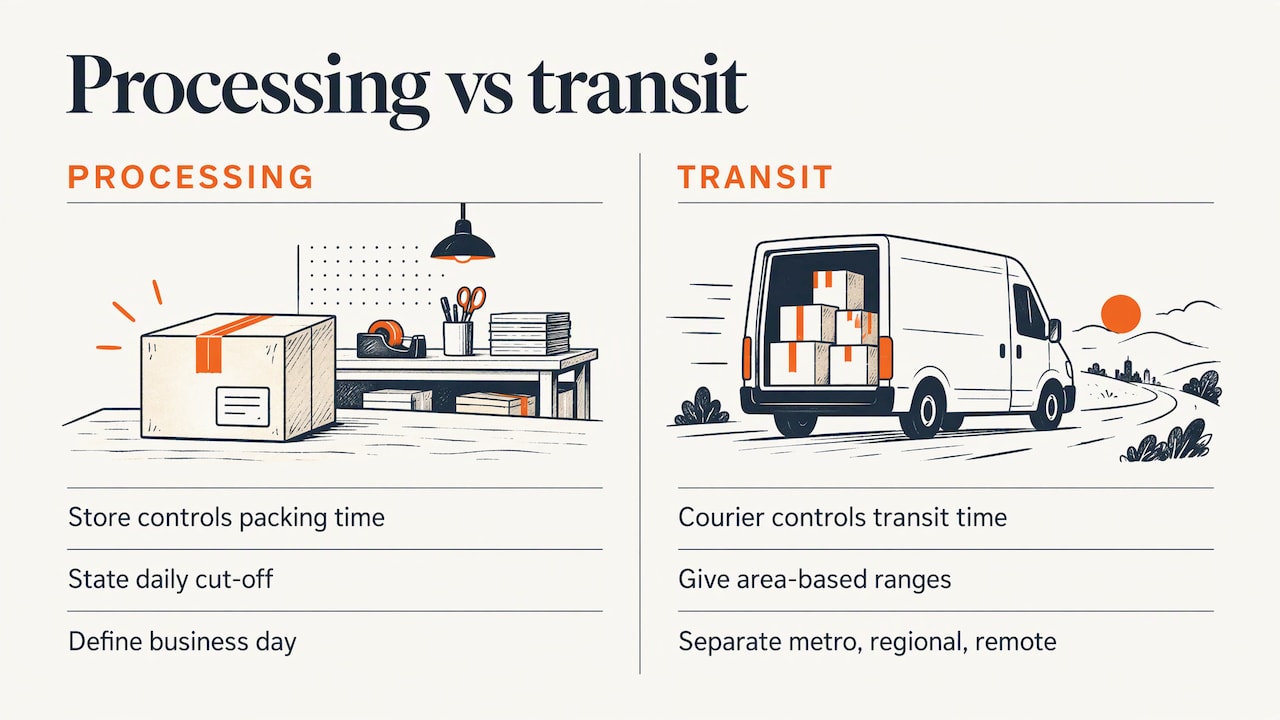
Sprintlaw advises separating processing time from transit time and giving ranges for metro, regional and remote areas by service type. The reason is simple: your packing time is yours to control, the courier’s transit time is not. State both, with a daily cut-off and a definition of a business day.
If your warehouse is on the east coast, list Western Australia, Tasmania and the Northern Territory separately, as eCommerce Circle’s Shopify template recommends. Those are the tiers where estimates most often run long.
Delivery estimates must be honest
Any delivery timeframe on a product or checkout page is a representation that can be misleading if you keep missing it. A 2026 ACL ecommerce guide gives “ships within 2 business days” as an example of a claim that becomes misleading if it is consistently missed. Sprintlaw adds that “express” should genuinely be faster and “next business day” must be accurate for the locations you advertise.
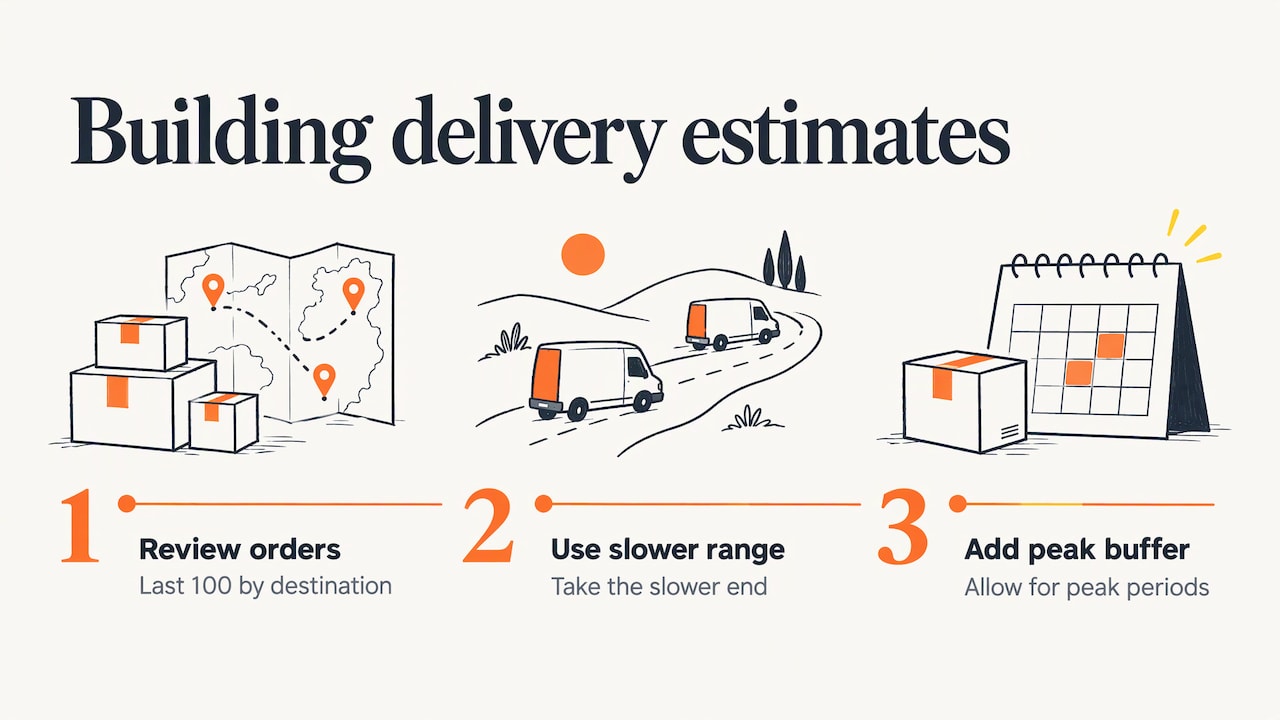
The fix is to base your windows on real data. Look at your last 100 orders by destination, take the slower end of the range, and add a buffer for peak periods. Comparing carriers by speed on your actual routes is quicker when you can see them side by side: our courier comparison guide covers price, speed and service.
Lost, late and damaged parcels: you own the problem
This is the clause shop owners most often get wrong. GetLaw’s explainer says that if a parcel is delayed, lost or damaged in transit, the retailer, not the courier, is responsible under the ACL. The Guardian reports the ACCC’s view that a reasonable delivery time is what most people would think is fair in the circumstances, and that persistent courier complaints can leave the retailer responsible for not choosing a more reliable carrier.
So write the clause as a commitment to respond, not as a promise of a specific outcome. eCommerce Circle’s template author says this approach lets you handle each case sensibly while giving the customer certainty. Do not write “no refunds for delivery delays”: Sprintlaw warns that blanket wording like that can backfire if it is misleading or unfair.
Your customer deals with you; you deal with the courier. Having tracking, insurance and a booking history in one dashboard makes that second conversation much easier. Insurance is included by default on parcels booked with us, and our dashboard tracks every shipment.
Authority To Leave
Authority To Leave lets a courier leave a parcel without a signature. It is convenient, and it cuts failed deliveries. It does not wipe out your obligations, though: Sprintlaw notes that these clauses do not remove the seller’s non-excludable duties if goods do not arrive or arrive damaged. Explain the term in one line, as the template does.
Your ACL line
Include a sentence saying the policy sits alongside, and does not limit, the customer’s consumer law rights. Both Shoppa and eCommerce Circle recommend it. This policy is general information, not legal advice. If your store sells regulated goods, ships overseas, or you are unsure about a clause, have a lawyer review the final text.
How to charge for shipping
Before you fill in section 4 you need a pricing model. business.gov.au lists four common options:
| Model | How it works | Best for |
|---|---|---|
| Free shipping | Cost is built into prices or taken as lower margin | Small, uniform products |
| Flat rate | One fixed charge per order | Similar-sized products |
| Tiered rate | Flat fee on smaller orders, free above a threshold (for example $10 under $99, free over) | Mixed baskets |
| Exact cost | Carrier quotes at checkout | Varied sizes and weights |
Exact cost avoids losing money on heavy or distant parcels, but customers cannot see the total until checkout. Flat rates are easier to explain but only work if your sizes are similar. Telstra suggests using your sales history to estimate average item size and weight when setting a flat rate.
Set the rate from real quotes
Here is a worked example. Say your most common parcel is a 2 kg box going to metro, regional and remote addresses. Get quotes for each tier from several carriers, note the cheapest reliable option for each, and set your flat or tiered rate near the average, adding a small handling margin. With us you can compare real-time quotes from multiple carriers for the same parcel and see a transparent price breakdown, so you are not guessing. Our shipping cost calculator guide explains how quotes are priced, and parcel shipping costs in Australia gives the wider picture.
Show the cost before payment
Price transparency is a legal point, not just a courtesy. The ACCC says that where a business charges for delivery but customers can also choose free click and collect, delivery need not be in the displayed product price. Otherwise, mandatory or pre-selected charges belong in the single total price. Shoppa’s template adds that if a delivery charge depends on the address, you should explain that early and show the calculated charge before payment. Put the same numbers in your policy and at checkout, and keep GST in both.
How to offer free shipping without losing money
Shoppers want it. Australia Post’s eCommerce Report 2025 found 56% of Australians ranked free shipping as their top delivery preference. It also found that 35% of businesses always offer free shipping and 30% offer it above a spending threshold, with $51 to $100 the most common band. The average online transaction in 2024 was $95.
The margin-friendly approach is a threshold. Three moves work together:
- Set the threshold above your typical basket. Eightx’s 2026 AOV study suggests the median basket plus 30 to 40%. A $70 median order means a threshold of about $95 to $100.
- Use the nudge. Australia Post’s free shipping article reports that one in four shoppers will spend up to $10 more, and one in five up to $20 more, to qualify.
- Ship free orders at standard speed. The 2025 report says 93% of threshold-qualified parcels go standard, so the cheapest reliable service is the one that matters. See how to reduce shipping costs for twelve ways to lower the bill underneath your threshold.
Australia Post also suggests offsetting costs with promotional windows, or by offering free shipping to subscribers and first-time shoppers, and trialling it during a key sales season while watching cart abandonment and conversion. Telstra frames free shipping as a differentiator that works best with a threshold or as a loyalty perk.
Whatever you choose, write the rule in your policy in one line: “Free standard shipping on orders over $[X] after discounts.” That matches how Sprintlaw’s sample policy words it.
Publish it where customers will see it
Put the policy on its own page linked from your footer, reference it at checkout and in order confirmation emails, and review it whenever carriers, fees or zones change. On Shopify, the simplest route is to create the page in your store’s policy settings and link it from the footer menu; check Shopify’s own shipping policy guide for the details it suggests customizing, such as cutoff times, rates, thresholds and local delivery.
For most stores the review trigger is a price change. Check your policy against current quotes at least every time a carrier updates its rates, and before each peak season.
Make the policy easy to keep
A policy is only as good as the operation behind it. If you sell on Shopify, WooCommerce, eBay or Wix, our integrations pull orders into one place, so your fees and delivery promises are produced by the same system. Our Wix shipping guide and eBay seller shipping costs guide show how this works on those platforms, and ecommerce order fulfillment covers the process from pick to dispatch.
Send with Sendaparcel
Once your policy is live, the parcels have to match it. At Sendaparcel you compare real-time quotes from multiple carriers, book parcel, satchel or same-day delivery, and pay no platform booking fees. Prices are shown as a clear breakdown, insurance is included by default, and redelivery fees are spelled out. Regular senders earn rewards, and you can upload orders in bulk from Excel or bring your own courier accounts. See our courier services or get a quote on Sendaparcel.

If your policy promises same-day delivery in your local area, our same-day courier options are built for that.
Our perspective
Most shipping policies fail for one reason: they are written before anyone has looked at real prices. The store promises a flat $10, a free threshold and a two-day express, then discovers that a 5 kg parcel to a remote postcode costs more than the margin on the order.
We built Sendaparcel around the opposite order of work. Get the quote first, with the price broken down, then write the promise. When you can compare carriers for your actual parcel sizes and destinations, your metro, regional and remote tiers stop being guesses. Because we charge no platform booking fees and include insurance by default, the cost you put in your policy is the cost of the courier, and the cover for a damaged parcel is already in place when a customer writes in.
The law puts the customer’s relationship with you, not the courier. That is why we think a seller’s tools should keep tracking, address books, saved parcel sizes and shipping history in one dashboard. The policy is a page; the dashboard is how you keep it.
Aeros
FAQ
Do I legally need a shipping policy in Australia?
No single law says you must publish a page with that name. But business.gov.au says the delivery information on your store must align with the ACL, and a clear policy is the easiest way to show it does. It also answers customer questions before they become disputes.
Who is responsible if the courier loses a parcel?
Under the ACL the seller is responsible when a parcel a customer has paid for is late, lost or damaged, as Recording Law explains. You then take the matter up with the courier. Insurance included on your booking helps you cover the cost.
Should delivery times be promises or estimates?
Estimates, counted from dispatch, with a separate processing time. Give ranges by metro, regional and remote area, and base them on your real delivery history. Claims you regularly miss can be misleading under the ACL.
What free shipping threshold should I choose?
Start from your median basket and add 30 to 40%, as Eightx suggests. Then watch conversion and cart abandonment and adjust. Australia Post’s data shows $51 to $100 is the most common band.
Do I have to charge GST on shipping?
It depends on your GST registration and the sale, so confirm with your accountant. For reference, one retailer’s published policy states that orders delivered within Australia carry 10% GST on product value and shipping fees. Keep displayed prices GST-inclusive.
Sources
- Shipping | business.gov.au
- Price displays | ACCC
- Australia Post eCommerce Report 2025
- Why free shipping is essential for eCommerce growth | Australia Post
- Shipping Policy Templates for Australian Ecommerce | Sprintlaw
- Creating a Shipping Policy for Australia | Sprintlaw
- What Is A Shipping Policy? | Sprintlaw
- Shipping policy template and examples | Shoppa
- Shopify Shipping Policy Template for Australian Stores | eCommerce Circle
- Legal Essentials for Australian Shopify Stores | eCommerce Circle
- How To Create a Shipping Policy | Shopify
- 5 shipping cost options for eCommerce | Telstra
- Average Australian ecommerce AOV 2026 | Eightx
- Online shopping and dodgy couriers | The Guardian
- Consumer protection in online fashion sales | GetLaw
- Online Shopping Rights in Australia | Recording Law
- Australian Consumer Law for Ecommerce 2026
- Shipping & Delivery | FS.com Australia