

You've packed a gift, a customer order or an urgent document, and now you need a courier from Sydney to Melbourne. The quotes look straightforward until you notice that the cheapest service has a wider delivery window, while the express option doesn't clearly say when someone will collect your parcel.
Advertised transit time isn't the whole door-to-door wait. Packing, pickup cutoffs, depot handling and the recipient's availability all affect when the parcel arrives. The right purchase is the service that meets your real deadline, not automatically the one with the fastest label.
Table of Contents
- Sydney to Melbourne Courier Options at a Glance
- What Actually Drives the Courier Price
- Why Delivery Times Vary on the Sydney to Melbourne Route
- Parcel Limits and Measurements to Check First
- Matching the Courier to Your Parcel Type
- Handling Failed Deliveries and Redelivery on Interstate Parcels
- Compare Live Quotes Before You Book
Sydney to Melbourne Courier Options at a Glance
Sydney to Melbourne is a major road-freight connection, and road transport underpins ordinary interstate parcel movements. Your practical choice is between service speeds, parcel eligibility and how each carrier manages collection and the last mile.
For initial planning, the Australia Post annual report gives general domestic estimates of 1–3 business days for Express Post and 2–6 business days for Parcel Post, with actual timing affected by lodgement and destination points.
Sydney to Melbourne courier options by speed and best use
| Service | Typical transit | Best for |
|---|---|---|
| Australia Post Express Post | Generally 1–3 business days | Documents and time-critical small parcels |
| Australia Post Parcel Post | Generally 2–6 business days | Non-urgent parcels where cost matters |
| CouriersPlease | Shown in live quote | Comparing eligible route-specific services |
| FedEx | Shown in live quote | Assessing tracked express options |
| StarTrack | Shown in live quote | Business shipments and account-based service comparisons |
| Aramex | Shown in live quote | Parcels with flexible, quote-led timing |
| Allied Express | Shown in live quote | Comparing eligible metro and regional services |
| Direct Couriers same-day | Not available interstate | Supported same-day moves within one metro area or state |
Treat the carrier rows as a shortlist, not a delivery promise. A carrier may offer different services for different postcode pairs, and its name alone doesn't tell you the collection arrangements, signature conditions or delivery commitment.
A same-day metropolitan service isn't an interstate express service. Don't select a local delivery product expecting it to connect Sydney and Melbourne. If the parcel needs exceptional interstate handling, establish an eligible service and its acceptance conditions before promising the recipient an arrival time.
Make the shortlist fit the job
For deadline-driven documents, start with Express Post or an eligible faster carrier service. Check the actual quoted window rather than assuming that express means arrival on the next working day.
For a non-urgent parcel, start with Parcel Post and compare the available alternatives. If the recipient is happy to wait, paying extra for speed may solve a problem you don't have.
Quick-pick rule: When your pickup window is tight, favour a service with explicit collection arrangements over one that only advertises a short transit estimate.
Keep your comparison tied to the packed parcel. A service that suits a document envelope may not be the right option for a bulky gift box, even when both are going to the same address.
What Actually Drives the Courier Price
The packed box sets the quote, not just the item inside it. Carriers commonly assess actual weight against volumetric weight and charge using the greater figure, subject to the selected service's rules. That's why a light item in an unnecessarily large carton can cost more than a heavier, compact parcel.
Volumetric weight converts the space a parcel occupies into a chargeable weight. Use the carrier's applicable calculation, not a divisor copied from another service. Different pricing rules can make apparently similar quotes less comparable than they first appear.
What changes a Sydney to Melbourne courier quote
| Driver | How it changes the price | Example |
|---|---|---|
| Actual versus volumetric weight | The carrier usually charges the greater of the two | A bulky, lightweight carton can be assessed above its scale weight |
| Weight band and extra boxes | Each extra box needs its own weight and size assessment | Adding another carton changes the shipment being quoted |
| Service speed | A shorter delivery window usually carries a premium | Compare standard and express prices for the same packed parcel |
| Postcodes and collection timing | Pickup suburb, delivery suburb and collection conditions affect pricing | A different Melbourne suburb can return a different quote |
| Surcharges after review | The carrier may revise charges after checking the shipment | Incorrect dimensions or an oversize assessment can change the total |
Compare the same shipment, not different assumptions
Say you're sending a lightweight lampshade. A roomy carton makes packing easy, but the carrier must transport the empty space as well as the lampshade. A closer-fitting box with suitable protective material may reduce chargeable volume without weakening protection.
Now change only the deadline. If the lampshade is a replacement for a display opening, a faster service may justify its premium. If it's going into storage, that premium is harder to defend.
The common pricing traps are practical rather than complicated:
- The cheapest service takes too long. A low freight price isn't a saving if the parcel misses the event it was sent for.
- An extra box changes the calculation. Don't assume an additional carton travels for a small marginal charge.
- The initial inputs understate the parcel. Measure after sealing, including bulges and protruding packaging, to reduce the risk of a revised assessment.
Check whether GST and applicable charges are included before comparing totals. Our estimated courier prices exclude GST, and surcharges may apply.
For packaging and comparison changes worth trying before sacrificing speed, use this guide to reducing shipping costs. Pay for speed when the deadline or consequence of delay justifies it, not because express sounds safer.
Why Delivery Times Vary on the Sydney to Melbourne Route
Similar transit estimates can produce different arrival days because parcels don't necessarily follow identical handling paths. The Rail Futures Institute submission hosted by the Department of Infrastructure identifies Sydney–Melbourne as Australia's busiest non-bulk freight corridor, with approximately 98% of contestable non-bulk freight moving by road.
Road incidents, maintenance and metropolitan congestion can affect the journey. Depot consolidation and transfer arrangements also matter: a parcel moving through scheduled network connections isn't the same operational proposition as a dedicated movement.
The timeline below shows the main physical stages.
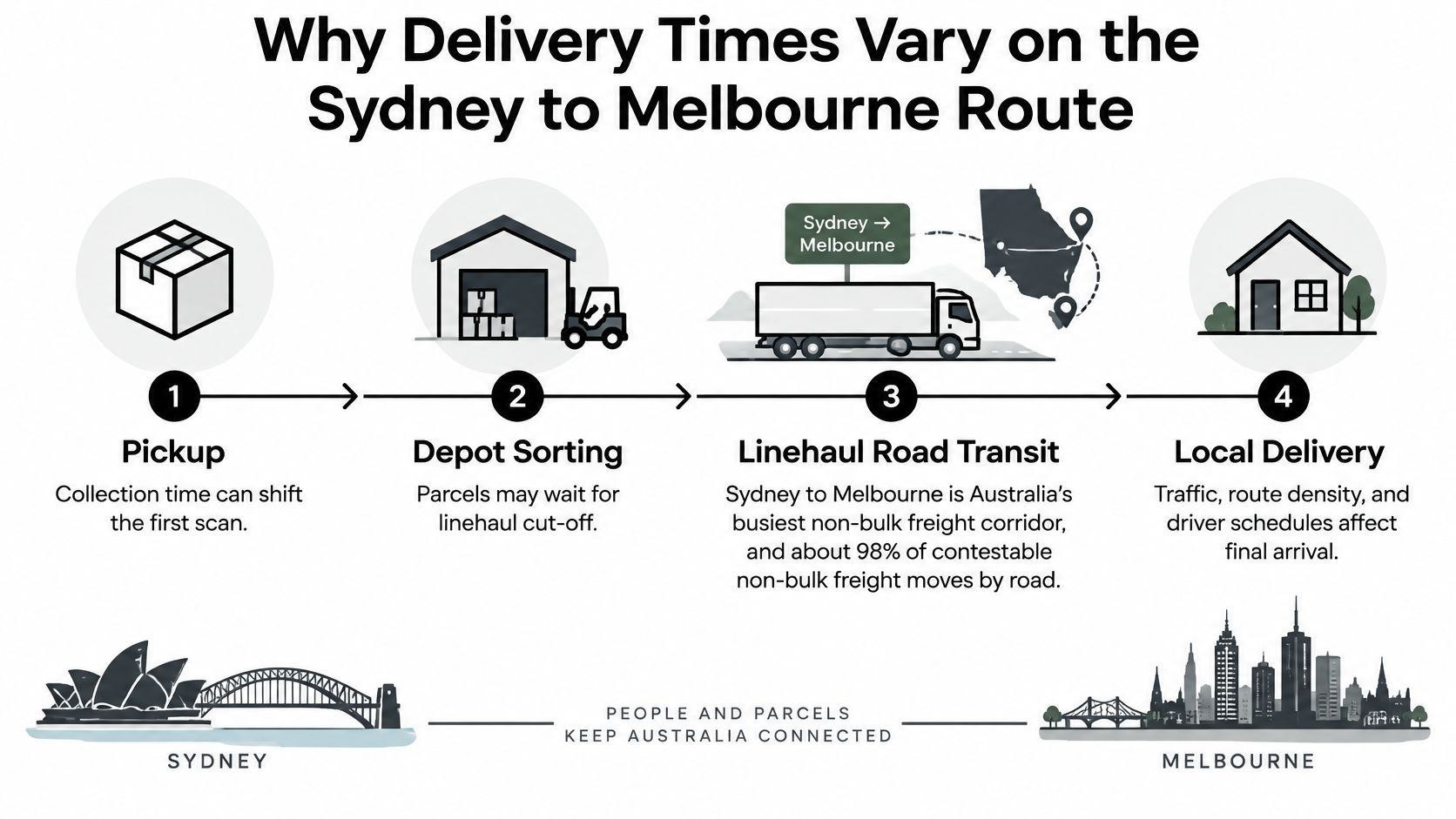
Where the time goes on a Sydney to Melbourne parcel
| Stage | What sets the time | What to check |
|---|---|---|
| Booking to collection | Pickup cutoff and collection date | Book before the applicable carrier cutoff |
| Collection to depot | Depot scanning and consolidation | Direct linehaul or depot-transfer arrangements |
| Line-haul | Road conditions on the Hume Highway | Quoted window against the deadline |
| Last mile | Metropolitan delivery in Melbourne | Business or residential address |
| Recipient availability | Whether someone can sign or accept | Access notes and permitted safe-place options |
Calculate arrival from readiness, not checkout
A parcel booked on Friday afternoon for a Monday deadline is a risky purchase if it misses collection. Buying an express service doesn't recover time before the courier accepts the parcel. Check the relevant Express Post cutoff considerations, including where and how the parcel enters the network.
Retailers need to separate order processing from courier transit. The Australia Post October 2025 ecommerce update reports that fulfilment usually takes two days, with about an extra day during peak periods. That's time before the transport estimate can do its job.
Use this planning calculation: preparation time + wait for acceptance + quoted transit + any wait for successful handover. Don't assume weekends count towards a business-day estimate, and don't add a fixed allowance when the carrier's actual schedule is available.
Before booking:
- Confirm both postcodes. Coverage across metro, regional and rural destinations depends on the exact pickup and delivery locations.
- Check collection against the cutoff. Establish when the parcel must be packed and ready.
- Clarify handling and commitment. Check transfers where relevant and distinguish an estimate from an explicit service commitment.
Delivery estimates are guides, and the courier confirms the service conditions. For a fixed deadline, check the collection plan first and the price second.
Parcel Limits and Measurements to Check First
Measure the parcel you'll hand over. Product dimensions from an online listing won't include the carton, cushioning, reinforced corners or anything protruding from the finished package.
These requirements apply to bookings on our platform. Individual couriers can also impose their own acceptance conditions, so meeting the booking limits doesn't override the selected service's rules.
Parcel requirements before booking
| Requirement | Limit or rule | Why it matters |
|---|---|---|
| Weight per parcel | Up to 25 kg | Heavier items may need a different option |
| Combined length, width and height | No greater than 180 cm | Measure the packed box, not the item |
| Actual versus volumetric weight | Greater of the two is usually priced | Light but bulky boxes can cost more than expected |
| Number of boxes | One entry per size, or quantity for identical boxes | Each size needs its own measurements |
| Pickup readiness | Collection date and ready time local to pickup | A sealed, labelled parcel avoids collection problems |
| Delivery address type | Residential or business | Affects access and delivery arrangements |
Measure and enter the finished package
- Weigh the sealed box. Include the carton, internal protection, tape and enclosed paperwork. Use parcel scales, or another scale that can support the package accurately.
- Measure the longest external length, width and height with a tape measure. Include bulging sides rather than measuring only along a neat carton edge.
- Add the dimensions together. Check the combined-size limit before spending time comparing services.
- Compare actual weight with the applicable volumetric weight. Use the selected carrier's calculation rather than assuming every service uses the same conversion.
- Enter each distinct box size separately. Use quantity only when the boxes consistently share the entered dimensions and weight.
- Set the collection date and the time the parcel will be ready, using local time at the pickup address.
- Confirm the address type. A shop inside a residential building or a home-based business still needs accurate access details, not just a business name.
When the parcel doesn't fit
If the packed item exceeds the limits, consider splitting the contents into smaller parcels, provided each piece can be protected properly. Don't divide an item to make the booking form accept it if doing so creates exposed parts or unstable packaging.
A large, awkward or indivisible item may need a freight option instead. The sensible choice is the handling method that suits the item, not the smallest carton you can force around it.
Matching the Courier to Your Parcel Type
The right service becomes clearer when you name the consequence of delay. A birthday gift sent well ahead of time and a contract needed for signing may fit in similar parcels, but they don't need the same delivery purchase.
Prepare the contents for network handling before deciding how quickly to send them.

Gifts and documents need different decisions
A personal gift without a deadline is a sensible candidate for Parcel Post or a competitively quoted standard service. Cushion fragile components separately, fill movement space and confirm the recipient's residential access instructions. Express won't compensate for a poorly protected ceramic mug.
For legal or time-critical documents, compare Express Post with eligible faster carrier services. Select tracking and signature arrangements that fit the handover requirement, and check whether the recipient needs the original document in hand rather than merely delivered to a reception desk.
An online retailer's regular orders call for consistency as well as price. Standardise packaging where practical, keep dispatch promises separate from transit estimates and compare performance for the actual destination suburbs. A cheap service becomes administratively expensive if staff repeatedly need to investigate avoidable delivery problems.
Equipment and difficult addresses need a handover plan
A business sending equipment for a Friday installation should choose the service with the clearest collection plan and enough room before the appointment for local delivery. Don't schedule the technician against the earliest edge of an estimated arrival window.
For an apartment or workplace without a safe place, confirm reception hours, intercom instructions and signature requirements before booking. A fast journey to a locked entrance still leaves the recipient waiting.
A heavy package may be easier to handle when its contents can be safely divided, but compare the complete shipment cost before splitting it. More cartons also mean more labels and separate pieces to track.
For a visual companion to the packing and dispatch preparation, watch the video below.
Match the service to the deadline, the consequence of loss or delay, and the receiving address. Don't choose by carrier name alone.
Handling Failed Deliveries and Redelivery on Interstate Parcels
A parcel locker isn't automatically the right answer to an unavailable recipient. In the DHL 2025 Australian shopper report, 64% prefer home delivery, while 53% prefer safe-place redirection when unavailable and 6% prefer a parcel locker.
Those preferences don't make unattended delivery appropriate for every parcel. Valuable goods, exposed entrances and signature-required services need a deliberate handover plan. Agree on a permitted fallback before dispatch rather than improvising after the driver reaches the door.
The process below highlights the decisions that follow an unsuccessful attempt.
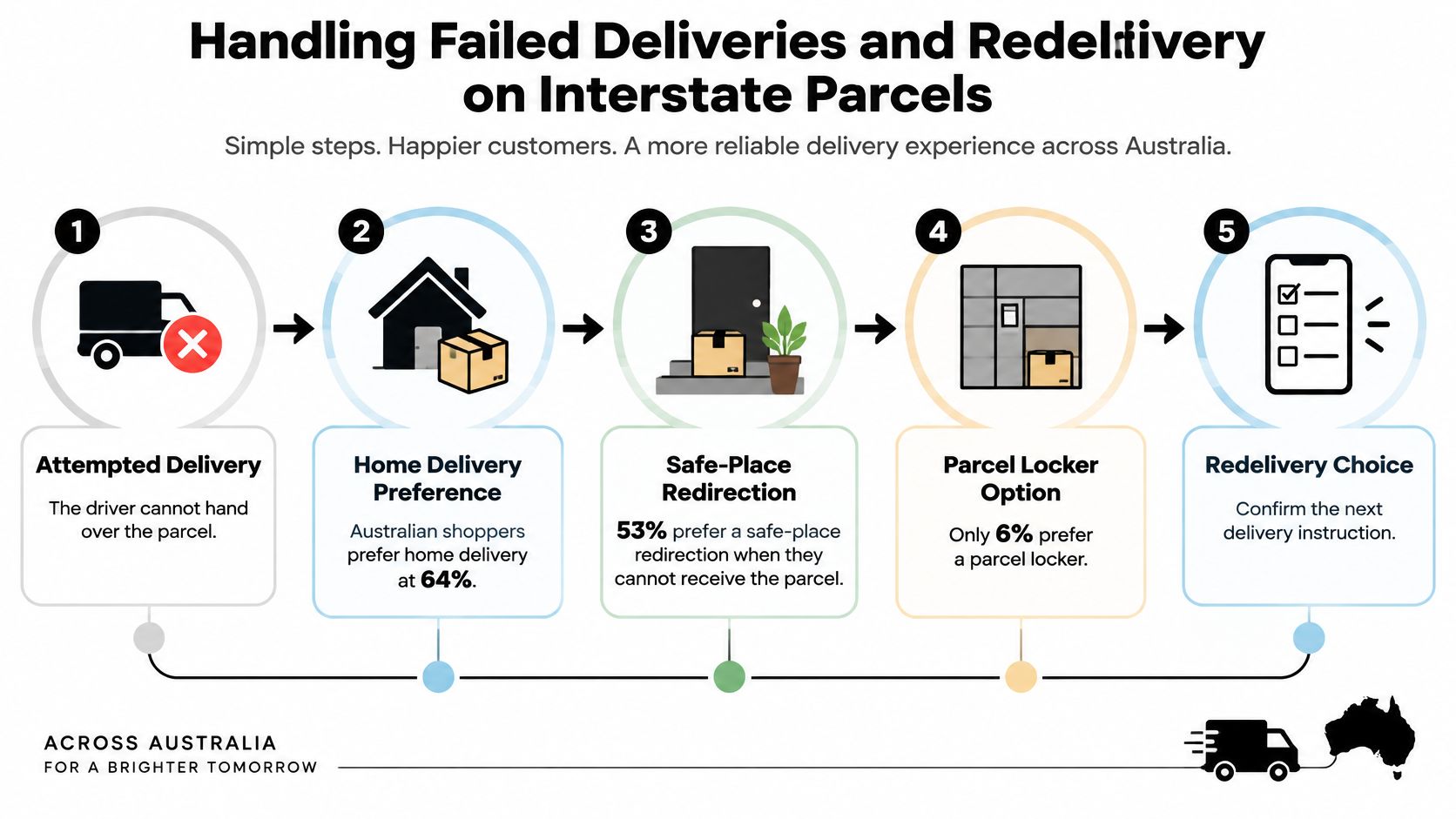
Recover from a missed attempt
- Check the latest courier update in Tracking. Read the event description, not just the delivery-status heading. Look for instructions about collection, another attempt or recipient action.
- Confirm the delivery address, unit number, access notes and whether a safe place is permitted. An intercom code won't help if it wasn't supplied through a channel the courier uses.
- Follow the courier's instructions for the selected service. Available actions may include authority to leave, depot collection or an address correction. Don't assume every option remains available once the parcel is on a delivery run.
- Check whether a courier redelivery charge applies. We don't charge our own redelivery fee, but courier charges may apply; the distinction is explained in our redelivery fee guidance.
- Escalate a stalled parcel with the booking reference. If it remains unresolved beyond the expected window, provide the latest scan, recipient details and any attempted correction when contacting the courier.
Tracking isn't an instruction change
Give the recipient the courier's name, tracking reference and the appropriate website or app before the first attempt. They need to know where to respond, not merely that a parcel is coming.
Viewing tracking doesn't change delivery instructions. A note saved in an order system, an email to the sender or a message to the recipient isn't necessarily a courier-approved redirection. Check that the requested change has been accepted through the selected service's process.
If tracking says delivered but the recipient can't find the parcel, review any proof of delivery and check reception or the nominated safe place before requesting redelivery. That's a different problem from a failed attempt, and it needs a different investigation.
Compare Live Quotes Before You Book
A live, route-specific comparison is more useful than a headline rate attached to a carrier's name. It tests the parcel you're sending against services available for the actual addresses, rather than relying on a generic Sydney-to-Melbourne assumption.
Our free account brings courier-price comparisons, favourite box sizes, saved addresses, labels and tracking together without a monthly platform fee. You pay the freight, GST and any applicable delivery charges for the shipment.
Turn a comparison into a booking
- Enter the pickup postcode and select the suburb. Choose the exact location rather than a nearby suburb with a more familiar name.
- Enter the delivery postcode and select the destination suburb. Check the recipient's address before accepting an automatically suggested location.
- Choose parcel or satchel, then enter the packed weight, external dimensions and quantity. Use the finished packaging details rather than an estimate of the contents.
- Compare each eligible service's price, estimated delivery and collection terms against the recipient's deadline. Read any conditions that affect acceptance or handover.
- Set the collection date and ready time, review the shipment details, then pay to create the booking.
A saved quote or imported order isn't a courier booking. Payment is required before the booking is created, so saving a promising option doesn't reserve a collection.
Make the final decision on the complete job
Before paying, check that someone can release the parcel at pickup and receive it at the destination. Confirm the sender's contact details, the recipient's phone number and any business closing time that could prevent handover.
Then ask what the faster option buys you. If it materially improves the chance of meeting a necessary deadline, the premium may be worthwhile. If both options comfortably fit a flexible delivery requirement, choose the cheaper suitable service and keep the saving.
Booking test: Choose the lowest-cost eligible service that meets your deadline with sensible room for collection and handover. Buy more speed only when it changes the outcome.
For a courier from Sydney to Melbourne, the next useful action is to compare the packed parcel against live availability. A precise quote gives you something actionable: a price, an estimated window and collection conditions you can assess together.
Sendaparcel lets you compare eligible Sydney-to-Melbourne courier services and manage booking, labels and tracking in one place. Visit Sendaparcel with your pickup and delivery postcodes, packed dimensions and weight to compare live quotes against your actual deadline.