
You've packed a customer order or a gift, and now you need to get it to another state. The quote form asks for postcodes, dimensions and a collection date, but the question you really want answered is simpler: which service will get it there in time without an unexpected charge?
For inter state transport, the useful starting point isn't the cheapest price or the shortest advertised delivery window. It's how the route, the packed parcel and the available pickup run fit together. Judge the quote and your delivery buffer together, especially when someone is counting on the parcel for a particular date.
Table of Contents
- What Interstate Transport Means for Your Parcel
- How Route Pricing Works and What to Enter Before You Book
- How Transit Estimates Are Built and Read
- Regional and Remote Routes Need Extra Planning
- A Worked Example From Melbourne to Brisbane
- Book Your Interstate Parcel With Confidence
What Interstate Transport Means for Your Parcel
Interstate transport means a parcel crosses a state or territory border between pickup and delivery; intrastate transport stays within the same state or territory. That's the distinction reflected in the Bureau of Infrastructure and Transport Research Economics freight framework, which also measures transport work in tonne-kilometres, combining cargo weight with distance travelled.
A parcel going across Melbourne and a parcel going from Melbourne to Brisbane can look identical on your kitchen bench. They don't require the same transport arrangement. The interstate parcel needs a service connecting its collection area with a destination network in another state.
Route types and what changes for each parcel
| Route type | Example | Same-day delivery | What drives price and transit |
|---|---|---|---|
| Same city | Melbourne CBD to Melbourne south east | Eligible routes only | Postcodes, weight, service level |
| Regional within one state | Sydney to Newcastle | Eligible routes only, within the same state | Distance, road access, service frequency |
| Interstate | Sydney to Brisbane | Not available | State border crossing, corridor distance, line-haul schedule |
A border isn't a distance measurement
An intrastate journey can still be long. Sydney to a distant regional NSW address may require more planning than the word “intrastate” suggests, so don't use the border distinction as a shortcut for speed.
Similarly, a border crossing doesn't automatically mean the carrier stops at the border or transfers your parcel there. It identifies the journey as interstate. The carrier's actual network determines where sorting, transfers and long-distance transport happen.
Weight matters alongside that geography. Say you're comparing a light satchel with a heavy carton travelling along the same corridor: both need carrying over the route, but they place different demands on the vehicle and handling process. A bulky, lightweight carton also occupies space that another parcel could otherwise use.
Practical rule: Check the actual pickup and delivery postcodes before deciding what sort of service you need.
We handle both local and interstate deliveries. Our same-day services are available only on supported routes within the same state, not interstate, so plan a cross-border parcel around the standard transit windows offered for its route.
How Route Pricing Works and What to Enter Before You Book
Start with the addresses, not the box. The origin and destination postcodes establish the corridor, which helps determine which carriers and services are available. Changing either end can change the quote, even if you don't change the parcel.
Australian freight planning also treats routes separately: government interstate freight analysis is organised around 56 state-to-state origin–destination pairs. That's useful context, not a parcel-pricing formula. Your quote needs the actual journey rather than a generic charge for crossing a border.
Read the price factors together
A large carton of cushions and a compact carton of books can create different transport requirements. Entering weight alone misses the space the cushions occupy; entering dimensions alone misses the handling demand of the books.
Price factors on an interstate quote
| Price factor | What changes | Why it matters for the quote |
|---|---|---|
| Origin and destination postcodes | Corridor distance and the carriers available | Changing either end can change both price and service options |
| Packed weight and dimensions | Transport work the courier must carry | Wrong measurements can lead to a revised charge |
| Number of boxes | Each box is a separate consignment | Identical boxes can be entered with a quantity |
| Service level | Speed and scheduling flexibility | Compare price and estimated delivery together |
| Collection date and readiness | Which pickup runs are available | A late ready time can move collection to a later run |
| Price basis | Estimated prices exclude GST | Budget for the final charge, not the first figure |
Surcharges may also apply. Review the full total, rather than treating the first estimated price as your complete shipping budget.
For a closer look at the inputs, our Australian shipping cost calculator guide explains how to approach a parcel calculation. Keep the details consistent while comparing services, otherwise you may be comparing different jobs.
Complete the booking in a reliable order
Confirm the pickup and delivery postcodes. Select the correct suburb so the postcode fills in correctly, then check the street address against it. Similar suburb names can send a quote towards the wrong service area. Our Australia-wide coverage includes metro, regional and rural destinations, but eligibility rests on the exact pickup and delivery postcodes.
Pack before weighing and measuring. Use parcel scales or a suitable household scale, then a tape measure for the outside length, width and height. Include the carton, protective material and anything attached to the outside. The common slip is using a product's listed weight, which doesn't describe the finished parcel.
Check the parcel limits before proceeding. Individual parcels can weigh up to 25 kg, with combined length, width and height no greater than 180 cm. Check both conditions, not just the weight. A lightweight but oversized package can still fall outside the permitted dimensions.
Count every box. Use quantity for identical cartons with the same packed weight and dimensions. Enter differently sized or weighted boxes separately so the booking represents what the driver will collect. Don't enter the total shipment weight as though it belongs to each carton.
Choose the collection date and local readiness time. Readiness means the parcel is sealed, labelled and accessible for collection, not that you expect to finish packing soon. If you change the date, check the price and available services again. A missed readiness time can mean losing the intended pickup opportunity.
Check the contents before paying. Dangerous goods must not go through our standard parcel form. If you're unsure about an item, raise it with our customer service team before booking. Don't assume that something sold for household use is automatically suitable for standard parcel transport.
Make sure both addresses are final. Include unit details, business names and useful access instructions where relevant. Address changes after dispatch need our confirmation, may attract charges and may be impossible once the parcel reaches its final delivery run. A recipient's likely address isn't a safe substitute for their confirmed one.
Compare the complete offer, then pay and save the reference. Assess the price, service and estimated delivery together, including whether the collection arrangement suits your availability. Payment is required before the courier booking is created. Keep the booking reference somewhere you can retrieve it without searching through unrelated emails.
Separate freight price from protection
A transport quote and financial protection answer different questions. The freight price tells you what you're paying for the selected movement; protection terms explain what may happen financially if something goes wrong.
If your job is a household move rather than a parcel shipment, House Moving Melbourne's resource on Melbourne interstate moving insurance claims is a relevant starting point for that different context. Don't transfer removalist assumptions to a courier parcel, or assume either type of booking provides identical cover.
A cheaper quote based on guessed details isn't a saving. It's an incomplete description of the job.
Before submitting, compare the form with the parcel in front of you. The most avoidable slips are ordinary ones: the wrong suburb, an estimated weight, an uncounted carton or a readiness time you can't meet.
How Transit Estimates Are Built and Read
An interstate parcel doesn't usually travel directly from your door to the recipient's door in the collecting vehicle. Its journey involves collection, sorting, long-distance transport and a delivery run. Each stage needs to connect with the next.
Booking and payment confirm the job. Collection follows within the booked arrangement, with the parcel ready at the nominated time; a readiness time isn't necessarily an appointment for the driver to arrive at that exact moment.
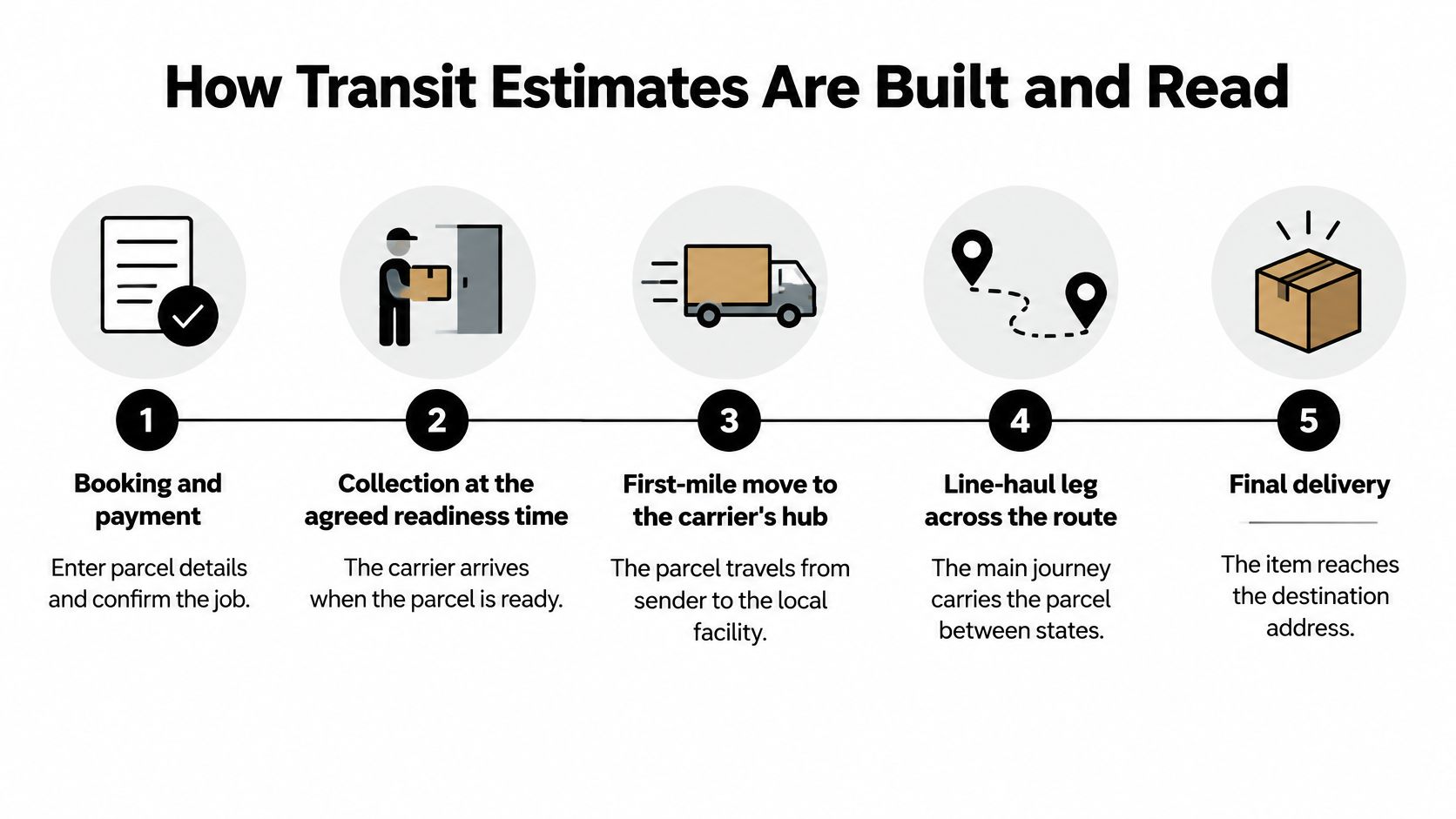
Transit stages and what can add time
| Stage | What happens | What can add time |
|---|---|---|
| Collection | Carrier collects under the agreed readiness arrangement | A late ready time moves collection to a later run |
| First-mile move | Parcel travels to the carrier hub | A missed collection can delay the onward connection |
| Line-haul | Parcel crosses the state border on the corridor | Corridor schedule and service frequency |
| Local depot | Parcel is sorted at a local depot | Depot hand-off on regional or remote postcodes |
| Final delivery run | Parcel is delivered to the recipient | Failed delivery or access constraints |
Separate the estimate from the promise
An estimate is a guide to expected timing. A guarantee is a written commitment with stated conditions and remedies. Don't infer a guarantee from a service name, a tracking screen or a short delivery window.
Carrier liability and optional protection are different again. Check the applicable terms for covered events, exclusions, packaging requirements and claim evidence rather than assuming a delivery estimate provides financial protection.
Independent research commissioned by NTI found that 70% of Australians experienced at least one parcel problem in the previous twelve months, while 93% of online shoppers consider a retailer's handling of lost, damaged or stolen parcels when choosing where to shop. A short advertised transit time therefore shouldn't be your only selection criterion.
Give a deadline room to move
Courier availability varies by route and shipment. Before choosing, establish whether the estimate assumes successful collection on the selected date and how the service counts its transit window.
Check the relevant cut-off, using our express post cut-off time guide to understand why acceptance timing matters. For an event or customer promise, work backwards from when the recipient needs the item and leave room for a missed connection or delivery attempt.
Regional and Remote Routes Need Extra Planning
A national delivery average can't tell you whether a driver serves a particular rural road on the day you need. A metropolitan pickup and a remote delivery are separate operating problems, even when they belong to the same booking.
The BITRE interstate freight dataset organises freight movements by specific state-to-state origin–destination pairs rather than treating Australia as a single uniform market. For a sender, the practical lesson is to investigate the actual corridor and both endpoints, not assume a capital-city service pattern applies everywhere.
Check the ends as carefully as the middle
A parcel may travel efficiently between major hubs but still need a less frequent connection to reach its destination. Collection from a regional property can introduce a different constraint at the other end.
Use these checks before committing to a service:
- Confirm postcode eligibility. Use the actual collection and delivery locations, not the nearest major town as a substitute.
- Allow collection and delivery room. Ask our customer service team to clarify the available arrangement if your deadline leaves little flexibility.
- Check for a depot hand-off. Establish whether another local operation is involved and whether the recipient needs to take any action.
- Understand tracking gaps. Ask what visibility to expect between facilities rather than assuming continuous location updates.
- Review additional charges. Check the full total and any applicable surcharge information before paying.
- Describe access accurately. Include practical details about gates, reception, loading areas or where a driver can safely reach the address.
Choose for the consequence of a delay
Say you're sending a replacement component needed to finish a customer's order. A cheaper service may be suitable when the customer can wait, but less useful when a missed connection prevents their work from proceeding.
A gift needed for a fixed occasion creates the same decision in a personal setting. Consider whether you can dispatch earlier, choose another eligible service or arrange a backup, rather than relying on an optimistic reading of the estimate.
Choose the service your deadline can tolerate, not just the price your budget prefers.
If collection is missed or tracking appears stalled, contact our customer service team with the booking reference, the last visible status and the relevant deadline. Explain the practical impact, such as a recipient leaving the address, so the team can investigate with useful context. Don't create a duplicate booking while the original collection status is still unclear.
A Worked Example From Melbourne to Brisbane
Say a homewares seller in Melbourne needs to send a carton to a customer in Brisbane. The customer wants it before a housewarming, so arrival timing matters more than it would for an ordinary replenishment order.
This is a hypothetical example, not a quoted freight price or a promised transit time. The illustrative carton weighs 6 kg, although the seller initially guesses 4 kg.

The service decision
The seller enters the Melbourne pickup postcode and the customer's confirmed Brisbane postcode. They measure the sealed carton, including its protective packaging, and examine the eligible services.
In this scenario, the cheapest option has the longest estimated delivery window. A faster option costs more and leaves more room before the housewarming, so the seller chooses it for the order's urgency rather than sorting by price.
| Decision | What the seller checks |
|---|---|
| Route | The full pickup and delivery addresses match the intended booking |
| Deadline | The selected estimate leaves room before the customer needs the order |
| Collection | The carton will be packed and accessible at the stated readiness time |
| Protection | The applicable terms suit the contents and their value |
The seller also checks whether the intended collection date is realistic. Booking an early readiness time would achieve nothing if the final product won't be packed until later.
The preventable charge correction
The mistake is leaving the guessed weight in the booking. After collection, the discrepancy is identified and the charge is revised to reflect the actual parcel details.
The lesson isn't to guess more cautiously. It's to weigh the finished carton before paying, so the quote describes the job being booked.
After dispatch, the seller keeps the booking reference with the order record and checks tracking for progress. If the parcel remains in the same status and the event deadline is approaching, they contact customer service with the reference and explain the customer's timing requirement. They also update the customer without promising an arrival the carrier hasn't confirmed.
For your own shipment, ask:
- Does the route cross a border? Select the appropriate service category.
- What is the parcel worth? Consider both replacement cost and suitable protection.
- How much delay can the order absorb? Choose a service and dispatch date that leave workable room.
Book Your Interstate Parcel With Confidence
Your next step is to build a quote from the parcel you'll hand over. Enter the pickup and delivery postcodes, add the packed weight and dimensions for each box, then compare the available offers with their estimated delivery times.
Keep the recipient's deadline visible while you choose. An inexpensive service can be a sound decision for a flexible delivery, while a time-sensitive order needs enough room between the expected arrival and the date it becomes unusable.
Make the comparison useful
Our Australian courier comparison guide can help you organise the decision around the shipment rather than a carrier name alone. Compare like with like: the same addresses, parcel details, collection date and readiness information.
Before paying, make a final pass through the details:
- Match the physical parcel. Check that the packed carton agrees with the measurements entered.
- Match the collection arrangement. Make sure someone can provide access and hand over the parcel when required.
- Match the recipient's circumstances. Confirm the destination is suitable for the selected delivery arrangement.
- Review the complete total. Read the final amount and applicable conditions rather than relying on an earlier estimate.
- Keep the shipment identifiable. Save the booking reference with the recipient's name or order record.
This final check is especially useful when you've changed a date or edited an address while comparing options. Don't assume an earlier selection still describes the finished booking.
Keep control when plans change
If you need to change a pickup, you can request pickup rebooking using the shipment selection or tracking number. Keep the booking reference available for every enquiry, and make clear whether you're changing an uncollected parcel or asking about one already moving through the network.
A new pickup request doesn't tell you where the original driver is or whether collection has already occurred. Confirm the shipment's status before handing the same parcel to another service.
For a deadline-sensitive delivery, decide in advance what would trigger action. That might be a missed collection, an unexpected tracking status or a recipient becoming unavailable. Having a response ready is more useful than repeatedly refreshing tracking without knowing what you'll do if the timing changes.
Check the postcodes, measure the packed parcel and compare quotes before choosing your service. That gives you a defensible price comparison and a delivery plan based on the journey you're booking.
Sendaparcel offers live courier comparisons, booking tools, labels and tracking for local and interstate parcels. Visit Sendaparcel to enter your route and packed parcel details, compare estimated delivery times and review the full total before you book.