
Tasmania's freight task reached 25.7 million tonnes in 2016-17, up 8.9% from 23.7 million tonnes in 2014-15, and road transport carried 23.7 million tonnes of it, or 88%, with rail taking the other 12%, according to the Tasmanian Government's freight survey. In 2014-15, publicly owned ports handled about 12.8 million tonnes and roughly 462,000 twenty-foot equivalent units, split almost evenly between 233,000 inbound and 229,000 outbound containers.
Those two sets of numbers describe different worlds. The first is trucks and trains moving goods around the island. The second is the island's actual doorway to the mainland, and that doorway is on water.
This is the fact that explains why shipping to Tasmania behaves unlike a delivery to any mainland suburb. A parcel bound for Hobart or Devonport isn't on a long road trip. It's on a road trip with a sea voyage in the middle, and the sea voyage runs to a schedule nobody sending a parcel controls.
Table of Contents
- Parcel Limits and Quote Inputs at a Glance
- How to Compare Tasmania Quotes Step by Step
- Why Bass Strait Sets Tasmania Transit Times
- Reading Tracking Scans Across the Sea Leg
- Peak Periods, Missed Sailings and Buffer Days
- Same-Day Limits and Items You Cannot Book
- Freight Assistance and When It Changes the Price
- Book Your Tasmania Shipment With Confirmed Details
Parcel Limits and Quote Inputs at a Glance
Two limits decide whether a Tasmania quote is valid at all. Each parcel can weigh up to 25 kg, and its combined length, width and height must not exceed 180 cm. Everything you enter after that is detail, and detail is where most revised charges start.
| Input | Limit or requirement | Why it matters |
|---|---|---|
| Weight per parcel | Up to 25 kg | Heavier items need a different plan or a split into smaller parcels |
| Combined length, width and height | No more than 180 cm in total | Measure the packed box including tape and padding |
| Packed weight | The actual weight of the packed item | Estimates based on empty boxes can lead to a revised charge |
| Number of boxes | One entry per box size, with a quantity for identical boxes | Keeps multi-box quotes accurate |
| Pickup date and ready time | Local to the pickup location | Sets the collection cut-off for the courier |
| Delivery postcode | Metro, regional or rural address | Coverage and delivery timing depend on the exact postcode |
Measure the box you're sending, not the box you bought. Close the lid, tape it, add the padding and the label, then run the tape around the outside. A carton's printed size describes what it was designed to hold, and padding can add a couple of centimetres to a side that looks flat.
The weight field means packed weight. Enter what is inside and on the parcel, because a folded cardigan and a box of doorstops fill similar space and sit at opposite ends of a scale. Couriers weigh parcels at their facilities, and a quote built on an estimate comes back as a revised charge.
For multi-box shipments, add one row per box size and use the quantity field for identical boxes. Three identical cartons entered as three different sizes, or as one carton at triple the weight, both distort the price and the service options.
The pickup date and ready time are local to the pickup address, and together they set the collection cut-off. A 9 am ready time quoted for a Perth sender means 9 am in Perth, not 9 am in Devonport. The delivery postcode is the other half of that pair: it decides coverage, and whether a metro, regional or rural address changes the service and its timing.
Once these inputs are right, quotes compare like for like. A shipping cost calculator for Australian routes is only as good as the numbers you feed it, and the Australian shipping and dispatch info from Everti covers the packing and dispatch decisions that happen before you open one.
How to Compare Tasmania Quotes Step by Step
A Tasmania quote is a set of inputs turned into a price and an estimated delivery window. Enter them in the right order and the comparison takes two minutes instead of an afternoon of guesswork.
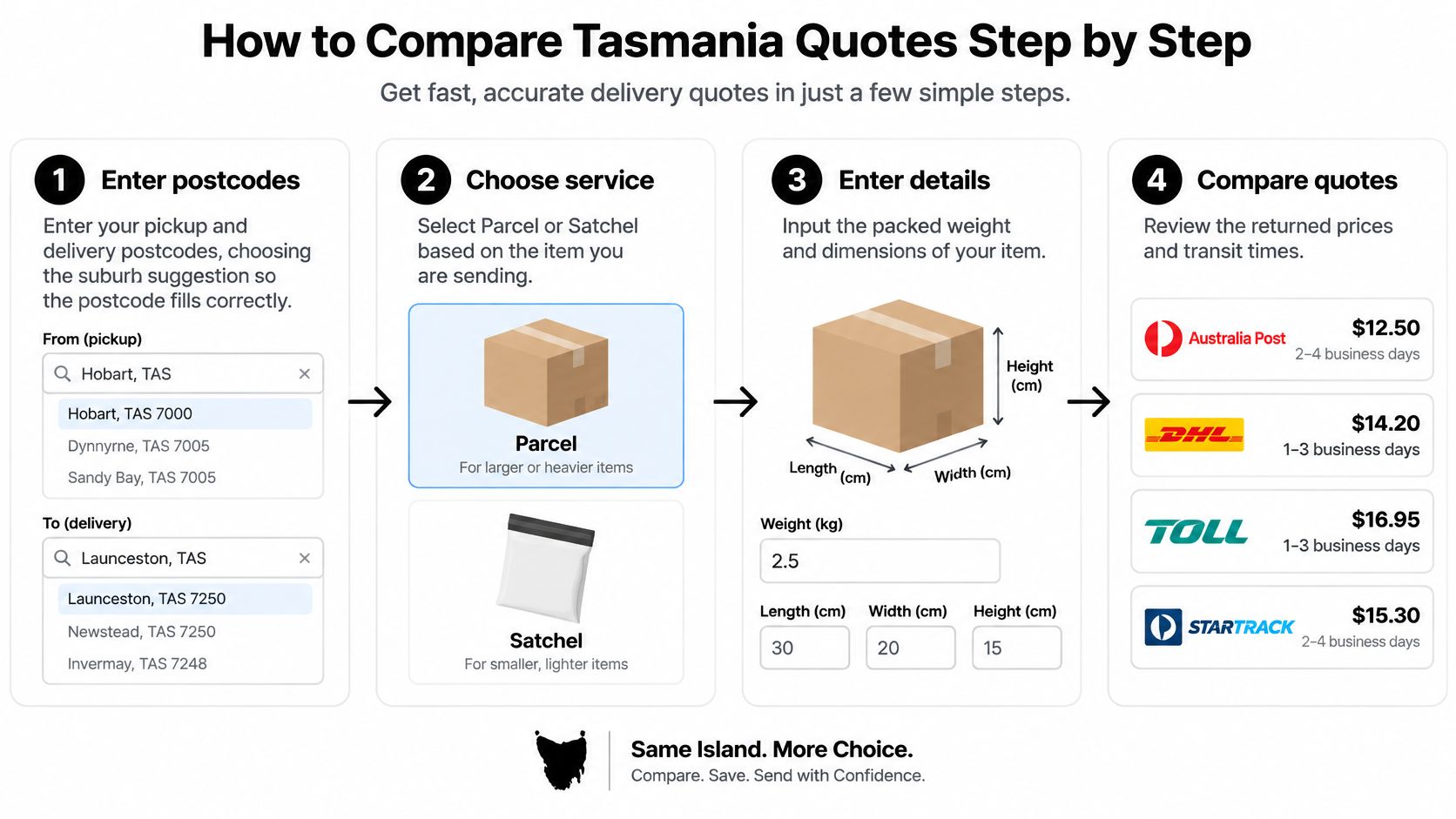
- Enter both postcodes and accept the suburb suggestion. The suggestion is what fills the postcode field correctly. Type over it and you can end up comparing services that don't cover the actual address.
- Pick Parcel or Satchel based on the item. Satchels suit documents and soft goods. Boxed items need a parcel entry, because that's the form that asks for dimensions.
- Enter packed weight and dimensions for each box. Reused cartons cause most of the surprises here, and the guidance on choosing cartons that fit your fridge makes a shipping point as well as a storage one: the outside of the carton is what has to fit. A wrong measurement triggers a revised charge after the parcel is already moving.
- Set a quantity for identical boxes. It's the difference between a multi-box price and a single-box price multiplied by guesswork.
- Enter the collection date and the time the packed shipment will be ready, both local to the pickup location. The most common missed pickup isn't a courier failure. It's a box that wasn't sealed when the driver arrived.
- Compare carriers on price and window together. Options include CouriersPlease, FedEx, StarTrack, Aramex and Allied Express. Write each estimated delivery window beside its price, because the cheapest service isn't a bargain if it lands after your deadline.
- Check whether same-day or bring-your-own carrier options apply to the route. Same-day runs only on supported routes within the same state, so a mainland-to-Tasmania parcel won't qualify. Bringing your own courier account is listed as free where you already have one.
- Confirm before booking, and read the price note. Estimated prices exclude GST, and surcharges may follow carrier assessment, so the figure you compare should be the figure you expect to pay.
What a reliable quote looks like
Four things: an available service for that exact pair of postcodes, a clear freight price, an estimated delivery window, and no ambiguity about weight or dimensions. If any of those is missing, you're comparing something other than delivery.
The research behind this article doesn't publish transit-day ranges for individual Tasmanian routes, and that's normal. The delivery window returned by your own quote, for your own postcodes and carton sizes, is the only transit estimate worth relying on.
Why Bass Strait Sets Tasmania Transit Times
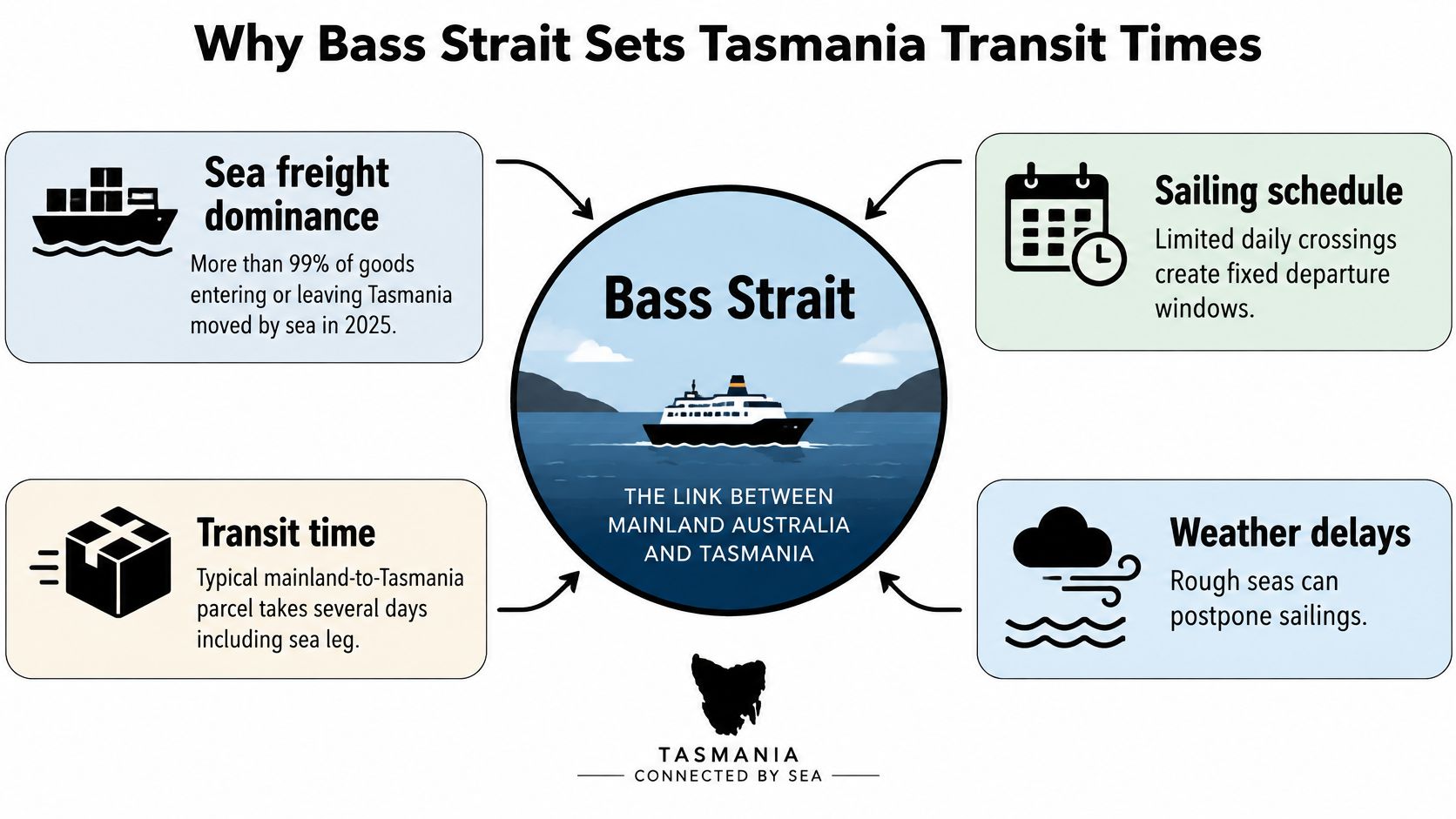
More than 99% of goods entering or leaving Tasmania were moved by sea in 2025, according to Transport Tasmania's ports, shipping and airports data. The Strait isn't a scenic interlude in the journey. It is the journey.
The four links in the chain
Every mainland-to-Tasmania parcel travels the same four links, and each one has its own failure mode.
Mainland pickup depends on your address being accessible on the booked day. Consolidation and line-haul is where parcels are grouped and moved toward the departure port, and where a carton can wait for a container or trailer to be scheduled. The crossing runs on fixed sailing slots. The Tasmanian road leg starts at the arrival port and ends at the door.
Distance between postcodes only predicts the first and last of those links. A straight-line hop across Bass Strait is shorter than plenty of mainland road runs, yet it routinely takes longer, because a vessel has to sail, berth and unload before the local leg can begin.
Regular services run from Devonport or Burnie to Melbourne, operated by Toll, Searoad and TT-Line, with roughly 900 sailings a year in both directions moving around 320,000 container units annually, as the Tasmanian Government's freight and logistics toolkit sets out. That's a busy corridor, not an occasional ferry.
The principal public ports are Burnie, Devonport, Bell Bay and Hobart. Every handoff between them and a road carrier is a point where timing can shift, which is why the way interstate transport is assembled matters as much as the kilometres involved.
Practical rule: treat a Tasmanian delivery date as a service estimate, never a fixed arrival time. Plan backwards from the sailing, not forwards from the postcode.
Courier coverage across Australia extends to metro, regional and rural destinations, and it depends on the exact pickup and delivery postcodes. A rural Tasmanian address can change both the service available and the day it's attempted.
Here's how that network looks when a parcel moves through it.
Reading Tracking Scans Across the Sea Leg
A tracking record for a Tasmania parcel isn't one continuous line. It's four stages, and each one produces different scans, or none at all.
| Tracking stage | Typical scan | What it means | What to do |
|---|---|---|---|
| Mainland pickup | Collected from sender | Parcel has entered the courier network | Confirm the collection was booked for the right date |
| Line-haul and crossing | No new scans for part of the journey | Parcel is likely on a truck, container or ship | Wait for the next scan unless the expected date has passed |
| Tasmanian arrival | Arrived at Tasmanian depot | Crossing and port handoff are complete | Check the depot's expected delivery window |
| Local delivery | Out for delivery | Final road leg is underway | Confirm access details and a safe delivery address |
The silent stretch
The middle of that table is where people panic. A parcel sits inside a container or on a trailer for the sea leg, and because it's inside an intermodal network rather than on a scanning conveyor, the record can go quiet for a stretch. The Tasmanian sea freight information paper makes the operational point plainly: a temporary absence of scans during the sea segment doesn't necessarily mean a parcel is lost.
So the right way to read tracking is by stage, not by continuous progress. Note three things when you check: the last scan, the next event you expect and the date your delivery window closes. If a parcel was collected on Monday and the window runs to Thursday, a blank Tuesday tells you almost nothing.
No new scans across Bass Strait is information about where your parcel is, not evidence that something went wrong.
Wait until the estimated window has closed before escalating. When you do escalate, quote the booking or tracking reference, because that's what lets customer service locate the consignment and see the same events you can. Escalating on day one of a five-day window usually produces a polite reply and no new information.
Route and shipment details change the sequence and the timing, so read your own booking rather than a general pattern. A two-box shipment to a rural postcode won't match a single satchel to central Hobart.
Peak Periods, Missed Sailings and Buffer Days
TasPorts handled 14.28 million tonnes of freight in FY2026 while noting that reduced scheduling flexibility sometimes caused vessel delays during peak shipping periods in Tasmania's North-West, according to its 2025-26 annual report. The same report captures a wider contrast: in October 2026, the five major Australian ports averaged 19% on-time vessel arrivals and 6.7 days of delay, against 32% on time and 4.2 days late across January to September.
Those are port figures, not parcel guarantees. What they establish is that vessel punctuality moves around a lot, that averages hide route-level differences, and that a North-West Tasmanian delivery can be exposed to scheduling pressure in a way a Hobart delivery isn't.
Five checks before you book
- Set the dispatch cut-off earlier than your deadline, then confirm the ready time matches what you can achieve on the day. A missed collection costs a full day before the parcel even reaches a port.
- Check for weekends and public holidays inside the transit window. A Friday dispatch that lands on a public holiday Monday loses more than a weekend.
- Know your tracking milestones, so a quiet stretch during the crossing reads as normal rather than as a problem to chase.
- Set an escalation trigger. Contact customer service once the estimated window has closed, with the reference number to hand.
- Add several buffer days for anything time-critical. A buffer isn't pessimism about the courier. It's pricing in weather, berth availability and the sailing you didn't book.
If a sailing is missed or a collection doesn't happen, rebooking is straightforward when you have the shipment selection or tracking number. We don't charge a redelivery fee, though courier charges can still apply, so it's worth checking the redelivery and rebooking terms in your booking confirmation before assuming the cost of a second attempt.
For a broader view of when volumes spike and cut-offs tighten, the guidance on peak season shipping is a useful companion to any date you're working toward.
Same-Day Limits and Items You Cannot Book
Same-day delivery to Tasmania isn't a premium option you haven't found yet. Southbound same-day isn't available, because the service runs only on supported routes within the same state, not interstate. A parcel leaving a mainland address for a Tasmanian postcode is an interstate shipment by definition.
The same-day timeframes that appear on supported intrastate routes are indicative metropolitan service guides, subject to account terms, route and collection availability. They're a statement about how quickly a courier can typically move something across a city, not a promise for a cross-Strait consignment.
That leaves two genuine decisions for a Tasmania shipment: which standard service and which contents.
Screen the contents before you book
Dangerous goods must not be booked through the standard parcel form, and the category is broader than expected. Some batteries and flammable liquids fall inside it, including items that seem ordinary when they're sitting on a bench.
If you're unsure whether a contents listing counts, raise it with customer service before booking rather than after. An inaccurate description can cause a shipment to be refused or held, and a held parcel on a Bass Strait route is expensive in time as well as money.
Candid answer: if the parcel is interstate and the contents are clear, a standard parcel quote is the right route. If the contents are uncertain, resolve that question first. Nothing else on the quote matters until it's settled.
Freight Assistance and When It Changes the Price
The Tasmanian Freight Equalisation Scheme offsets the cost of moving eligible non-bulk goods across Bass Strait, and it has just become more generous. The Australian Government increased assistance rates by 25% for shipments from 1 July 2025 through 30 June 2027, with an estimated additional cost of $93 million over two years, as set out in the government response to the TFES review.
The common assumption worth correcting is that a parcel sent to a Tasmanian address automatically attracts a discount. The scheme is built around eligible freight and eligible shippers, and it doesn't reduce every consumer courier quote. Most personal parcels sent to a friend in Launceston are personal parcels.
A worked comparison
Say a Hobart retailer needs a pallet of non-bulk stock from Melbourne each month. The door-to-door freight quote includes the crossing, the port handoff and the local delivery, and the headline price looks steep next to a mainland run of similar distance. If the movement qualifies, the assistance available against that crossing changes the net cost, which is the number that belongs in a budget.
Now take a birthday present posted to Devonport. Same Strait, same sailing schedule, no eligibility, no offset. The quoted price is the whole price.
Those two shipments look identical on a quote screen and behave completely differently in an accounts spreadsheet. A higher headline courier price can still be the lower net cost for an eligible business movement.
Before assuming anything, work through five points: who is sending (the shipper's status), how the goods classify, whether the movement includes a sea-freight leg, what documentation you hold, and when claims must be lodged. Confirm eligibility with the relevant authority or an adviser before you build a price around it, because the scheme applies to freight categories rather than to a postcode alone.
Book Your Tasmania Shipment With Confirmed Details
This final pass takes a few minutes and prevents most of the problems that show up later.
- Confirm both postcodes and note whether each address is metro, regional or rural, since coverage follows the exact pair.
- Check every box against the limits. Weigh the packed parcel, measure the closed carton, and split anything over 25 kg or 180 cm combined.
- Lock in the collection date and ready time, in the pickup location's local time.
- Choose the service whose estimated delivery window fits your deadline, then add a buffer for the crossing and any peak period you're booking into.
- Review the contents for anything classed as dangerous goods, and ask before booking if you're uncertain.
- For business freight, run the eligibility checks rather than assuming an offset applies.
Sendaparcel is free to use with no monthly platform fee, and you pay the freight, GST and any applicable delivery charges shown for your shipment. Getting a quote doesn't create a shipment, so nothing moves until you decide it should. If you want a question cleared up before you pay, email save@sendaparcel.com.au and ask.
Comparing quotes is the step many shippers skip, but it can determine whether a Tasmanian delivery lands on time. Sendaparcel puts available courier services for your pickup and delivery postcodes side by side, with prices and estimated delivery windows you can weigh against your own deadline before you commit to anything. Enter your packed carton details, see what the crossing costs for your route, and book only once the numbers make sense at Sendaparcel.