
Volumetric Weight Shipping: How Australian Couriers Charge
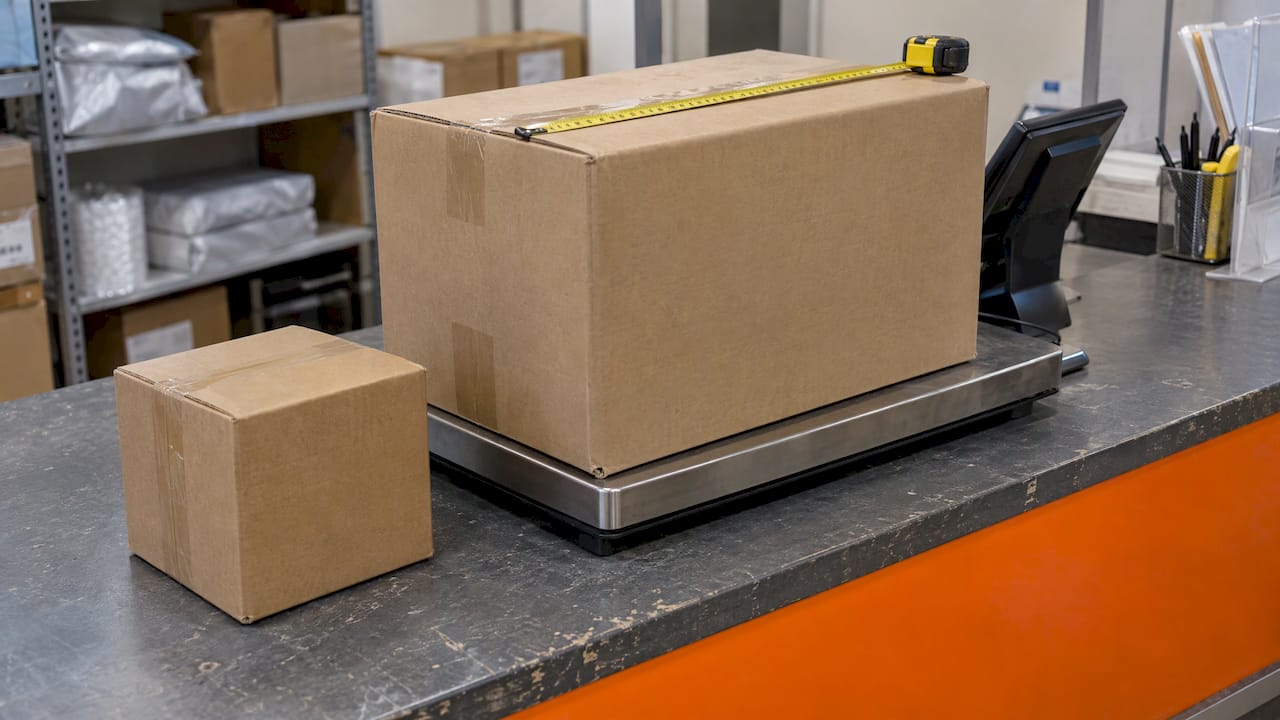
Volumetric weight, which Australian carriers usually call cubic weight, is a weight worked out from the size of your parcel rather than from the scale. The courier compares it with the actual weight and bills the greater of the two. A light, bulky box can therefore cost as much as a heavy, compact one. We built Sendaparcel so you can see real-time quotes from multiple carriers for your parcel before you book, with no platform booking fees, and this guide gives you the formula and the habits that keep the size you pay for down.
SendaparcelCompare Quotes for Your ParcelEnter your parcel’s dimensions to compare real-time courier quotes from multiple carriers, with no platform booking fees.VisitTL;DR
- Volumetric (cubic) weight is the weight a courier assigns to the space your parcel takes up. You are billed on whichever is higher: actual weight or cubic weight.
- For Australia Post parcels in your own packaging, the formula is length × width × height in metres × 250. A 50 × 30 × 40 cm box is 15 kg for billing, even if it weighs 10 kg.
- Divisors differ between carriers and services, so the same box can carry a different chargeable weight depending on who moves it.
- Right-sizing the box, removing void space and avoiding loose straps or flaps are the quickest ways to bring the number down.
- Comparing quotes for your actual box size shows which carrier treats it most kindly.
Table of Contents
- What volumetric weight is, and why couriers use it
- The formula, step by step
- What the rules look like at Australia Post
- Why it matters for sellers
- Seven ways to reduce cubic weight costs
- Measure like a courier
- Quick reference: how the box changes the bill
- How Sendaparcel helps with cubic weight
- Our perspective
- FAQ
- Sources
What volumetric weight is, and why couriers use it
A delivery van, a sorting machine and an aircraft hold are limited by two things: how much weight they can carry and how much space they have. A 2 kg pillow in a huge carton uses far more space than a 2 kg book parcel. If couriers charged on scale weight alone, the pillow would be subsidised by everyone else.
So carriers convert the parcel’s outer dimensions into a notional weight. You will see it called:
- Cubic weight, the usual term in Australia
- Volumetric weight, the term used in international shipping
- Dimensional weight (or DIM weight), common in the US
They all mean the same thing. The weight you are billed on is the chargeable weight: the greater of the actual (dead) weight and the cubic weight.
The formula, step by step
Australia Post’s published method for parcels in your own packaging multiplies the parcel’s volume in cubic metres by a conversion factor of 250. Its domestic parcels guide sets out the calculation like this:
- Measure the outside of the parcel in centimetres: length, width and height. Measure the packed parcel, not the product. Include any bulge.
- Convert to metres by dividing each by 100. A 50 cm side becomes 0.5 m.
- Multiply the three to get volume in cubic metres (m³).
- Multiply the volume by 250 to get cubic weight in kilograms.
- Compare with the scale weight. The larger figure is your chargeable weight.
Worked example: heavy, compact parcel
A box measures 50 × 30 × 40 cm and weighs 10 kg.
- Volume: 0.5 × 0.3 × 0.4 = 0.06 m³
- Cubic weight: 0.06 × 250 = 15 kg
- Scale weight: 10 kg
- Chargeable weight: 15 kg
This is the same example Australia Post uses in its own guidance, and eBay Australia’s rate table update uses the same figures.
Worked example: light, bulky parcel
A 1 kg cushion packed in a 40 × 25 × 20 cm box.
- Volume: 0.4 × 0.25 × 0.2 = 0.02 m³
- Cubic weight: 0.02 × 250 = 5 kg
- Scale weight: 1 kg
- Chargeable weight: 5 kg
The price difference is real. Australia Post’s retail Parcel Post prices, in force since 1 September 2026, list $16.00 for up to 1 kg and $24.45 for up to 5 kg. The box, not the cushion, moves the parcel into the more expensive band. Retail prices are reviewed periodically, so treat these as the published figures for that period.
Divisors and the 250 factor
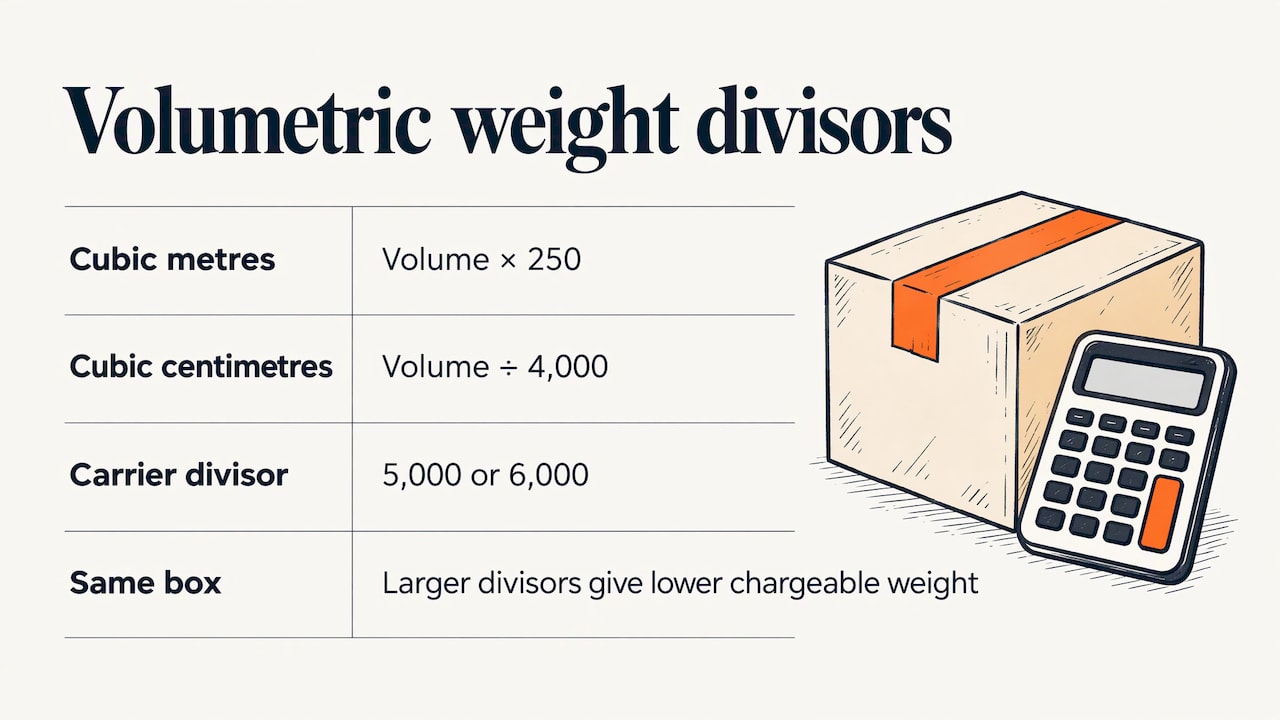
You will also see this written as a divisor: volume in cubic centimetres divided by 4,000. It is the same maths, since 1,000,000 cm³ in a cubic metre divided by 250 is 4,000. Other services and international or express carriers often use 5,000 or 6,000, which gives a lower chargeable weight for the same box. Divisors vary by carrier, by service and sometimes by contract, so always check the one that applies to the service you are booking.
What the rules look like at Australia Post
Three details from Australia Post’s published guidance matter to everyday senders.
Cubic weight mainly applies above 1 kg in your own packaging. Parcels over 1 kg in non-flat-rate packaging are charged on actual or cubic weight, whichever is greater. Australia Post also reserves the right to cube parcels under 1 kg, especially large, irregular or cylindrical ones.
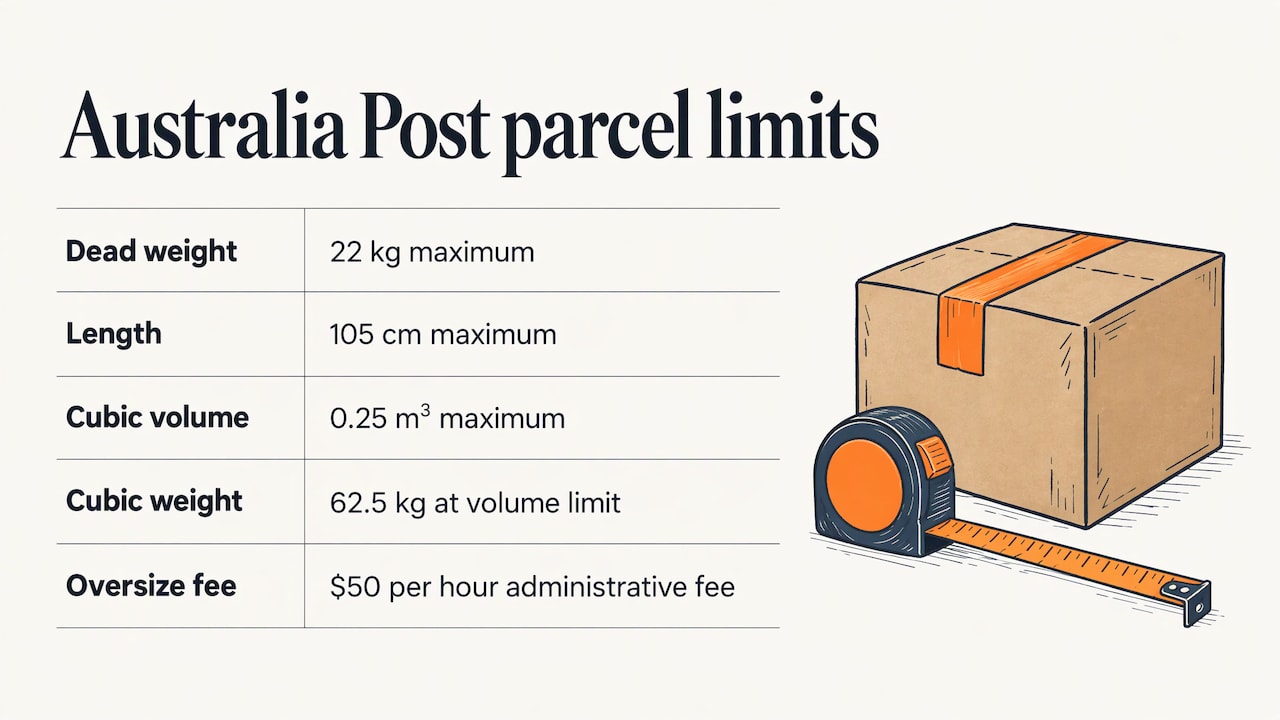
There are size limits. The Parcel and Freight Preparation Guide (version 8, July 2026) sets domestic parcel maximums of 22 kg dead weight, 105 cm length and 0.25 m³ cubic volume. At the volume limit, 0.25 × 250 gives a cubic weight of 62.5 kg. It also says oversized parcels identified at lodgement may be returned with a $50 per hour administrative fee.
Shape and packaging affect the reading. Australia Post’s postage calculation guide advises avoiding loose straps, flaps, strings or handles, because they can affect the cubic assessment on automatic sorting machines. A parcel with a tight, regular shape is measured more predictably.
Why it matters for sellers
If you sell online, cubic weight can quietly erode margins. Take a seller listing a lightweight product with a scale weight of 0.8 kg. If the packed box works out at 4 kg cubic, every order is quoted at 4 kg, and the listing’s shipping charge needs to cover that.
Marketplaces now apply the same logic. From 31 October 2024, eBay Australia’s weight-based rate tables consider both dimensional weight and physical weight and charge the greater. Once a seller opts in, they cannot go back to physical weight only. If you use rate tables, the weights you enter for each listing should reflect the packed box, not the bare product. Our guide to eBay seller shipping costs in Australia covers how to set them.
For other stores, the same discipline applies. Work out cubic weight for each product’s standard box, record the higher of the two numbers, and use that in your shipping settings. If you ship in volume, our bulk parcel shipping guide covers the routine.
Seven ways to reduce cubic weight costs
The aim is simple: pay for the weight of the goods, not the air around them.
- Choose a box that fits. Every 5 cm you trim from a side shrinks the volume. Taking the cushion example from 40 × 25 × 20 cm to 35 × 22 × 15 cm drops the volume to 0.01155 m³, a cubic weight of about 2.9 kg instead of 5 kg.
- Switch to a satchel or poly mailer for soft goods such as clothing and linen. Flexible packaging compresses to the product’s real shape. Our sub-500g parcel guide explains how small, light items are best sent.
- Remove void fill you do not need. A little protection is essential. Excess paper and air pillows add centimetres, and centimetres add kilograms.
- Compress or flat-pack where possible. Vacuum-sealed bedding and flat-packed products take up a fraction of the space.
- Keep the outside clean. Avoid loose straps, handles and flaps, which can inflate a machine’s reading of the parcel.
- Split the shipment sensibly. Two compact boxes can sometimes cost less than one oversized carton. Quote both ways before you decide.
- Save your standard sizes. If you ship the same products often, a saved list of box sizes saves re-measuring and keeps quotes consistent.
For more savings beyond packaging, see our list of 12 practical ways to reduce shipping costs.
Measure like a courier
Most billing disputes come from a measurement that differs from the courier’s. Use this routine every time:
- Pack the parcel first, then measure. Never measure the product alone.
- Measure the longest point on each side, including any bulge from soft contents.
- Round up to the next whole centimetre, as a courier’s reading will not round in your favour.
- Weigh the sealed parcel on a scale, then compare with your calculated cubic weight.
- Enter the higher of the two when you request a quote.
If you want the full calculation with more examples, our guide to calculating cubic weight for Australian parcels walks through it. And if your parcel is big, the large parcels guide covers measuring, packing and booking.
Quick reference: how the box changes the bill
| Parcel | Dimensions | Scale weight | Cubic weight (×250) | Chargeable weight |
|---|---|---|---|---|
| Books | 30 × 20 × 15 cm | 4 kg | 0.09 × 250 / 10 = 2.25 kg | 4 kg |
| Cushion | 40 × 25 × 20 cm | 1 kg | 5 kg | 5 kg |
| Power tool | 50 × 30 × 40 cm | 10 kg | 15 kg | 15 kg |
| Jacket in satchel | 35 × 25 × 5 cm | 0.9 kg | 1.09 kg | 1.09 kg |
The first row shows when scale weight wins: a dense parcel is billed on what it weighs. Cubic weight bites when the box is large for what is inside.
How Sendaparcel helps with cubic weight
Working out cubic weight is the easy part. The harder part is knowing which carrier gives the best price for your box. Sendaparcel is a web-based platform where you compare real-time courier quotes from multiple carriers, then book. There are no platform booking fees, price breakdowns are transparent, and insurance is included.
For regular senders, the dashboard lets you keep an address book and saved parcel sizes, so your standard boxes are ready every time. If you sell on Shopify, WooCommerce, eBay or Wix, our integrations connect your store. Bigger volumes can use Excel bulk uploads, and if you already have courier accounts you can bring them along. Frequent shippers also earn rewards.
Ready to see what your box costs? Compare courier quotes on Sendaparcel.

Need it there today? Our same-day courier options cover urgent local deliveries.
Our perspective
Cubic weight is not a trick. It is how carriers pay for space in vans and on sorting lines, and once you know the rule it becomes something you can plan around.
What frustrates people is the surprise: a quote that jumps because a box was a few centimetres bigger than expected. That is why we focus on clear pricing. You should see the price breakdown before you book, with no platform booking fees on top, and with insurance included.
Our advice is to treat the box as part of the product. Choose the packaging first, measure it packed, and keep those sizes saved so every quote starts from the right numbers. Then compare carriers on the same parcel. A box that is expensive with one service can be sensible with another, and the only way to know is to look at real quotes side by side.
For sellers and frequent senders, those small savings add up. Good things add up, and so do rewards for regular shipping.
Aeros
FAQ
What is the difference between volumetric weight and actual weight?
Actual weight is what the parcel weighs on a scale. Volumetric weight is a calculated figure based on the parcel’s size. The courier charges on whichever is greater, called the chargeable weight.
How do I calculate cubic weight for Australia Post?
Measure length, width and height in metres, multiply them to get cubic metres, then multiply by 250. A 50 × 30 × 40 cm parcel gives 0.06 m³ × 250 = 15 kg. This applies to parcels over 1 kg in your own packaging, though Australia Post may also cube parcels under 1 kg that are large, irregular or cylindrical.
Is dimensional weight the same as volumetric weight?
Yes. Dimensional weight, volumetric weight and cubic weight are different names for the same idea. Australian carriers usually say cubic weight, while international and US sources say volumetric or dimensional weight.
Does every courier use the same divisor?
No. Australia Post uses 250 kg per cubic metre, which equals a divisor of 4,000, while other carriers and services may use 5,000 or 6,000. Check the rule for the service you are booking, or compare quotes for your parcel on Sendaparcel.
How can I reduce my volumetric weight charges?
Use a box that fits the product, remove unneeded void fill, use satchels for soft goods and avoid loose straps or flaps. Measure the packed parcel and compare quotes before you book.
Sources
- Domestic parcels guide, Australia Post
- Parcel and Freight Preparation Guide, Australia Post
- How to correctly calculate your postage
- Australia Post parcel prices, Postal Calculator
- Rate Table Update, eBay Seller Centre
- 5,000 vs 6,000: How Volumetric Weight Inflates Shipping Costs