
Standard parcel delivery in Australia averaged about A$11.30 in 2026, and express averaged about A$15.50, so most everyday sends land between those two figures before GST and any carrier surcharge. Same-day sits higher again, and the stretch between the headline price and the final invoice is where parcel budgets break. The average price table below sets the baseline for every comparison in this guide, and the checklist further down covers the extra charges to check before you book.
Table of Contents
- The Real Cost of Sending a Parcel in Australia
- Average Courier Prices in Australia for 2026
- What Drives Your Courier Quote Up or Down
- How to Compare Courier Quotes and Book Without Surprises
- GST and Extra Charges to Check Before You Book
- A Worked Example From Quote to Invoice
- Choosing the Right Service for Your Shipment
The Real Cost of Sending a Parcel in Australia
Ask five Australian couriers to price the same carton from a Melbourne postcode to a Brisbane one and you'll get five different numbers. That isn't gouging. It's five different vehicle networks, zone maps and surcharge schedules answering the same question. The national benchmark for a standard parcel has climbed again this year, and express has moved with it, but neither figure tells you what your own parcel will cost.
Every quote is assembled from the same handful of inputs: the postcode pair, the packed dimensions, the deadline and whatever surcharges attach to that route. Change one input and the price moves. Packed size is the cheapest lever to adjust, because a carton that closes tightly around the product measures smaller in every direction the carrier bills on. Packaging suppliers cover the mechanics well, including this guide to ecommerce packaging film solutions from Crayex, where pack format and film choice determine how much empty volume ends up in the cubic measurement.
The frustration this guide solves is simple: the number on screen at checkout and the number on the invoice are rarely the same, because GST, volumetric weight and carrier surcharges land afterwards. What follows is a 2026 average price table you can benchmark against, the factors that move a quote up or down, a repeatable method for comparing quotes on identical inputs, a checklist of GST and extra charges, a worked quote-to-invoice example with the arithmetic shown, and scenario advice for choosing between standard, express and same-day. Work through it and you can price a parcel accurately and book it without an invoice surprise.
Average Courier Prices in Australia for 2026
Average Australian delivery prices in 2026
| Service level | 2025 average | 2026 average | Typical transit |
|---|---|---|---|
| Standard parcel | A$10.39 | A$11.30 | About 2.2 days on average |
| Express parcel | A$14.69 | A$15.50 | Faster than standard, route dependent |
| Same-day | Separate dataset (Fully Loaded, 2025) | No separate 2026 average published | Same business day on eligible intrastate metro routes |
The 2026 figures come from an Australian shipping benchmark reported by RetailBiz: standard delivery averaged A$11.30, up 8.7% from A$10.39 in 2025, express averaged A$15.50, up 5.5% from A$14.69, more than 94% of deliveries arrived on time, average transit fell to 2.2 days, and retailers still advertised an average checkout delivery time of 5.2 days.
How to read the averages
The 2025 and 2026 columns show one year of movement, so a quote saved twelve months ago is already stale. Costs are rising across standard and express, and the cheaper-looking service can still be the wrong buy once the transit estimate is read beside the price.
Same-day sits outside this benchmark. Fully Loaded's 2025 dataset is the reference point for that service, but a historical metro figure should not be pasted onto your route and treated as a quote. Eligible same-day work depends on the pickup and delivery postcodes, collection timing and courier availability on the day.
These are national averages across retailers and carriers. A specific postcode pair, packed size and service level can quote well below or well above them. A satchel capped at 250 g, 500 g, 1 kg, 3 kg or 5 kg, for instance, often beats a cubic parcel quote on the same lane because the format removes the volumetric question entirely.
On Sendaparcel, estimated courier prices are in Australian dollars and exclude GST unless stated otherwise, with surcharges potentially applying after the headline figure. That is the quote-to-invoice gap in plain terms: the average gives you a benchmark, while the payable total decides whether the quote was cheap.
Benchmarking a quote you've just received
Benchmarking rule: a quote near or below the national average, paired with a realistic transit estimate, is competitive. A quote far below average deserves the surcharge checks. A quote far above it usually means dimensions, weight or zone rather than an unreasonable carrier.
Use the averages as a filter, then compare the full total for the route, parcel size, weight and service needed before paying and booking. If a checkout promise looks slower than the service's real transit, tighten the estimate instead of padding it. A conservative delivery promise can lose a sale that the courier would have delivered early.
What Drives Your Courier Quote Up or Down
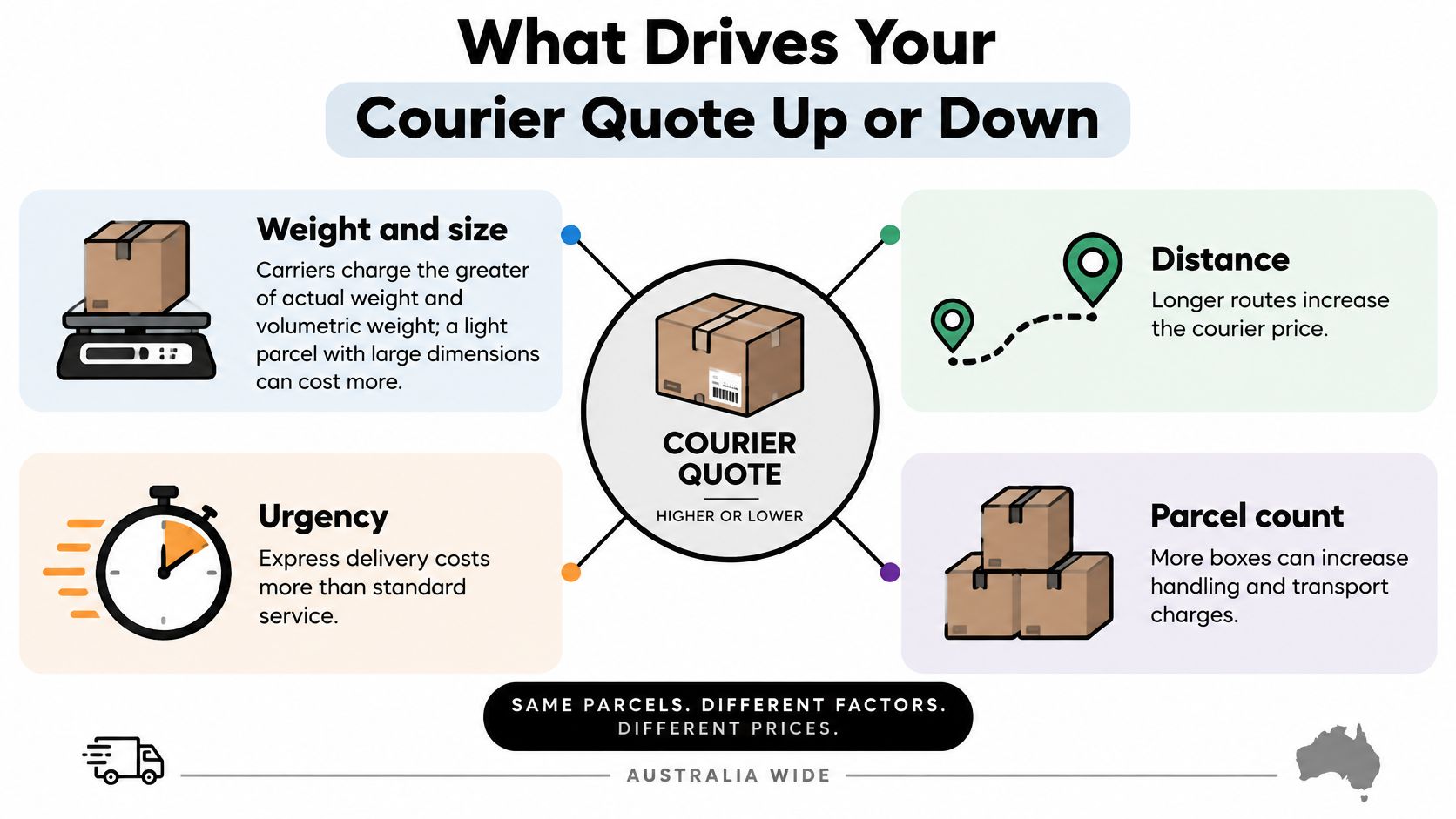
A quote is assembled, not declared. Four inputs do most of the work, and three of them are set before the courier ever sees the parcel.
Weight, cubic size and the volumetric rule
Carriers bill the greater of actual weight and volumetric weight, so a light carton of pillows or a flat-pack shelf can be priced as though it were heavy. The divisor matters: ask which one the carrier applies, because a low divisor and a high divisor turn the same carton into wildly different billable weights. Measure the packed parcel with a tape, round each dimension up, and work out the billable weight before you assume the scales decide it.
This is the first place the gap between quote and invoice opens. Incorrect measurements, weight, addresses or service details can produce a revised charge after booking, so a figure you guess at today can cost you on the final bill.
Route, zone and distance
Metro to metro is the cheapest lane in the country because parcel density per kilometre is highest. Regional, remote and thin interstate routes cost more, because fewer vehicles serve them and the last leg is longer. A parcel from Sydney to Melbourne and one from Sydney to a remote Western Australian postcode can differ by more than the parcel is worth.
Collection timing and service availability feed into the rate too, which is why the same postcode pair can quote differently from one week to the next.
A short walkthrough of how these inputs combine is worth two minutes:
Deadline and season
Speed sets the price tier, and capacity sets the surcharge on top. Standard, express and same-day sit at three distinct price points, and nothing sharpens the gap like December. Australia Post's FY2024-25 annual report recorded 102.8 million parcels delivered during the Christmas peak, with domestic parcel volumes up 2.6% for the year after a 1.8% rise the year before.
That volume has to be funded. The same report shows the Parcels and Services segment generating A$7.64 billion in revenue, total revenue of A$9.45 billion, and a network reaching 12.8 million delivery points nationally. Every one of those points is a cost the freight components pay for. Letter pricing shows the same upward pressure: Australia Post's 2024 annual report records the basic postage rate rising from A$1.20 to A$1.50 in April 2024, a 25% lift in a single step.
Keep one more thing in view while you compare. Quoted courier prices typically exclude GST, and surcharges may apply on top of the headline rate, so two quotes a few dollars apart can land further apart on the invoice. The cheapest headline figure is rarely the cheapest delivered parcel.
What you control: packed size, service level, box count and pickup readiness. What the route controls: distance, zone, fuel and remote-area access. Spend your effort on the first list.
How to Compare Courier Quotes and Book Without Surprises
The cheapest quote on the screen is rarely the cheapest parcel delivered. Run the same routine every time and the comparisons become reliable rather than lucky. The order matters, because a mistake in step one distorts every quote after it.
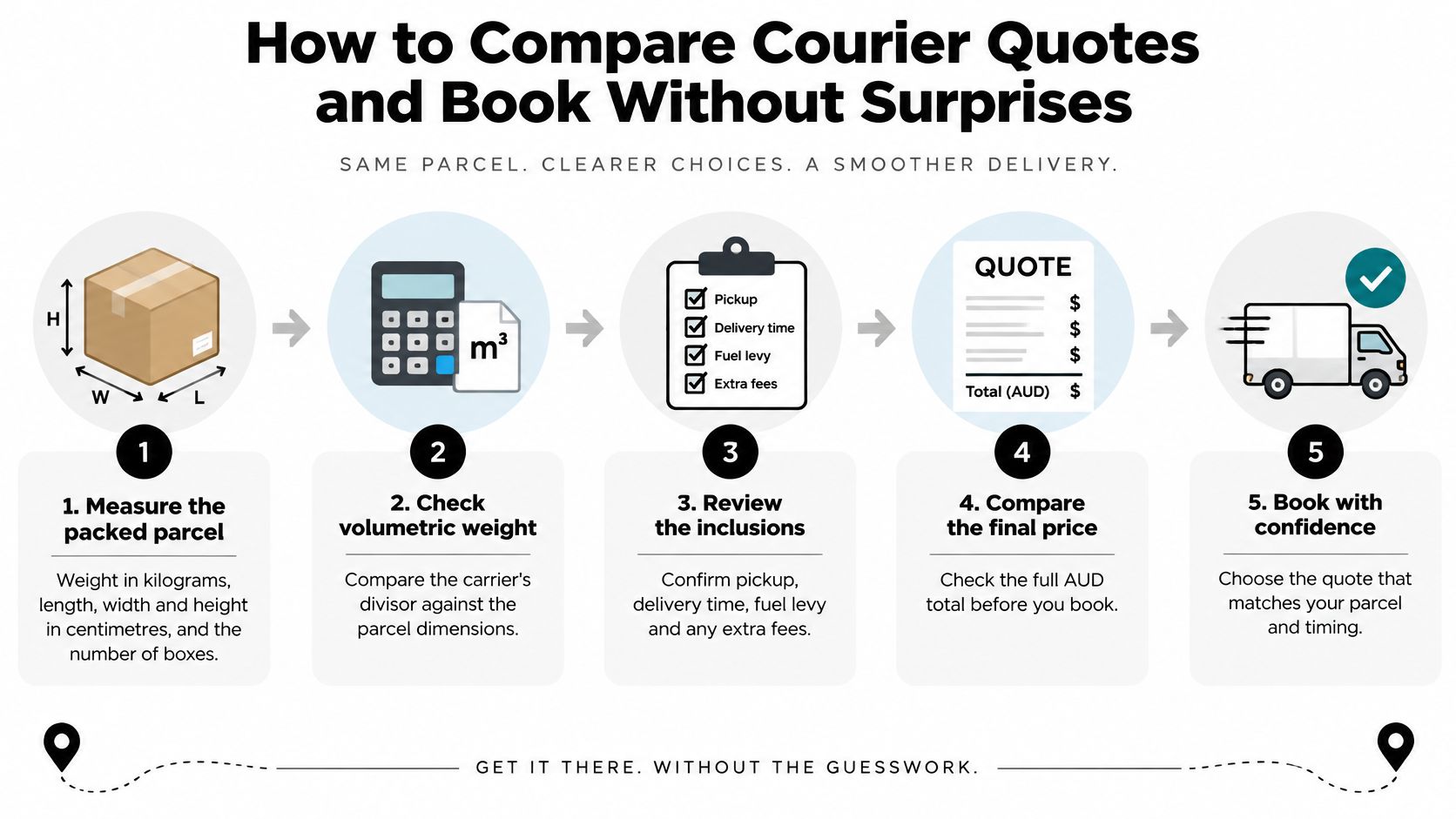
Measure the packed parcel, not the empty box. Weigh it in kilograms with everything inside, then record length, width and height in centimetres and count how many boxes the consignment is. The same carton can hold a cardigan or a set of doorstops, and only one of them is cheap to send. Check: does the total match what you'll hand over at pickup?
Fix the route with exact postcodes. Zone pricing keys off the postcode pair, so enter postcodes rather than suburb names. Coverage and available services depend on the exact pickup and delivery postcodes, whether the destination sits in a metro, regional or rural area. Check: is the delivery address residential or commercial? That single field changes the fee on many lanes.
Quote like for like. Enter identical weight, dimensions, item count and service level across every carrier you're comparing, so the carrier is the only variable left. Comparing a door pickup against a depot drop-off tells you nothing about which carrier is cheaper. Our courier comparison for Australia lays out the services we list side by side, and there's no shipping-volume tier to clear before you can see prices. Stores wiring rate calls into checkout can read how the plumbing works in this guide to live rate lookups for shipping SaaS. Check: is the only difference between your quotes the logo?
Compare the estimate against your real deadline. A FedEx-sponsored study of Australian e-commerce found that 85% of online orders typically took three days or longer to arrive and only 15% reached consumers within two days, yet 36% of Australian small and medium-sized enterprises believed their deliveries arrived within two days or less, per the FedEx e-commerce white paper. Check: is your promised date built on a service level the courier offers on that lane, with the cut-off time noted?
Check what the price includes. Confirm tracking, included cover and what happens if the first delivery attempt fails. Sendaparcel charges no redelivery fee of its own, though courier charges may apply, and cover is included up to A$150 while the parcel is in Sendaparcel's possession, subject to terms and exclusions. Check: does that cover match what the parcel is worth?
Review the full total before paying. Freight, GST and any applicable delivery charges belong on one screen you've read, because incorrect measurements, weight, addresses or service details can produce a revised charge once the carrier assesses the parcel. Check: does the total on the payment screen match the quote you benchmarked?
Delivery estimates are guides, and service conditions are confirmed by the courier. Book against the date you can defend, not the date you'd like.
A saved quote or an imported order is not a courier booking. The rate becomes a job only once payment goes through, so that payment screen is your last clean chance to check the total, the service level and the collection window before anything moves.
GST and Extra Charges to Check Before You Book
"Why does my final courier price differ from the online quote?" is the most common question in Australian shipping and the least answered. The headline price is the start of the calculation, not the end of it, and the gap comes from a short list of well-known causes: GST treatment, dimensional weight, postcode zones, residential or remote-area fees, reclassification after carrier inspection, and fuel or handling surcharges, as the Australia Post parcel post guide illustrates through its zone and weight-band pricing, which lists different charges for parcels above 5 kg across every state and territory.
Where GST sits in the number you see
Most advertised freight estimates exclude GST, so the payable amount is roughly 10% higher than the displayed figure unless the quote says otherwise. On our bookings, estimated courier prices exclude GST and surcharges may apply. If you're building a budget or a retail price from a freight figure, calculate GST inclusive prices from Nanak Accountants and Associates rather than doing the addition in your head at the end of a long day.
The charges that arrive after the headline
| Charge | What it is | When it applies | How to avoid a surprise |
|---|---|---|---|
| GST | A 10% tax on the freight price | Estimates that exclude GST | Compare the GST-inclusive total before booking |
| Fuel surcharge | Carrier levy on fuel costs | Varies with fuel prices and carrier | Check the carrier's current surcharge schedule |
| Residential delivery fee | Extra for home addresses | Deliveries to residential rather than commercial addresses | Declare the address type when quoting |
| Remote area surcharge | Extra for regional and remote postcodes | Thin routes and remote zones | Always get a postcode-specific quote |
| Volumetric weight adjustment | Billed on cubic size when larger than actual weight | Light, bulky cartons | Measure packed dimensions accurately |
| Reclassification after inspection | Carrier re-weighs or re-measures and revises the charge | Wrong or undeclared measurements and service details | Declare true packed weight and size |
| Redelivery or re-attempt fee | Fee for a failed first delivery | Receiver not available at the address | Use tracking and check the carrier's redelivery terms |
The redelivery line deserves its own note. A missed first attempt can add carrier cost, and it's the fee people discover last because it lands after the parcel has already travelled. Sendaparcel doesn't charge its own redelivery fee, though courier charges may still apply, and the mechanics of who charges what are set out in this explanation of how redelivery fees work.
Habits that protect the invoice
Declare the true packed weight and dimensions, because a freight price depends on the information supplied and the service selected. Quote by postcode rather than national average, and confirm whether the address is a home or a business before you compare totals. Read the redelivery terms once, then keep tracking visible so a failed attempt gets caught the same day.
The cheapest headline quote is not always the cheapest delivered shipment. A slightly higher transparent quote routinely costs less than a low quote followed by carrier adjustments.
A Worked Example From Quote to Invoice
Take a 3 kg standard parcel from one metro postcode to another, quoted at the 2026 national average of A$11.30. Sendaparcel prices are in Australian dollars and freight prices exclude GST unless stated otherwise, so that headline figure is not what leaves your account.
- Freight quoted: A$11.30.
- Add 10% GST: A$11.30 × 1.10 = A$12.43 payable.
- Run the same arithmetic on the faster option: express at A$15.50 becomes A$17.05 once GST lands. Both figures now sit GST-inclusive, which is the only honest way to compare them.
- Test the gap. Say the carton gets re-weighed and attracts an illustrative A$3.00 adjustment. That pushes the standard total to A$15.43, a 24% lift on what the quote screen showed, and it is the kind of revised charge that follows incorrect measurements, weight or service details.
- Compare the upgrade on value, not price. Express costs A$4.62 more than standard inclusive of GST (A$17.05 minus A$12.43). For a parcel that must arrive tomorrow, faster transit usually justifies A$4.62. For one that can wait, it does not.
Run the same five steps on your own live quotes. The full total is visible before you pay and book, so the only excuse for invoice shock is skipping the arithmetic.
Choosing the Right Service for Your Shipment
Price only becomes a decision once you attach a scenario to it. The same parcel can justify three different services depending on what happens if it arrives late.
| Sending situation | Best-fit service | Why it fits | Watch for |
|---|---|---|---|
| Small document or gift, metro to metro | Standard parcel or satchel | Lowest average cost with about 2.2-day transit | Allow extra days in peak periods |
| Customer order with a promised date | Express | Faster transit and priority handling for about A$15.50 | Confirm cut-off times and estimate versus guarantee |
| Urgent contract or forgotten item, same state | Same-day where available | Only about A$2.70 above express on average in 2025 | Intrastate metro routes, pickup readiness and cut-offs |
| Bulky carton over 5 kg, interstate | Quoted parcel freight | Weight bands and postcode zones dominate the price | Volumetric weight and remote-area surcharges |
| Regular weekly ecommerce dispatches | Standard with saved box sizes | Repeatable lanes make comparison and tracking easy | Track actual transit against the estimate |
When same-day earns its price
Independent Australian shipping data reported in 2025 put average standard delivery at A$10.39, express at A$14.69 and same-day at A$17.39, which is only A$2.70 above express and well below the A$31 average the same measure reported in 2018, according to Fully Loaded. That changes the decision. Same-day isn't automatically an emergency premium. For a high-value item, a contract that must be signed today, or a replacement that avoids a failed delivery, it can be the rational choice.
What the average doesn't tell you is whether same-day exists on your lane. It depends on intrastate route coverage, pickup readiness, cut-off times and traffic. Our same-day courier options are worth checking against eligible metro routes, and Direct Couriers timeframes are indicative metropolitan service guides subject to account terms, route and collection availability. Decide on cost per hour saved, parcel value and the consequence of a day's delay, not on the absolute price.
Express, standard and the bulky carton
Express earns its premium when a customer has been given a date and the order touches a deadline. Standard wins on everything else, provided you build peak periods into the promise rather than the courier's obligation. Once a carton passes 5 kg and crosses a state border, none of the service tiers dominate the price any more. Weight bands and postcode zones do, so quote the exact route with exact dimensions and watch whether volumetric weight overrides the scale.
For weekly dispatch runs, the discipline that pays is consistency: quote the same lanes, save the box sizes that recur, and compare actual transit against the estimate each month. A service that's fast in the estimate and slow in practice is expensive at any price, and courier availability varies by route and shipment, so a lane that works in March is worth re-checking in November.
Sendaparcel compares live prices across CouriersPlease, FedEx, StarTrack, Aramex, Allied Express and same-day Direct Couriers options using the route, packed size, weight and quantity you have, and shows freight, GST and estimated delivery together before you pay. There's no monthly fee and no volume tier to reach before you can see prices, so a one-off gift and a weekly dispatch run get the same view of the market. Visit Sendaparcel to price your next parcel and book it with the full total in front of you.