
The number that reframes what a same day courier cost really is doesn't appear on any quote you'll be shown. In a reported Australian freight-network benchmark covering more than 100 million consignments and over 500 carriers, the typical fuel levy climbed from 16.6% to 29.8% in under a month, translating into an 11.3% increase in total freight costs (eCommerce News Australia's report on late freight and rising fuel surcharges). A surcharge that shifts 13 percentage points before you've picked a carrier is why a same-day quote behaves less like a price and more like a timestamp.
So the useful question isn't what same-day delivery costs in Australia. It's what you'll pay for this parcel, on this route, booked now, with GST and levies included, and what your deadline looks like if it runs late. The benchmarks below, the cost stack behind them and the checks that separate a cheap quote from a good one all point at the same total.
Table of Contents
- Same Day Courier Costs at a Glance
- What Drives and Adds to Your Same Day Courier Price
- How Parcel Size and Weight Change the Quote
- Metro, Regional and Interstate Routes Compared
- Paying for Speed Versus Dependable Delivery
- Compare Quotes and Book Your Same Day Courier
Same Day Courier Costs at a Glance
Speed is the most expensive line item in Australian courier pricing, and the gap between same-day and next-day is wider than many senders assume. A published comparison for a standard 1 kg parcel measuring 22 cm × 16 cm × 7.7 cm in Sydney put same-day Courier Post at AUD 34.95, next-day Express Post at AUD 15.30 and two-day Parcel Post at AUD 10.85, a same-day premium of roughly 128% over next-day and 222% over the standard service (Easyship's comparison of Australian shipping services). Treat those as benchmarks rather than tariffs. Your price depends on the postcode pair, the cutoff, packed dimensions, whether the address is residential or a business, and which carriers have capacity at that hour.
At the national level, the averages have moved down rather than up. Shippit's State of Shipping 2025 analysis put the average Australian same-day delivery at AUD 17.39 in 2025, against AUD 31 in 2018 (Fullyloaded's coverage of retail shipping costs), with AUD 18.26 in 2024 reported from the same series (Inside Small Business on Shippit's findings). Averages hide a lot, though, because same-day service exists only on supported routes within the same state, so an interstate same-day quote won't appear at all.
| Benchmark | Service | Price (AUD) | What it shows |
|---|---|---|---|
| 1 kg parcel, Sydney, 22 × 16 × 7.7 cm | Same-day Courier Post | 34.95 | Same-day premium of about 128% over next-day |
| 1 kg parcel, Sydney, same dimensions | Next-day Express Post | 15.30 | Reference for speed versus cost |
| 1 kg parcel, Sydney, same dimensions | Two-day Parcel Post | 10.85 | Standard service baseline |
| Australian same-day average | Shippit, 2018 | 31 | Historical comparison point |
| Australian same-day average | Shippit, 2024 | 18.26 | Higher than the 2025 figure |
| Australian same-day average | Shippit, 2025 | 17.39 | Lowest of the three years |
Use the table as a sense check, not a verdict. A quote far outside these ranges for a similar parcel isn't automatically a bad price, so confirm the route, the packed weight and whether GST is included before you decide it is.
What Drives and Adds to Your Same Day Courier Price
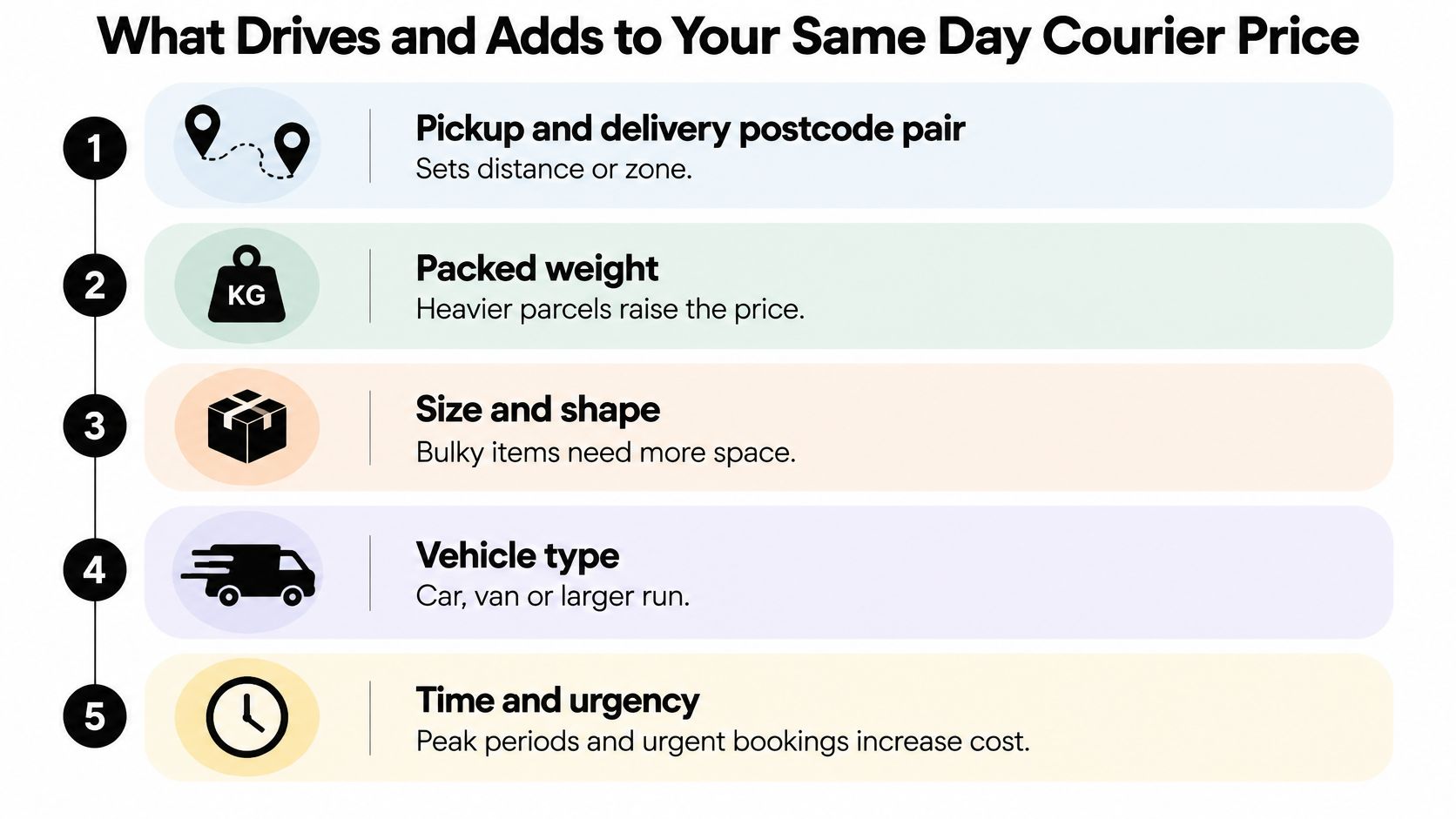
Same-day pricing arrives as a stack of charges. Base freight covers the run, a distance or zone allowance covers how far it goes, and chargeable weight covers what the parcel takes up in the vehicle. Fuel, after-hours, weekend or public-holiday surcharges sit on top of that, and GST applies last. Two quotes for the same parcel can land well apart without either carrier being wrong.
The variables that move the number most
The pickup and delivery postcode pair carries more weight than any other input. It sets the distance band, and it decides whether a same-day option exists on that route at all. Packed weight and dimensions come next, because they set the chargeable weight and can push a parcel into a pricier tier while the route stays identical. The remaining levers are softer but still move the total: the service selected, the number of items in the booking, the collection time, the access at each address, and whether the carrier has spare capacity that day.
Service availability is the variable senders misread most often. A route can support next-day delivery every weekday while same-day runs only when a driver is free inside the window. Quotes that ask for packed dimensions and a pickup-ready time exist for that reason: they match the booking to a collection the courier can make.
Where the total diverges from the headline
Fuel is the layer most likely to shift between quote and delivery. Carriers revise their fuel levies on their own schedules, and published updates such as the Australia Post StarTrack pricing updates show these percentages changing over time. A percentage levy scales with the size of the job, adding cents to a short metro satchel and dollars to a longer run. Two carriers can quote identical base freight and land on different totals because their levies took effect on different dates.
Then GST. Estimated courier prices exclude GST, and surcharges may still apply, so AUD 34.95 plus 10% GST is AUD 38.45 before any levy touches it. On a heavier parcel crossing a zone boundary, the levies and GST together can exceed the gap between two base rates, which is why the payable total matters more than the headline figure.
The check that saves arguments later: compare quotes on identical postcodes, identical packed weights and the same collection date. Any other comparison measures the difference between two shipments, not two providers.
| Cost item | Included in headline price? | What to check |
|---|---|---|
| Base freight | Usually included | Compare on identical postcodes and packed details |
| GST | Often excluded from estimates | Add 10 per cent before comparing totals |
| Fuel levy | Not usually | Confirm the percentage and its effective date |
| Weekend, after-hours or public holiday surcharge | Rarely | Ask before booking if collection falls on these times |
| Carrier-assessed charges | Not included | Expect possible changes after the courier reviews the parcel |
| Address change after dispatch | Not included | May attract charges and may not be possible on the final delivery run |
Post-booking charges form their own category. An address change after dispatch needs confirmation, may attract charges, and may not be possible once the parcel is on its final delivery run. Missed deliveries follow similar logic: Sendaparcel charges no redelivery fee of its own, though courier charges may apply, and the guide to redelivery fees explained sets out what triggers them.
To find which variable is driving your number, change one input at a time. Re-quote with only the packed weight altered, then only the delivery postcode, then only the collection time. Whichever change produces the biggest jump is the main cost driver, and it is usually the one worth adjusting rather than haggling over the base rate.
How Parcel Size and Weight Change the Quote
The item's weight isn't the number that gets priced. The packed weight is, which means the carton, void fill, tape and label all count. A 700 g item in a sturdy double-wall box crosses into a heavier band, and the quote follows the box.
Couriers price on chargeable weight, tied to distance bands, included kilometres and disclosed surcharges rather than one flat figure, as Aero's courier rate card guide explains. The consequence is that crossing a band boundary costs more than the grams that pushed you over it.
Where the bands sit
Satchel options run to 250 g, 500 g, 1 kg, 3 kg and 5 kg, and each step changes the price tier. Individual parcels top out at 25 kg, with combined length, width and height no greater than 180 cm across the three dimensions.
| Shipment type | Limit | Effect on the quote |
|---|---|---|
| Satchel, lowest band | Up to 250 g | Use for documents and very light goods |
| Satchel, second band | Up to 500 g | Round up if packaging adds weight |
| Satchel, third band | Up to 1 kg | Check packed weight before choosing |
| Satchel, fourth band | Up to 3 kg | Moves into a higher price tier |
| Satchel, top band | Up to 5 kg | Confirm the band in the quote before paying |
| Individual parcel | Up to 25 kg | Heavier parcels need a separate check |
| Individual parcel | 180 cm combined length, width and height | Oversized boxes may need a different service or a re-quote |
The measuring routine
Weigh the packed box on parcel or kitchen scales, not the item alone on a bathroom scale. Measure the three longest edges in centimetres, because a long, light carton can be awkward for a van even when it's well under weight. Round up when a parcel lands within 50 g of a band ceiling, since packaging settles, labels add grams and a re-quote costs more than the cushion.
Multiple boxes need separate entries, one per box, each with its own weight and dimensions. Use the quantity field only when the boxes are identical in size and weight. A three-box order entered as one box produces a quote the courier won't honour at pickup.
If you want to see how a change to any of these inputs lands before committing, run the numbers through our shipping cost calculator guide. For the broader picture on trimming spend across a batch of orders, these freight savings tips from Supply Automate cover consolidation and carrier selection.
A box sitting 300 g over a satchel band can cost more in freight than the item inside it is worth. That's not an argument for under-declaring. It's an argument for repacking into a smaller carton before the quote, not after.
Metro, Regional and Interstate Routes Compared
A Sydney to Sydney run and a Sydney to regional New South Wales run are different products wearing the same label. Same-day delivery in Australia is primarily a metropolitan and intrastate service, and its availability tracks network density: independent courier-market guidance describes same-day as typically limited to metro postcodes, commonly booked before a cutoff of about 10:00 a.m. to 12:00 p.m., with regional same-day uncommon outside specific city-pair lanes and costing roughly three to five times standard express pricing (ClickPost's guide to Australian courier services). The same guidance gives a broad published-rate benchmark of AUD 25 to AUD 75 for a 20 kg domestic parcel, which is a general express reference across distance, carrier and service level rather than a same-day tariff.
Three route types, three different checks
Metro to metro. The deepest pool of options: several carriers, frequent cutoffs, and prices closest to the published benchmarks. Book before the midday cutoff and a same-day collection is usually achievable.
Metro to regional. A city-pair lane may carry a same-day service and may not, and the premium climbs steeply when it does. Check whether a same-day option appears for that postcode pair before promising a customer anything.
Interstate. Same-day doesn't operate across state lines here. Same-day delivery is available only on supported routes within the same state, so interstate bookings are an express or next-day comparison. Local and interstate courier delivery both sit inside what we run, but they're priced as different products.
The same postcode pair can show different options on different dates, because courier availability varies by route and shipment. That's not a platform glitch; it's drivers and vehicles being allocated differently each morning.
Compare by postcode pair rather than city name, confirm a regional destination shows a same-day option before assuming one exists, and treat any interstate request as a next-day or express comparison from the start. Those three habits remove most of the surprise from urgent freight.
Paying for Speed Versus Dependable Delivery
Only 26% of Australian consumers expect same-day or next-day delivery when an order is time-sensitive or for a special occasion, and only 43% are willing to pay extra for that speed, according to Australia Post's 2026 eCommerce research (Australia Post's eCommerce report). The preference splits sharply by age: 70% of Gen X, 87% of Baby Boomers and 90% of Builders prefer certainty over speed, while 49% of Gen Z prefer speed.
That's the honest framing for many senders. Speed is a product you buy when a late parcel costs more than the premium, not a default setting you leave switched on.
Collection today isn't arrival today
A same-day booking buys a collection window and a fast run, not a guarantee. Same-day timeframes from Direct Couriers are indicative metropolitan service guides, subject to account terms, route and collection availability. If the parcel isn't packed when the driver arrives, the clock restarts tomorrow and the premium buys nothing.
The consequence test: if the parcel arriving a day late costs more than the gap between the same-day and next-day price, pay for speed. If it doesn't, buy certainty instead.
Run the test on specifics rather than instincts. A signed contract needed at a 9:00 a.m. meeting justifies almost any premium, because a missed meeting can cost the deal itself. Replacement parts for a machine that's stopped production follow the same arithmetic. A spare phone case, a birthday gift ordered late or a routine retail restock doesn't, and a dependable next-day service at less than half the price is the better buy.
For freight that isn't a parcel at all, the logic scales up rather than changing, and Peak Transport's expedited trucking guide explains how rush capacity gets priced when the load won't fit in a van.
When something does go wrong, check the latest courier update in Tracking and follow the courier's instructions for the service you booked rather than guessing at depot process. If you're weighing two carriers across a repeat route, our courier comparison walkthrough covers how to read the difference between them over several shipments instead of one.
Compare Quotes and Book Your Same Day Courier
Comparing quotes takes about as long as writing a shipping label, provided you have the right inputs in front of you. Work through the steps in this order and you won't have to re-quote halfway through checkout.
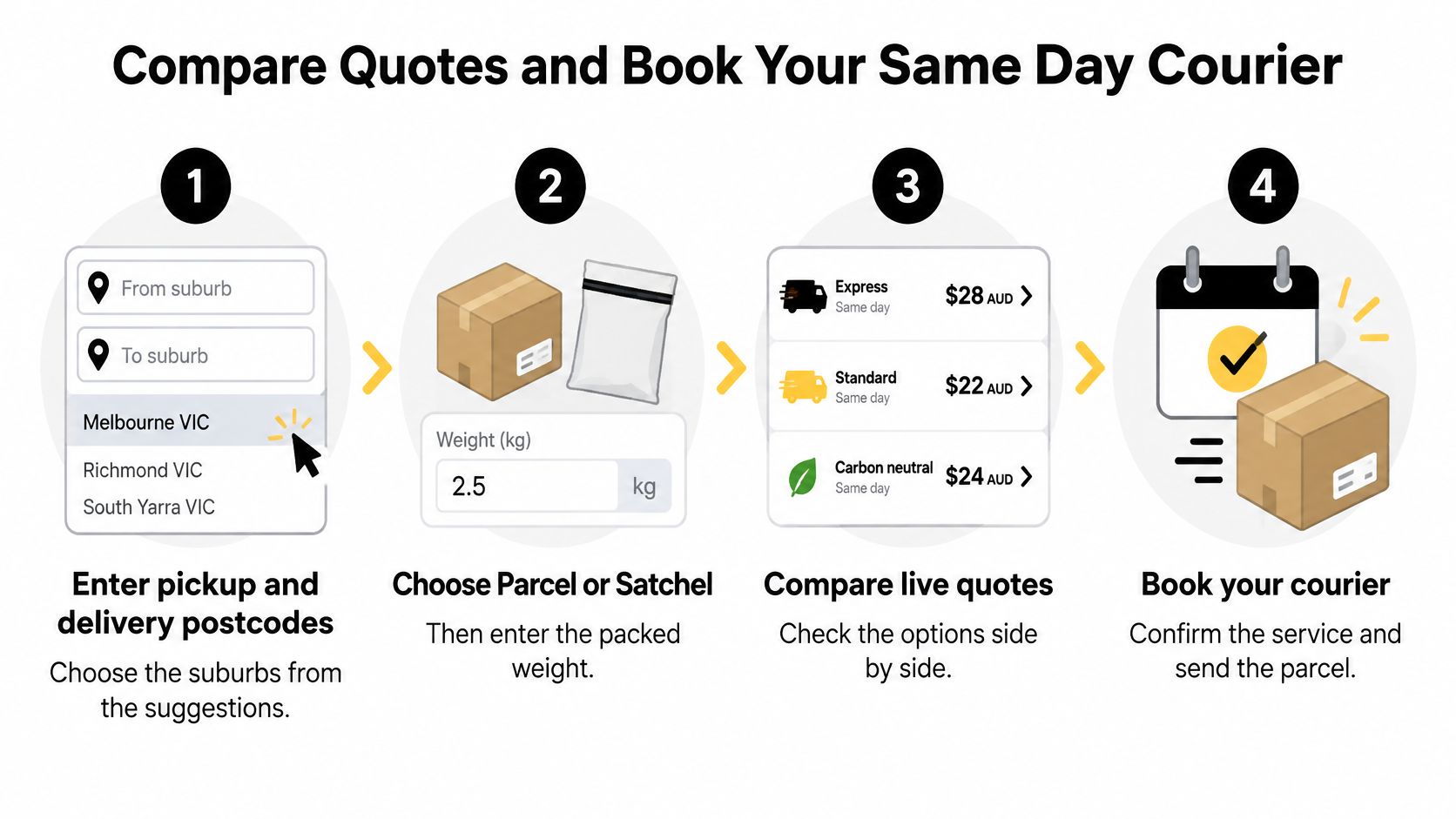
- Start with the postcodes. Enter the pickup and delivery postcodes for the shipment, since quotes are priced on the exact route rather than a city name. A postcode one zone out can return different services at a different price.
- Choose Parcel or Satchel, then measure. Enter the packed weight and dimensions for each box, using the quantity field only for identical boxes. If the courier's measurement differs from yours, additional charges can follow carrier assessment.
- Compare same-day alongside standard services. Eligible Direct Couriers same-day services appear in the results only on supported routes within the same state, so an interstate run will return standard options instead. Treat any same-day timeframe as an indicative metropolitan guide, since it depends on route and collection availability. Direct Couriers same-day deliveries don't require a courier label.
- Set the collection date and readiness time. Enter the date and the time the parcel will be packed and ready, local to the pickup point. A time you can't hit is worse than a later time you can.
- Read across, not down. Put price, service and estimated delivery window side by side. Estimated prices exclude GST and surcharges may apply, so a low headline figure can end up costing more than a mid-priced line once the payable total is shown.
- Check the total, then note the date. Review the full total before paying and record when you quoted it, because rates can move with collection timing, service availability and surcharges between the quote and the booking.
- Pay and book. Payment by card through secure checkout creates the courier booking. Book earlier than feels necessary, since a late booking may move to the next eligible collection day and undo the point of paying for speed.
Quotes are free to compare, there is no shipping-volume tier to climb before you see live prices, and the account carries no platform fee or monthly subscription. The decision comes last: book the cheapest option that clears your deadline rather than the cheapest option full stop.
Sendaparcel puts live quotes for same-day options on supported intrastate routes next to standard services, so you can see the freight, the estimated GST and the delivery window before you commit. Enter your postcodes, packed weight and dimensions, and compare what each service costs for your parcel rather than what a headline rate suggests. Visit Sendaparcel to compare quotes and book your next urgent shipment.